
Introduction
When hundreds of flowers fade and nature lies bleak, one bloom emerges quietly in the depths of winter — the wintersweet. As a cherished Chinese garden plant, it carries rich symbolic meaning and deep cultural value.
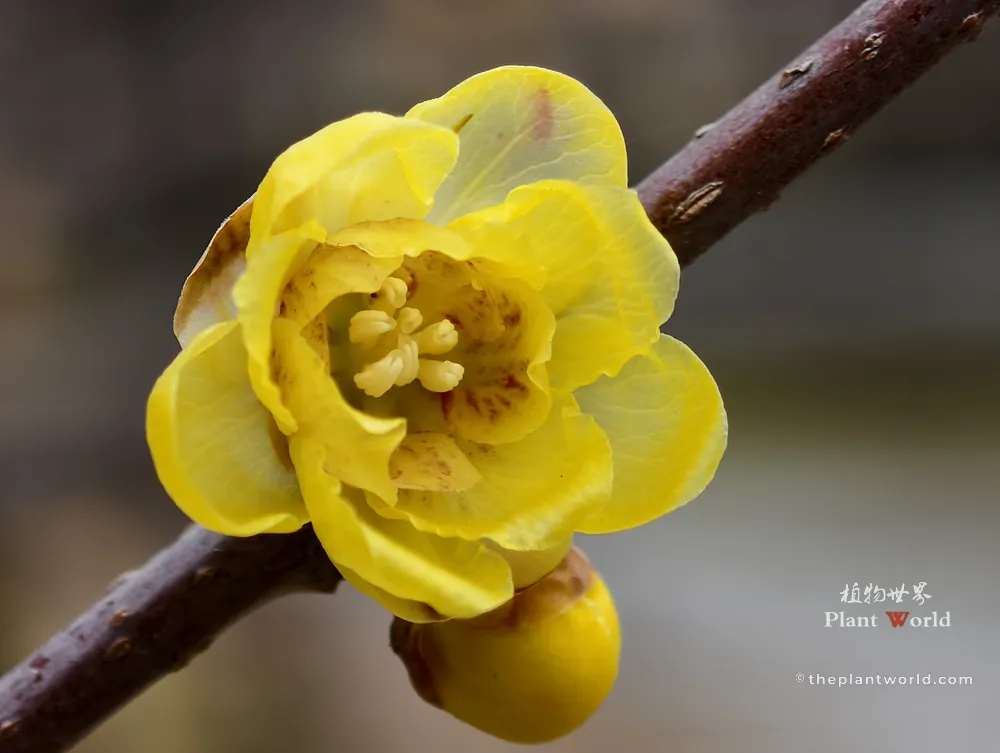
The wintersweet (Chimonanthus praecox) is named for its color, which resembles beeswax, and its fragrance, which recalls the plum blossom. Its small, exquisite flowers range from brilliant gold to soft butter-yellow, as if carved from warm yellow jade. But the wintersweet’s beauty is not only visual — its fragrance is extraordinary. A rich, never-cloying perfume drifts through the cold air, thread by thread, refreshing the heart and penetrating the senses. Whenever a breeze passes, the wintersweet’s scent floats with it, filling the entire winter with warmth and poetry.
Yet the wintersweet is the most commonly misunderstood flower in two ways: it is not a plum blossom, despite sharing the character “mei” (梅) in its Chinese name — a coincidence of fragrance and bloom time; and its proper name is “wax plum” (蜡梅,là méi), not “twelfth-month plum” (腊梅) — it is named for its beeswax-like color, not for blooming in the twelfth lunar month. To fully grasp the wintersweet flower meaning, you have to start with its taxonomy, its critical distinctions, its cultural symbolism, and its care.
- Introduction
- Plant Profile
- A Critical Distinction: Wintersweet Is Not Plum Blossom, and Its Name Is "Wax Plum," Not "Twelfth-Month Plum"
- Varieties: Pure-Heart, Bell-Mouth, and Dog-Tooth
- Wintersweet Flower Meaning: Unyielding Pride and the First Herald of Spring
- Wintersweet in Poetry: From Su Shi to Huang Tingjian
- Uses: Ornamental, Tea-Scenting, Food, and Medicinal
- Toxicity and Pet Safety: "Earth Croton" and Chimonanthine
- Cultivation and Care Guide
- Final Thoughts
- References
- More from The Plant World:
Plant Profile
- Scientific Name: Chimonanthus praecox (L.) Link
- Common Names: Wintersweet, Winter Sweet, Japanese Allspice (loose)
- Chinese Name: 蜡梅 (là méi, “wax plum”); also 黄梅花 (“yellow plum blossom”), 香梅 (“fragrant plum”), 腊梅 (popular misspelling), 狗蝇梅, 干枝梅, 素儿 (“Su’er,” a literary alias)
- Family: Calycanthaceae (蜡梅科, the sweetshrub family) → Genus Chimonanthus
- Native Range: Endemic to China; native to central China (North China, East China to Southwest China); introduced and cultivated in Japan, Korea, Europe, and the Americas
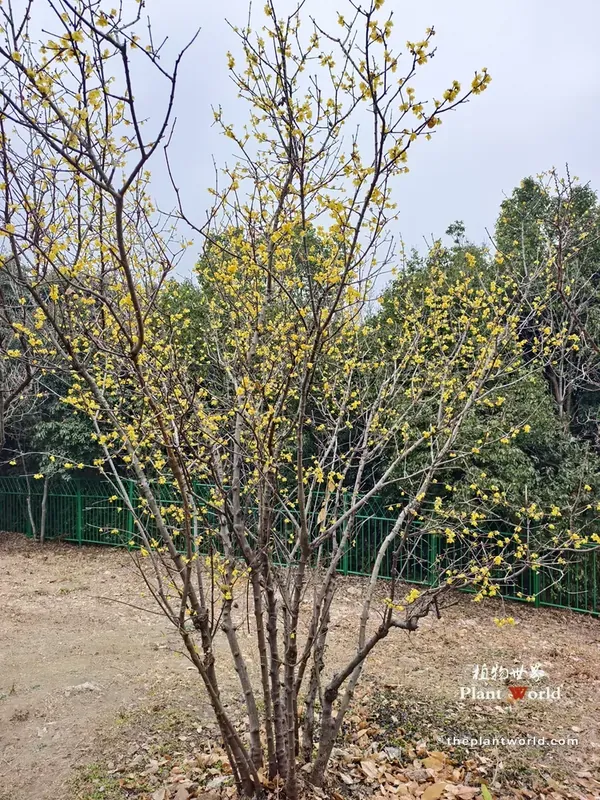
- Growth Form: Deciduous shrub growing 3–4 m tall; leaves opposite; flowers bloom before leaves emerge, waxy yellow, glossy, and intensely fragrant
The wintersweet is a deciduous shrub that can reach 3 to 4 meters in height. Its young branchlets are slightly four-angled, while older branches become nearly cylindrical and gray-brown. The leaves are opposite (borne in pairs along the stem), ovate-elliptic to ovate-lanceolate, 7 to 15 cm long, with entire margins; the upper surface is green and rough, while the lower surface is blue-gray and smooth.
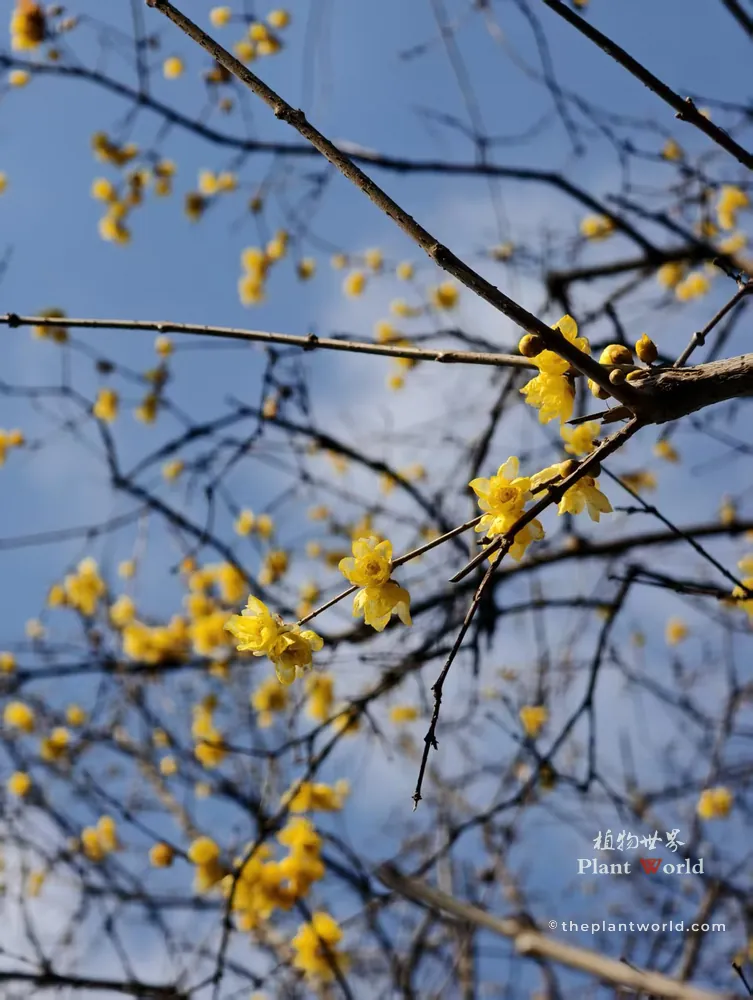
The wintersweet’s most distinctive trait is that it blooms before its leaves emerge — flowers appear on bare branches before any foliage unfolds. The flowers are solitary, borne in the leaf axils of the previous year’s branches. The tepals are numerous, waxy yellow with a glossy, wax-like sheen; the outer tepals are larger and paler, while the inner tepals are shorter, often with purplish-brown markings at the base. There are 5 to 7 stamens and 7 to 14 carpels. The flowers possess a rich, intense fragrance that carries remarkably well in cold air.
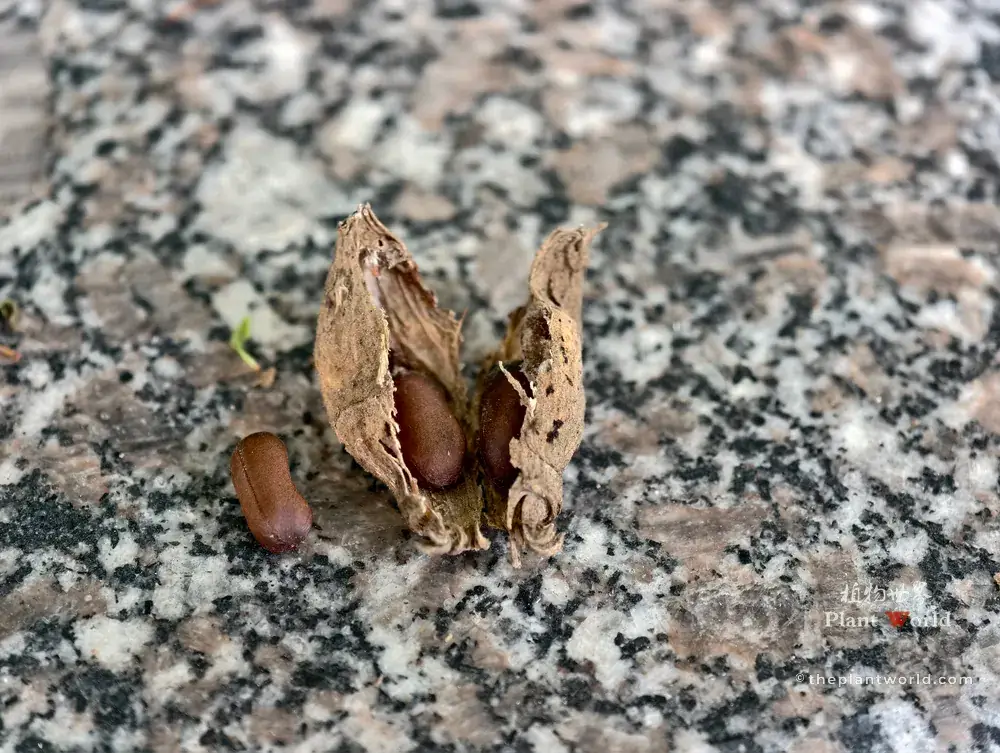
The bloom period is generally from November through March of the following year (varying by region and cultivar: in the Yangtze River basin and points south, blooming can begin in November; in northern regions such as Beijing, it is typically concentrated from February through mid-March). Early-blooming cultivars start in mid-November, while late-blooming ones can continue into early March — a bloom season lasting two months or more. The fruiting period is April through November. The fruit receptacle becomes nearly woody, urn-shaped or obovoid, turning gray-brown at maturity and containing several dark brown seeds — known in folk tradition as “earth croton” (土巴豆), which are toxic and must never be eaten.
It is worth noting that the wintersweet’s taxonomic placement has shifted over time: traditionally, the family Calycanthaceae was placed in its own order, but the modern APG classification system places Calycanthaceae in the order Laurales. The genus Chimonanthus is endemic to East Asia, with about 6 species, all found in China.
A Critical Distinction: Wintersweet Is Not Plum Blossom, and Its Name Is “Wax Plum,” Not “Twelfth-Month Plum”
These are the two most important clarifications in any article about wintersweet.
Wintersweet Is Not Plum Blossom
Wintersweet and plum blossom are often mistaken for the same plant or close relatives because their flowers look similar, their bloom times overlap, both bloom before leafing out, and both share the character “mei” (梅) in their Chinese names. In reality, they belong to different families and different genera, and are not closely related at all:
| Trait | Wintersweet (Chimonanthus praecox) | Plum Blossom (Prunus mume) |
|---|---|---|
| Family & Genus | Calycanthaceae, Chimonanthus | Rosaceae, Prunus |
| Plant Form | Deciduous shrub, 2–4 m | Deciduous small tree, 4–10 m |
| Leaf Arrangement | Opposite (in pairs) | Alternate (singly along stem) |
| Flower Color | Primarily waxy yellow | White, pink, red, purple-red, etc. |
| Fragrance | Intense, rich | Light, subtle |
| Bloom Period | Nov–Mar (varies by region; earlier) | Jan–Mar (slightly later) |
| Flowering Habit | Blooms before leaves emerge | Flowers and leaves often emerge together |
| Fruit | Woody urn-shaped receptacle; seeds inedible | Subglobose drupe; the edible plum (梅子) |
The Institute of Botany, Chinese Academy of Sciences, explicitly states: “Wintersweet is not a plum. In plant taxonomy, wintersweet is a deciduous shrub in the genus Chimonanthus, family Calycanthaceae, with yellow flowers; the plum is a deciduous tree in the genus Prunus, family Rosaceae, with white, pink, or purple-red flowers.”
The National Forestry and Grassland Administration also emphasizes: “Wintersweet and plum blossom have neither a close genetic relationship nor are they the same species.”
Before the Song Dynasty, people did not particularly distinguish between the two, or considered wintersweet simply a yellow variety of plum blossom. It was only during the Song Dynasty that wintersweet gradually came to be recognized and named as a distinct flower. The poems praising wintersweet by Northern Song poets such as Huang Tingjian and Su Shi mark the establishment of wintersweet as an independent ornamental flower.
“Wax Plum” or “Twelfth-Month Plum”?
Wintersweet is often misspelled as “twelfth-month plum” (腊梅) because it blooms in the cold twelfth lunar month. However, its name derives not from the month, but from its beeswax-like color.
In the Ming Dynasty, Wang Shimao (王世懋) wrote clearly in his horticultural work Miscellaneous Notes on Gardening (《学圃杂疏》):
“Wintersweet is a supreme flower among cold-weather blooms. People call it by the twelfth-month name because it blooms in that month, but this is incorrect — its color is precisely like yellow wax.”
Scholars generally use “wax plum” (蜡梅) as the correct name, while “twelfth-month plum” (腊梅) is a popular folk misspelling. In formal botanical literature and horticultural works, “wax plum” should be used.
Varieties: Pure-Heart, Bell-Mouth, and Dog-Tooth
Wintersweet has relatively few cultivars. Traditionally, they are classified by the color of the flower center and the flower shape into the following types:
Pure-Heart Wintersweet (素心蜡梅)
The pure-heart wintersweet is the most prized variety. Its petals, flower center, and stamens are all yellow, with no mixed colors whatsoever. The tepals are pure yellow, and the inner tepals are also yellow, free of purplish-red markings. The flower color is pure and the fragrance rich — the most highly regarded wintersweet.
Modern garden cultivars such as ‘Golden Flower’ (金花), ‘Curved-Tepal Pure-Heart’ (卷被素心), ‘Golden Cloak’ (金披风), and ‘Pale-Yellow Late Pure-Heart’ (浅黄晚素) all belong to the pure-heart cultivar group.
Bell-Mouth Wintersweet (磬口蜡梅)
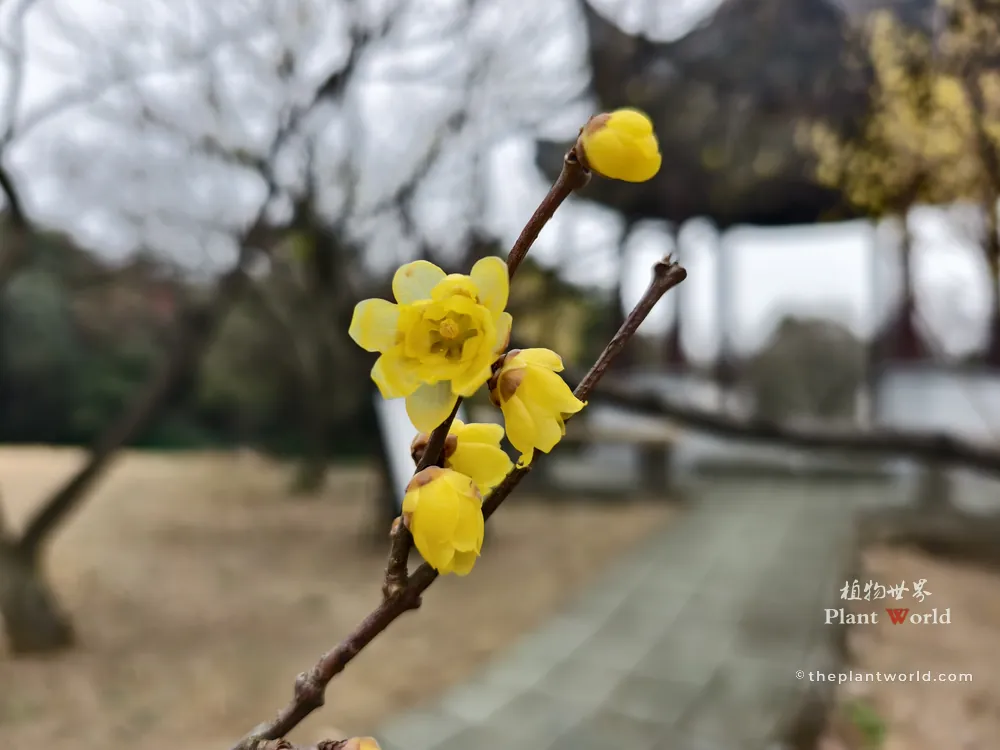
The bell-mouth wintersweet is named because its flowers remain half-open at full bloom, resembling the mouth of an ancient musical instrument called a qing (磬). The flowers are relatively large, with rounded tepals that never fully spread, remaining in a half-closed state. The outer tepals are yellow, and the inner tepals bear purplish-red markings. The fragrance is rich.
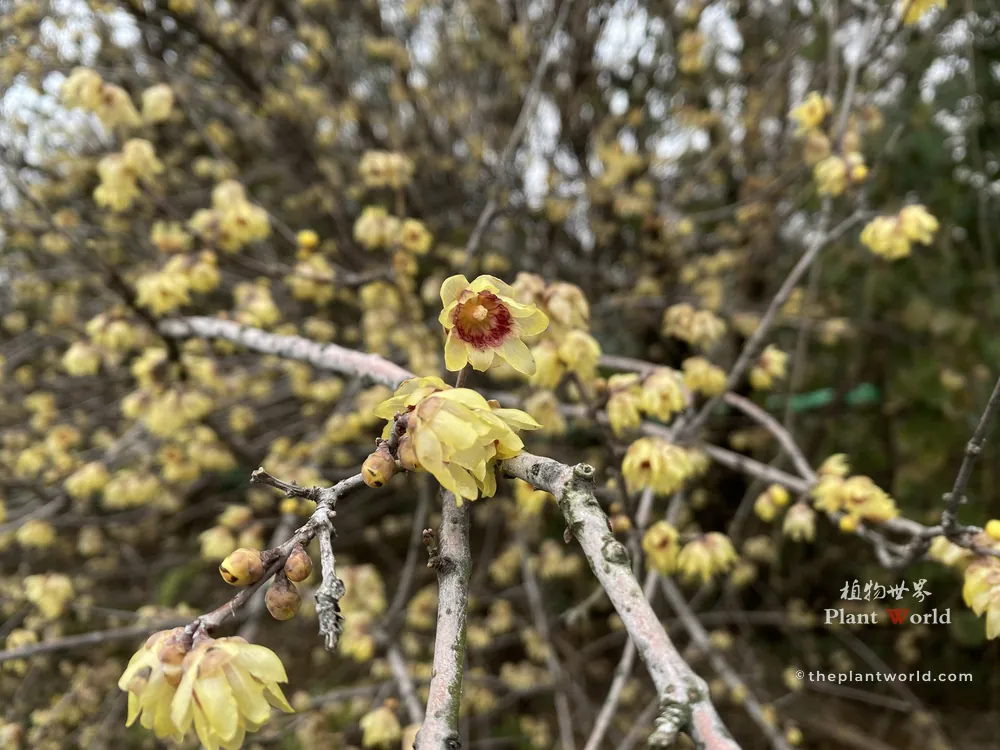
Dog-Tooth Wintersweet (狗牙蜡梅 / 狗蝇梅)
The dog-tooth wintersweet, also called dog-claw wintersweet, red-heart wintersweet, or dog-fly wintersweet, has relatively small flowers, 1 to 1.2 cm across. The flowers are pale yellow, with narrow, pointed tepals shaped like long ovate-lanceolate blades; the outer tepals are yellow, while the center of the inner tepals is purple. It flowers relatively sparsely with a lighter fragrance.
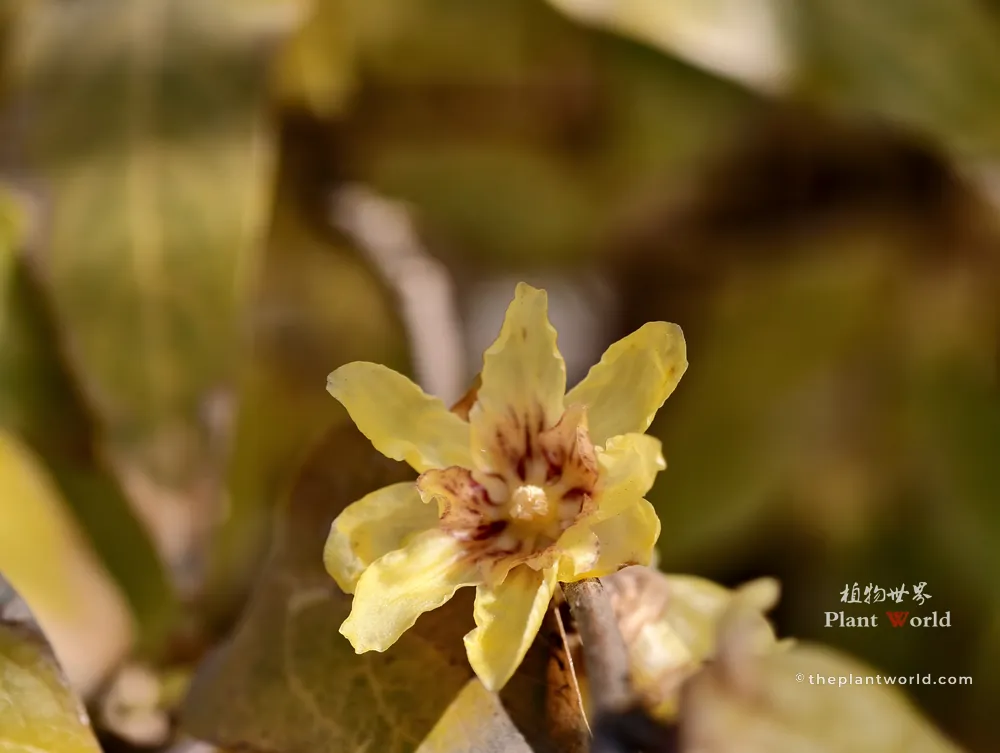
Modern Cultivar Classification
The most recent cultivar classification system divides wintersweets into three groups based on the color of the inner tepals:
- Pure-Heart Group: Inner tepals yellow; flower color uniform.
- Blushed-Heart Group: Inner tepals bear some purplish-red markings.
- Red-Heart Group: Inner tepals are extensively purplish-red.
Wintersweet Flower Meaning: Unyielding Pride and the First Herald of Spring
In Chinese culture, the wintersweet’s meaning is vivid and powerful — it is the unyielding pride of the resilient, the strength that defies the bitter cold, and the earliest messenger announcing spring.
Unyielding Pride: Blooming Alone in the Snow
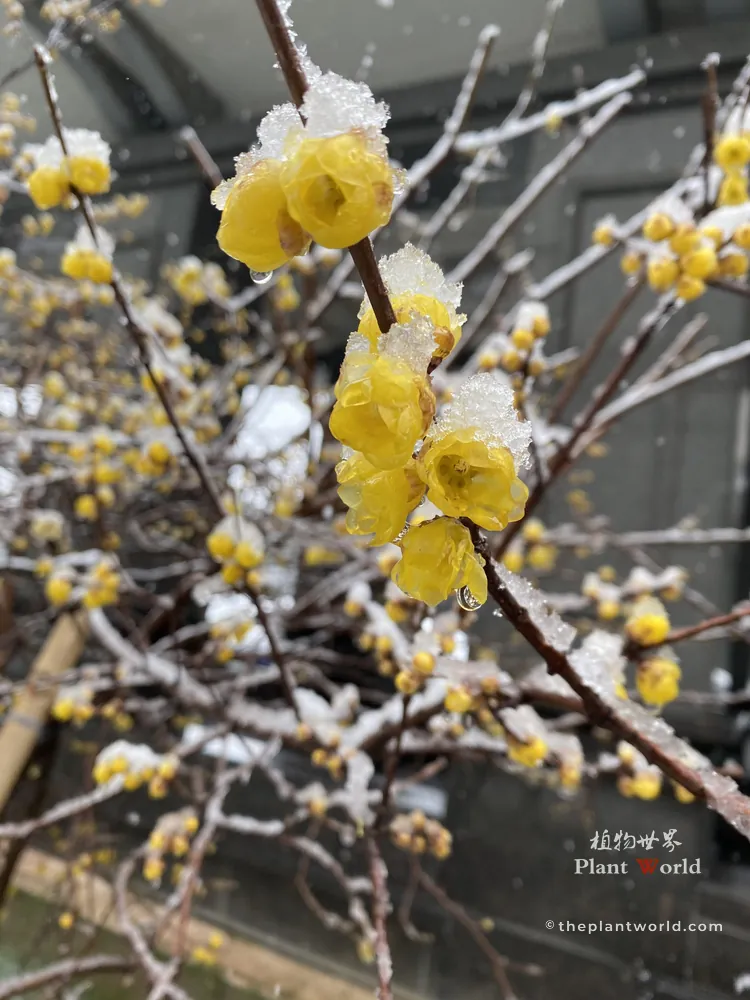
The wintersweet blooms in the depths of winter, when a hundred flowers have faded and all nature lies desolate — yet it bursts into bud and blossom amid ice and snow. This quality of blooming in the harshest of environments makes the wintersweet a symbol of resilience, unyielding pride, and indomitable spirit.
The wintersweet’s petals possess a waxy coating — as if the flower wears a thin gauze garment, a natural “protective suit” against wind and snow. The ancients praised the wintersweet as “the cold guest” (寒客) — a flower of resilient character and strong cold tolerance.
The Cold Guest Heralds Spring: The Earliest Messenger
The wintersweet’s bloom period stretches from November to March, making it one of the most important flowers in the transition from winter to spring. It blooms earlier than the plum blossom, and when the wintersweet is in full flower, spring is already stirring. For this reason, the wintersweet is hailed as the earliest messenger of spring, symbolizing hope and renewal.
Standing with the Plum Blossom: The Two Beauties of Winter
Although wintersweet is not a plum blossom, in culture the two are often mentioned together, hailed as “the two beauties of winter” (冬日双姝). Both bloom in the cold, both represent resilience and purity, and their bloom times follow one after another — together forming the core of China’s winter flower culture.
Wintersweet in Poetry: From Su Shi to Huang Tingjian
Wintersweet was widely recognized and celebrated only from the Song Dynasty onward, which left behind many beautiful poems.
Su Shi (Northern Song): “Wintersweet, Presented to Zhao Jingkuang”
“Heaven’s artisan dots 酥 (butter) to make plum blossoms, / here is wintersweet in the Chan master’s home. / Bees gather flowers to make yellow wax, / taking wax to make a flower — it is the same substance.”
Huang Tingjian (Northern Song): “Playfully Singing of Wintersweet, Two Poems”
“Golden buds lock in the spring cold, / vexing that the fragrance has not yet unfurled. / Though it lacks the peach and plum’s fair face, / its flavor and character run exceedingly deep.”
Chao Buzhi and “Su’er”
“Its fragrance is light, its appearance modest, / I recall Su’er was just like this plum.”
In the poem, Chao Buzhi compares the wintersweet’s understated elegance to “Su’er,” a maid in Wang Zhifang’s household. “Su’er” (素儿) subsequently became one of the wintersweet’s literary aliases.
Uses: Ornamental, Tea-Scenting, Food, and Medicinal
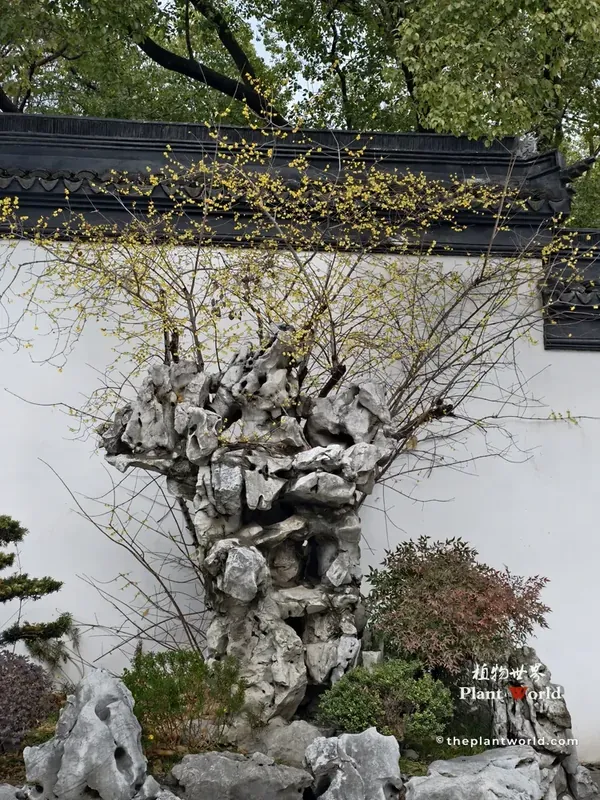
- Ornamental: Ideal for garden landscaping, ancient-stump bonsai, and indoor cut flower arrangements.
- Tea-Scenting: Flowers are used to scent tea leaves, creating a refreshing infusion that relieves summer heat and stimulates appetite.
- Food (With Caution): Used traditionally in pastries, but requires professional heating/processing due to natural alkaloids.
- Traditional Medicine: Flower buds, roots, and stems are recorded in TCM for dispersing heat, stopping coughs, and relieving pain. (Requires expert supervision).
Toxicity and Pet Safety: “Earth Croton” and Chimonanthine
⚠️ Toxicity Warning: The entire wintersweet plant is toxic, with the seeds being the most poisonous part.
- Toxic Compounds: Contains indole alkaloids, primarily chimonanthine and calycanthine, which can affect the nervous system and induce convulsions in mammals.
- “Earth Croton” Seeds: The mature urn-shaped fruits contain dark brown seeds known as “earth croton” (土巴豆). Ingestion causes severe gastrointestinal distress, vomiting, and diarrhea.
- Pet Safety: Highly dangerous to dogs and cats if leaves, stems, or seeds are ingested. Keep potted plants or garden specimens out of reach of pets.
Cultivation and Care Guide
- Light: Prefers full sun for optimal bloom and scent; tolerates partial shade.
- Temperature: Extremely cold-hardy (down to -15°C / Zone 5/6). Protect from harsh, dry winter winds.
- Soil: Well-draining, loose, slightly acidic sandy loam.
- Watering: Highly drought-tolerant (“a wintersweet cannot be killed by drought”). Avoid waterlogging at all costs.
- Pruning: Prune aggressively immediately after flowering to stimulate strong new shoots for next winter’s blooms.
Final Thoughts
The wintersweet is a timeless symbol of perseverance, warmth, and artistic inspiration in Chinese plant culture. From Su Shi’s poetic praise to its golden blooms braving the cold snow, understanding the wintersweet flower meaning connects us to centuries of eastern aesthetic wisdom.
References
- Plants of the World Online (POWO). Chimonanthus praecox (L.) Link. Royal Botanic Gardens, Kew.
- Institute of Botany, Chinese Academy of Sciences. “Only Wintersweet Breaks Through, Blooming Alone in the Snow.”
- Institute of Botany, Chinese Academy of Sciences. “Toxic Plants — Wintersweet.”
- National Forestry and Grassland Administration. “Wintersweet: Golden Glimmers in the Depth of Winter.”
- Beijing Municipal Bureau of Landscape and Forestry. “Wintersweet Is Not ‘Plum’ Either.”
- Wang Shimao (Ming Dynasty). Miscellaneous Notes on Gardening (《学圃杂疏》).
More from The Plant World:
- Chinese Wingnut: The Romantic “Ingot Tree” and Its Cultural Charm
- Plum Blossom Meaning: Symbolism & Cultural Significance
- The Hidden Meanings Behind Red Plum Blossoms
- Chinese Wisteria: History, Symbolism, and Identification
- Peach Blossoms in China: History, Culture, and Symbolism
- Chinese Crepe Myrtle: Guide to Origins & Symbolism
- Ginkgo Leaf Meaning: 5 Secrets of This Ancient Fossil
- Chinese Loquat Tree: Guide to Benefits & History
- Rose of Sharon Tree: Guide to Meaning & Care
- Hosta Plant Benefits: 5 Surprising Uses & Planting Guide
- Strawberry Begonia Care: How to Grow Saxifraga Stolonifera
Discover more from The Plant World
Subscribe to get the latest posts sent to your email.