
- 1. Basic Profile & Naming Origin
- 2. Origin & Distribution
- 3. Botanical Features of Pterocarya stenoptera
- 4. Ancient Records & Traditional History
- 5. Poetry & Ancient Ecological Engineering
- 6. An Ancient Forensic Trick & Its Scientific Principle
- 7. Modern Uses & Ecological Value
- 8. Conclusion
- References
- More from The Plant World:
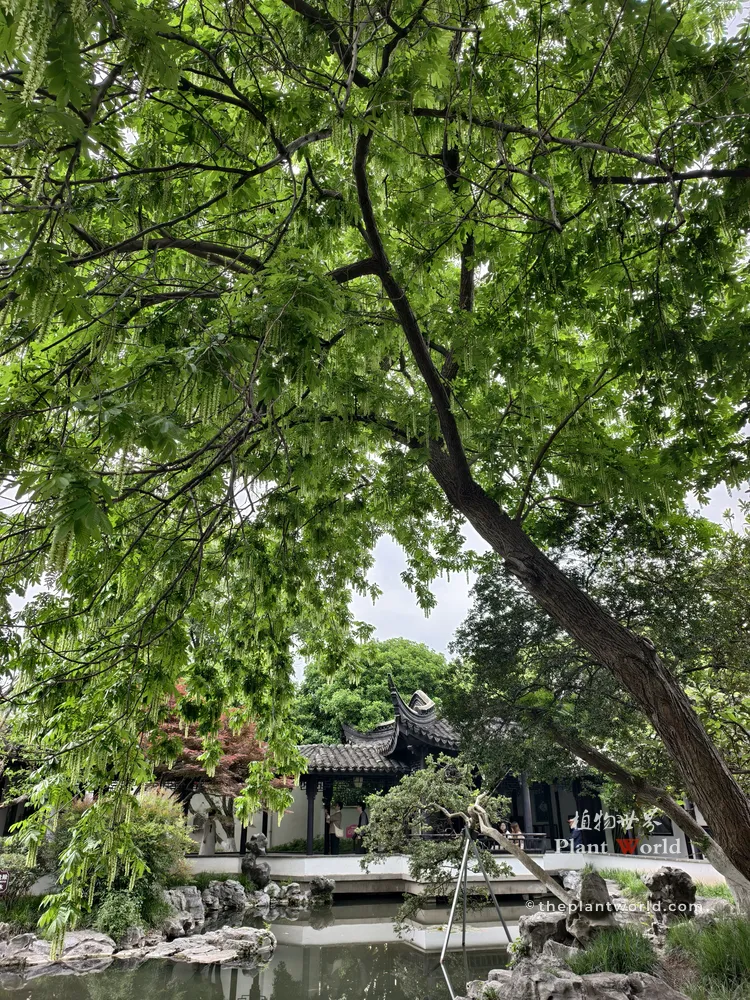
The graceful branches of Pterocarya steroptera (Chinese Wingnut) frame a serene traditional pavilion in a classic Chinese garden.
Dangling gracefully from slender, drooping branches, long clusters of feathery leaves and unique winged fruits make the Chinese Wingnut one of China’s most elegant native trees. Its foliage resembles locust leaves—yet it unfolds larger, softer, and in a richer shade of green, like peacock plumage.
Most charming of all are its fruit clusters: foot-long strands hanging like festive firecrackers, glinting softly in the breeze and swaying gently with every gust. As celebrated Chinese essayist Liang Heng once described, it is a tree that beautifully blends sturdy vitality with delicate romance, remaining playful and picturesque through every season.
Commonly known as the Chinese Wingnut or Hemp Willow, this large native tree is ubiquitous across southern China. Boasting a broad, dense canopy and gracefully weeping branches, its signature dangling fruit clusters resemble beaded curtains, tiny bells, or delicate earrings, softening the rugged grandeur of mature trees with a gentle, poetic beauty.
1. Basic Profile & Naming Origin
- Scientific Name: Pterocarya stenoptera
- Common Names: Chinese Wingnut, Centipede Willow, Bigleaf Willow, Water Hemp Willow
- Family & Genus: Juglandaceae (Walnut family), Pterocarya genus
The Chinese Wingnut is a large deciduous tree, capable of reaching up to 30 meters in height with a trunk diameter of 1 meter. Its Chinese common name combines the characters for “maple” (枫) and “poplar” (杨), which often causes botanical confusion—it actually belongs to neither genus and shares no close relation to them.
This poetic local name likely honors its dual traits: the rugged hardiness of poplars and the graceful elegance of maples. In contrast, its English name, Chinese Wingnut, is wonderfully straightforward, directly referencing its distinctive winged nuts.
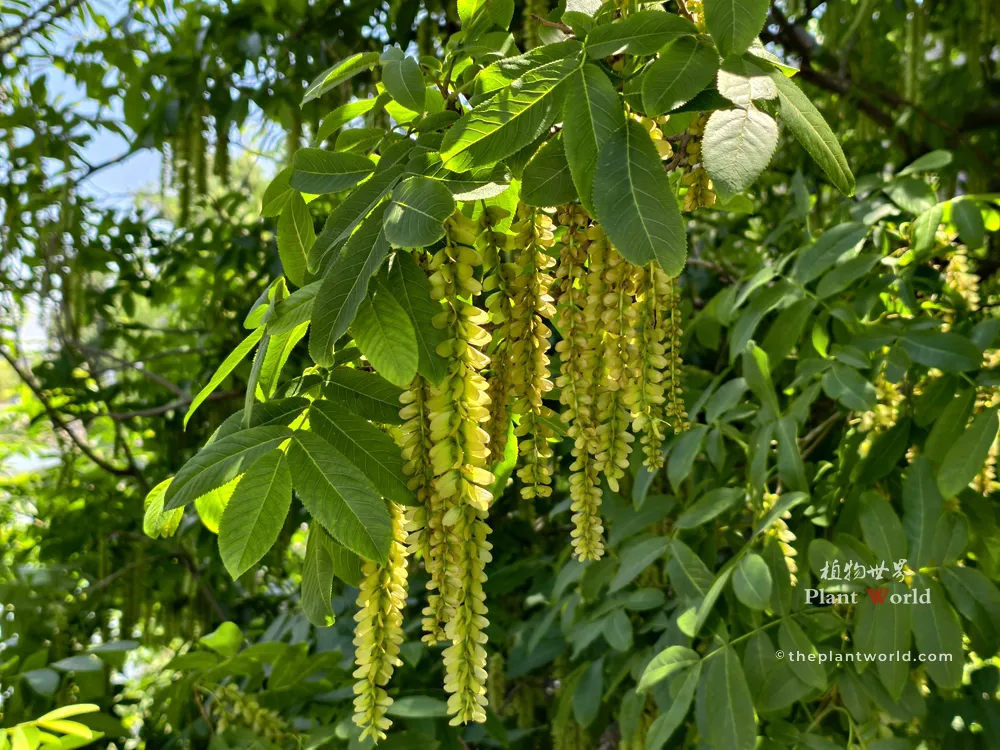
Bright summer sunlight illuminates the cascading winged fruit clusters and lush green foliage of the Chinese Wingnut (Pterocarya stenoptera).
2. Origin & Distribution
The Chinese Wingnut is an endemic species native exclusively to China. It thrives abundantly along the Yangtze and Huai River basins, with sporadic cultivated populations in Northern and Northeastern China. In the wild, it colonizes damp forests, stream banks, and river beaches at altitudes below 1,500 meters.
As a water-loving, flood-tolerant tree, it naturally gravitates toward riverbanks and low-lying wetlands. Its extensive, robust root system firmly anchors the soil and effectively prevents riverbank erosion, acting as a natural ecological defender for fragile riparian systems.
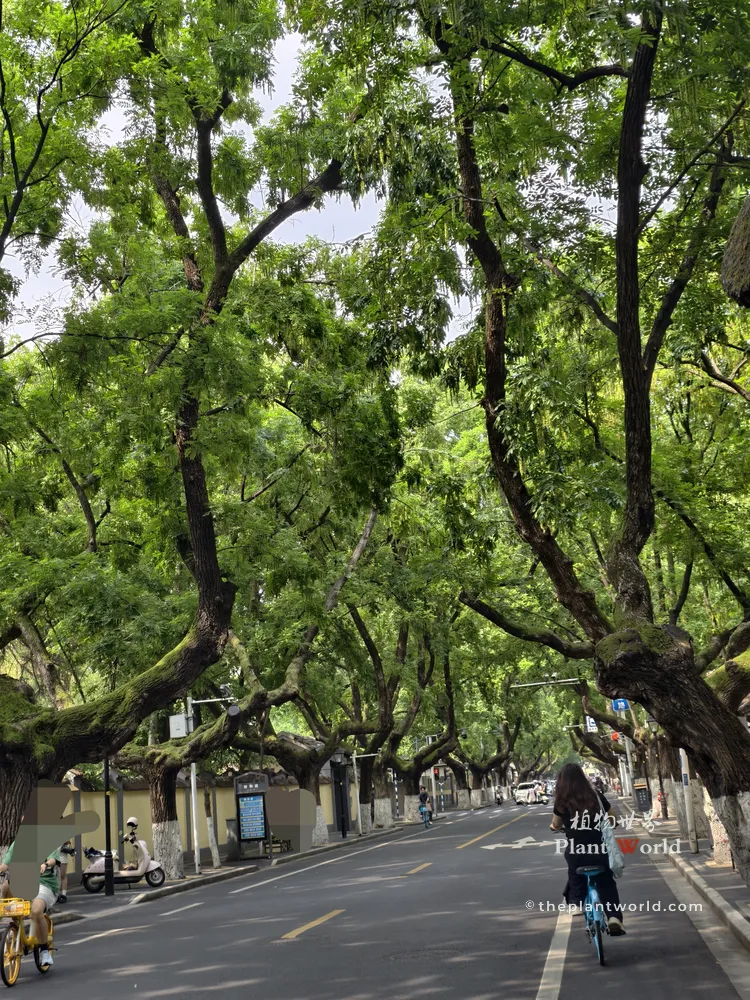
Planted over 90 years ago, these historic Pterocarya stenoptera (Chinese Wingnut) trees create a magnificent living canopy over Nanjing’s famous Yihe Road.
3. Botanical Features of Pterocarya stenoptera
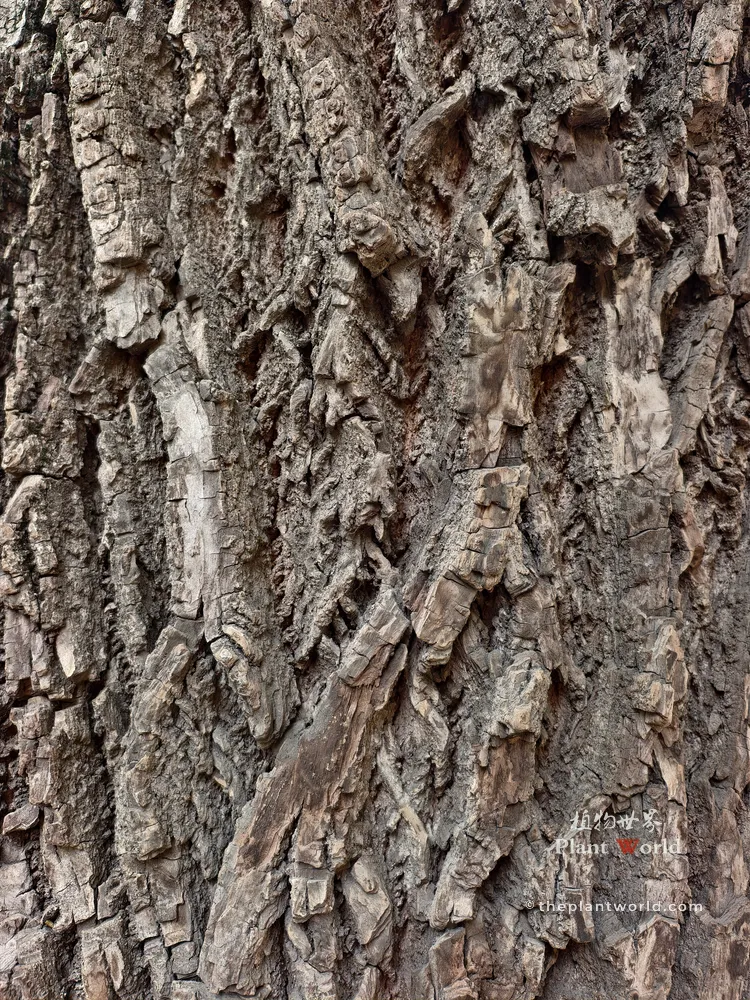
Rugged, Cracked Bark
Mature Chinese Wingnuts develop thick, sturdy trunks covered in dark gray bark marked with deep vertical fissures. The bark feels rough and deeply textured to the touch, embodying the tree’s enduring, resilient character against the elements.
Unique Winged Leaf Axes (Core Identification Trait)
Its foliage consists mostly of even-pinnate compound leaves (rarely odd-pinnate), arranged symmetrically along the leaf axis like neat feathers. The most reliable identification feature is the narrow, woody wing growing along the leaf axis. This layout earned it the local nickname “Centipede Willow,” as the layered leaves and winged stems whimsically resemble a centipede’s body.
Each small leaflet is elongated and lance-shaped with finely serrated, inward-curving edges. The leaves grow stalkless (sessile) directly on the axis, featuring deep green blades dotted with tiny, pale raised bumps.
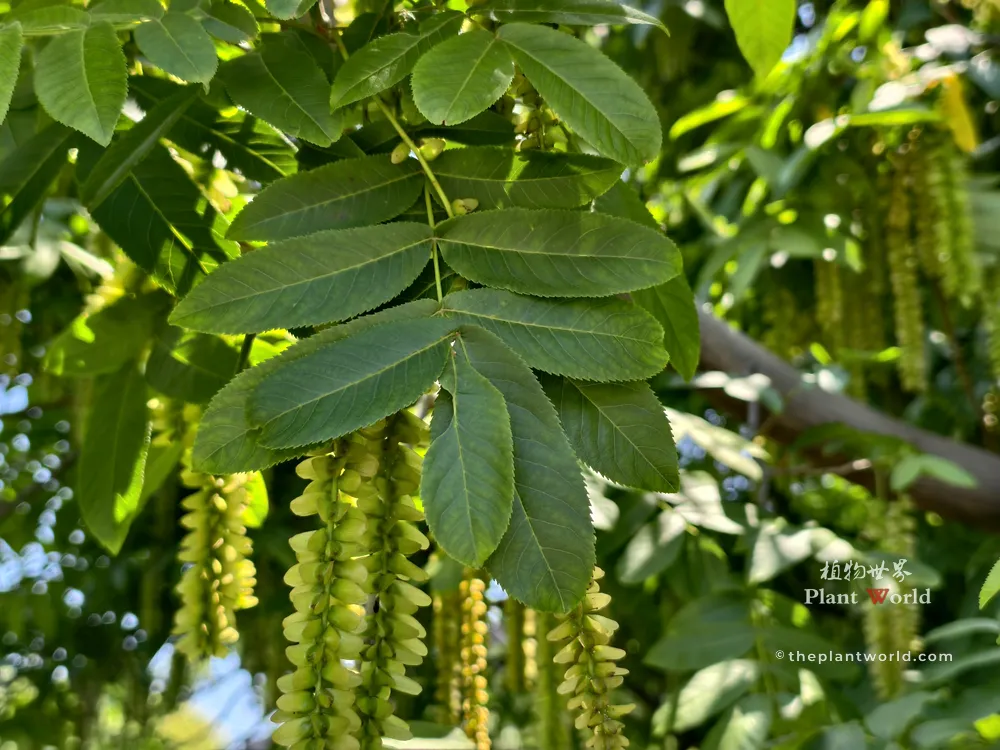
Close-up of the characteristic pinnately compound leaves and distinctive winged fruit clusters of the Chinese Wingnut (Pterocarya stenoptera).
Caterpillar-Like Catkin Flowers
The tree is monoecious (bearing separate male and female flowers on the same tree) and blooms from April to May. All flowers grow in drooping catkins that look remarkably like slender green caterpillars hanging from the branches. Male catkins sprout from the leaf axils of old branches and drop off after shedding pollen, while female catkins grow atop new branches, developing into long fruit clusters after pollination.
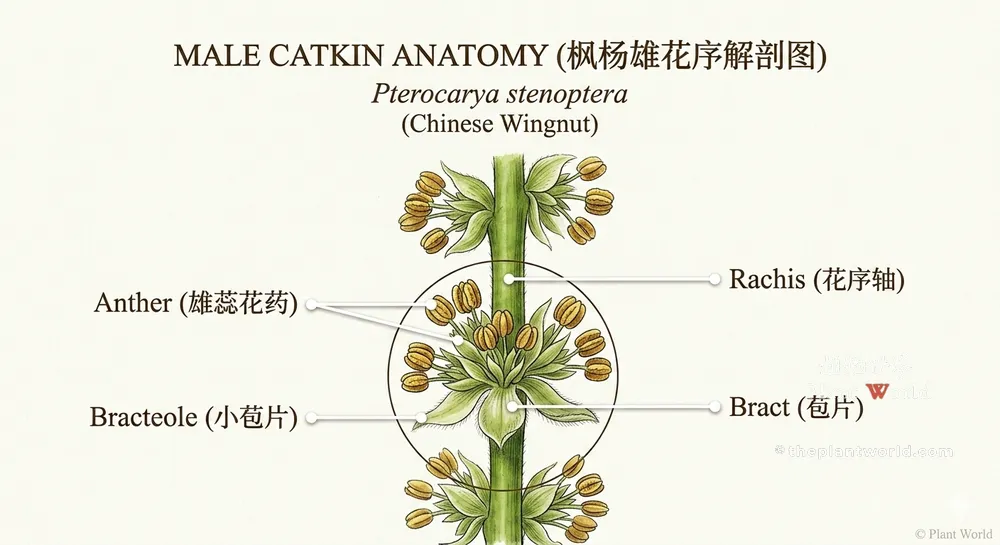
Figure 1: Anatomical structure of the male catkin of Pterocarya stenoptera (Chinese Wingnut), showing rows of pollen-bearing anthers protected by specialized bracts.
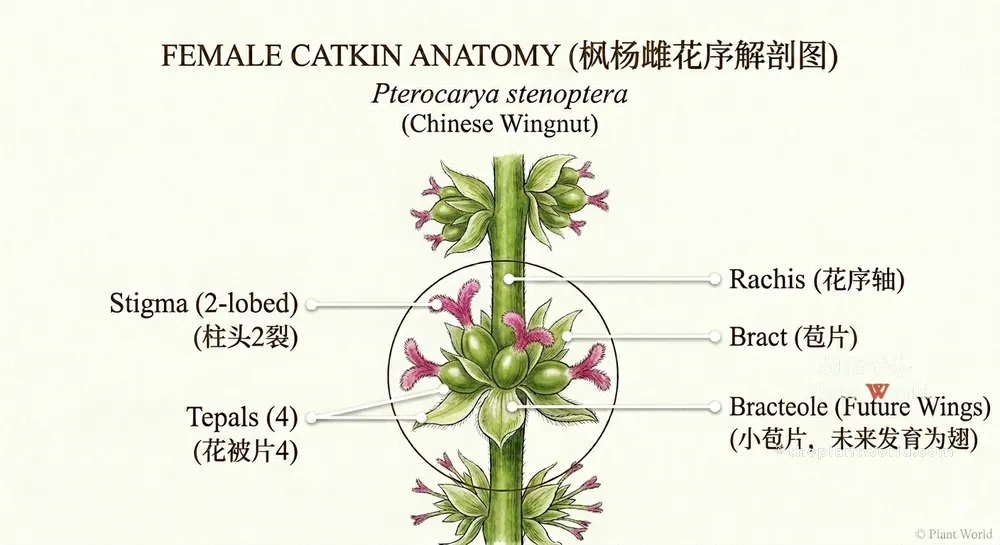
Figure 2: Anatomical structure of the female catkin of Pterocarya stenoptera. The distinctive 2-lobed pink stigmas catch pollen, while the bracteoles will later develop into the characteristic winged samaras.
Flying “Green Ingots”
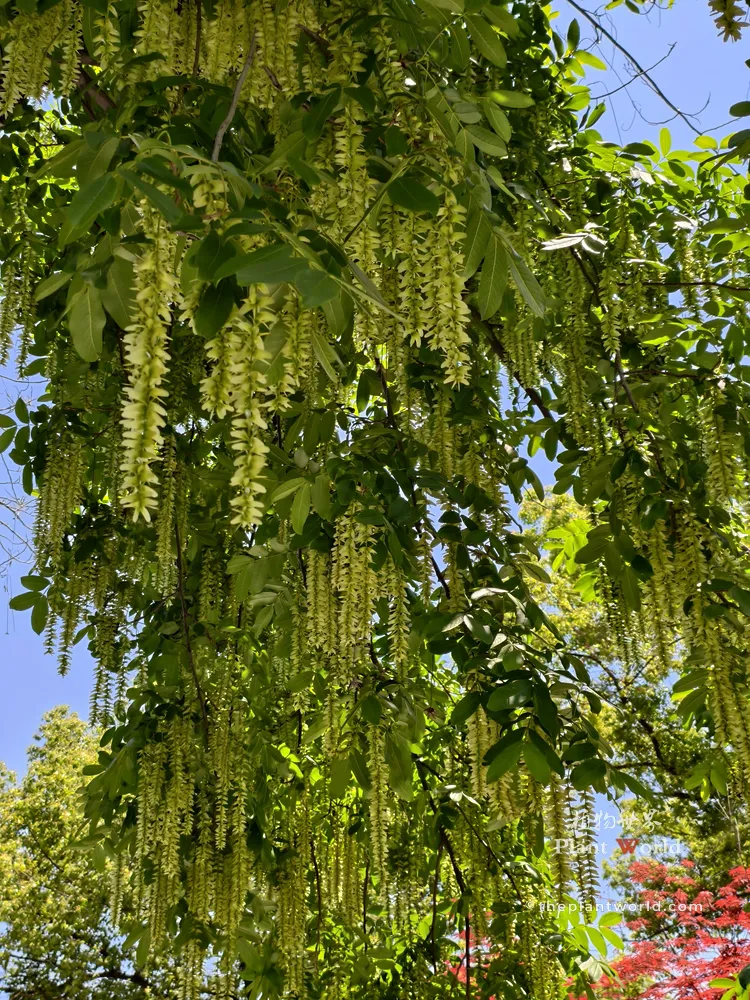
In summer, the female flower clusters mature into lush, dangling fruit strands 20 to 45 cm long, swaying like wind chimes. Each tiny nut is flanked by two elongated, wing-shaped bracts, forming a shape identical to miniature ancient Chinese gold or silver ingots (Yuanbao)—earning it the lovely traditional title “The Ingot Tree.” When ripe in autumn, these winged nuts spin and drift to the ground like tiny biological helicopters, traveling far on the wind to spread their seeds.
4. Ancient Records & Traditional History
The Chinese Wingnut has accompanied Chinese civilization for thousands of years, documented in classic texts under various ancient names including Qi (榿), Willow Catalpa, and Ghost Willow.
- Shanhaijing (Classic of Mountains and Seas, Pre-Qin Dynasty): The earliest written record of the tree, colorfully describing it as a poplar-like tree with red textures and blood-like sap.
- Mencius (Warring States Period): A famous philosophical metaphor compares human nature to the flexible branches of this tree, which ancient artisans wove into durable daily utensils due to its outstanding toughness and pliability.
- Compendium of Materia Medica (Ming Dynasty, by Li Shizhen): Documented the tree’s medicinal values. Its bark and leaves are bitter and pungent, traditionally used in herbal medicine to dispel “wind toxins,” relieve dampness, and treat stubborn skin rashes, eczema, and tinea infections via boiled topical washes.
5. Poetry & Ancient Ecological Engineering
Growing primarily along rivers and surrounding historic villages, the Chinese Wingnut is a classic symbolic element in ancient Chinese pastoral and wanderer poetry. The great Tang Dynasty poet Du Fu wrote beautifully of its graceful, drooping branches and tranquil rural presence, capturing its soft, swaying summer silhouette.
Beyond its poetic charm, ancient Chinese communities utilized the tree for practical hydraulic engineering. A Northern Song Dynasty water conservancy manual records that planting wingnut trees along dykes dramatically strengthened river embankments. Their tangled, deep root systems trapped sediment, consolidated loose soil, and reinforced dykes over time—a highly sophisticated, nature-based ecological method adopted centuries ago.
6. An Ancient Forensic Trick & Its Scientific Principle
A fascinating historical account from the Song Dynasty text Mo Ke Hui Xi (墨客挥犀) records a clever legal dispute solved using the wingnut tree:
A county magistrate was judging a physical fight dispute where both the accuser and the accused bore realistic red and purple bruises. The magistrate instantly identified the weaker man’s injuries as real and the stronger man’s as fakes.
He revealed that local tricksters used wingnut leaves and bark to forge fight wounds. Smashing the leaf juice onto skin created a bruise-like discoloration, while heated bark pressed onto the skin formed highly realistic trauma marks that resisted water washing. However, the magistrate knew the secret: true bruises feel hardened due to blood clotting beneath the skin, while fake wingnut stains leave the skin perfectly soft to the touch.
The Scientific Explanation
Modern chemistry validates this ancient detective trick. The Chinese Wingnut contains juglone (an organic compound oxidized from hydrojuglone inside the plant tissue). When the leaves are crushed and exposed to air, these active substances oxidize and bind irreversibly with the keratin in human skin cells. This forms a stable, dark stain that cannot be washed away with soap and water, lasting 1 to 2 weeks until the skin naturally exfoliates.
Juglone is also a powerful natural antifungal agent that disrupts fungal cell walls. This explains why ancient doctors successfully used it to treat skin conditions like athlete’s foot and eczema.
7. Modern Uses & Ecological Value
| Category | Practical Applications & Benefits |
|---|---|
| Medicinal & Industrial | Extracts from the bark and leaves offer proven antibacterial and antiparasitic properties. The wood is lightweight yet remarkably water-resistant, making it highly valued for plywood manufacturing and paper pulp. |
| Urban Forestry | With its expansive, dense canopy, it provides superb shade for riverside walks and urban greenways. Unlike the widely planted London Plane tree (which releases highly irritating airborne fuzz and pollen in spring), the Chinese Wingnut is cleaner and much friendlier for urban allergy sufferers. |
| Phytoremediation | Modern environmental research confirms that the tree efficiently absorbs and accumulates heavy metals (such as cadmium, lead, and zinc) from contaminated soil, serving as an excellent green tool for restoring polluted industrial lands. |
A Childhood Natural Toy
For generations of children raised in China, the wingnut tree is a nostalgic piece of childhood. The fresh summer winged fruits are slightly sticky at the base; children traditionally stick them onto their faces as “fake beards,” hang them over their ears as natural earrings, or toss them into the air to watch them spin down like darts. It remains one of the most romantic and playful “natural toy trees” in regional childhood memories.
8. Conclusion
The Chinese Wingnut perfectly marries rugged, deep-rooted vitality with a delicate, weeping elegance. Whether standing quietly along ancient canals, shading classical gardens, or framing historic city avenues, it brings a peaceful, poetic beauty to the changing seasons.
The next time you stroll past a lakeside, a river embankment, or a city green belt in East Asia, look up into the canopy. Those dangling, winged “green ingots” are not just beautiful scenery—they are a living plant heritage carrying thousands of years of history, ecological wisdom, and warm childhood memories, a graceful Chinese Garden Plants.
References
- Ancient Chinese Classics: Shanhaijing (Classic of Mountains and Seas), Mencius, Compendium of Materia Medica (1578), Mo Ke Hui Xi (11th Century)
- Flora of China (Volume 21: Juglandaceae, Pterocarya)
- Plants of the World Online, Royal Botanic Gardens, Kew
- iNaturalist & Wikipedia: Pterocarya stenoptera
More from The Plant World:
- Plum Blossom Meaning: Symbolism & Cultural Significance
- The Hidden Meanings Behind Red Plum Blossoms
- Chinese Wisteria: History, Symbolism, and Identification
- Peach Blossoms in China: History, Culture, and Symbolism
- Chinese Crepe Myrtle: Guide to Origins & Symbolism
- Ginkgo Leaf Meaning: 5 Secrets of This Ancient Fossil
- Chinese Loquat Tree: Guide to Benefits & History
- Rose of Sharon Tree: Guide to Meaning & Care
- Hosta Plant Benefits: 5 Surprising Uses & Planting Guide
- Strawberry Begonia Care: How to Grow Saxifraga Stolonifera
Discover more from The Plant World
Subscribe to get the latest posts sent to your email.