Travel through the misty ancient villages and preserved heritage gardens in Jiangnan, and you may encounter a legendary tree deeply celebrated across thousands of years of Chinese literature: the Red Bean Tree, known botanically as Ormosia hosiei. Its smooth, vivid scarlet seeds have carried the profound emotional weight of longing, remembrance, and romantic affection in the orient for more than a millennium.
Many Western readers easily mix up several plants nicknamed “red bean”. We will clarify the key differences clearly in the dedicated guide below.
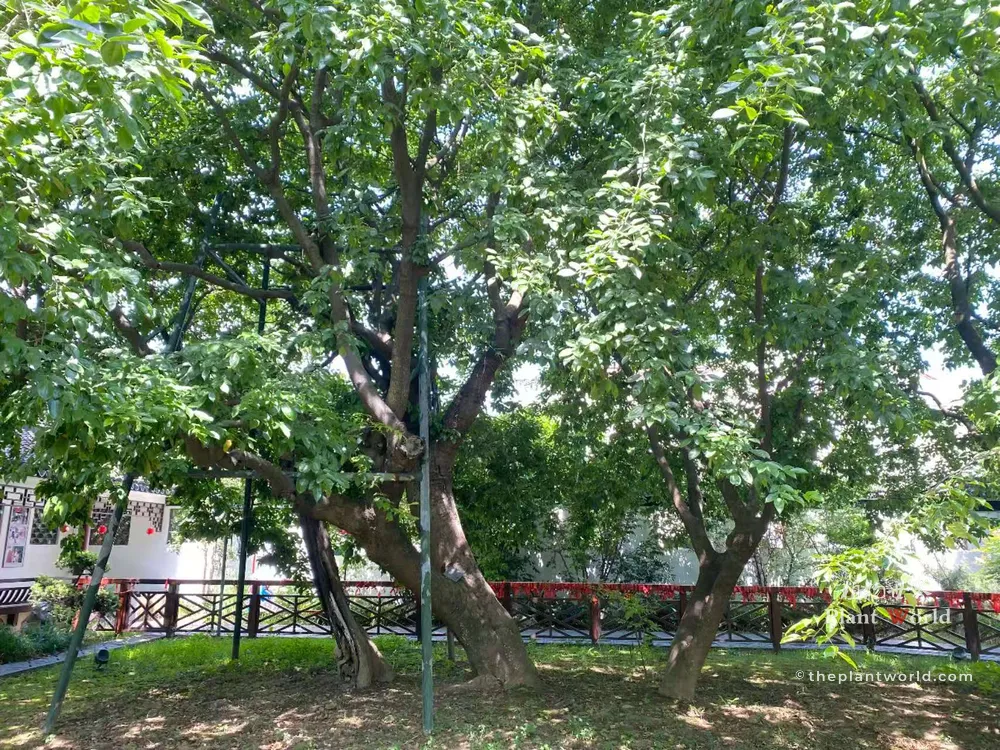
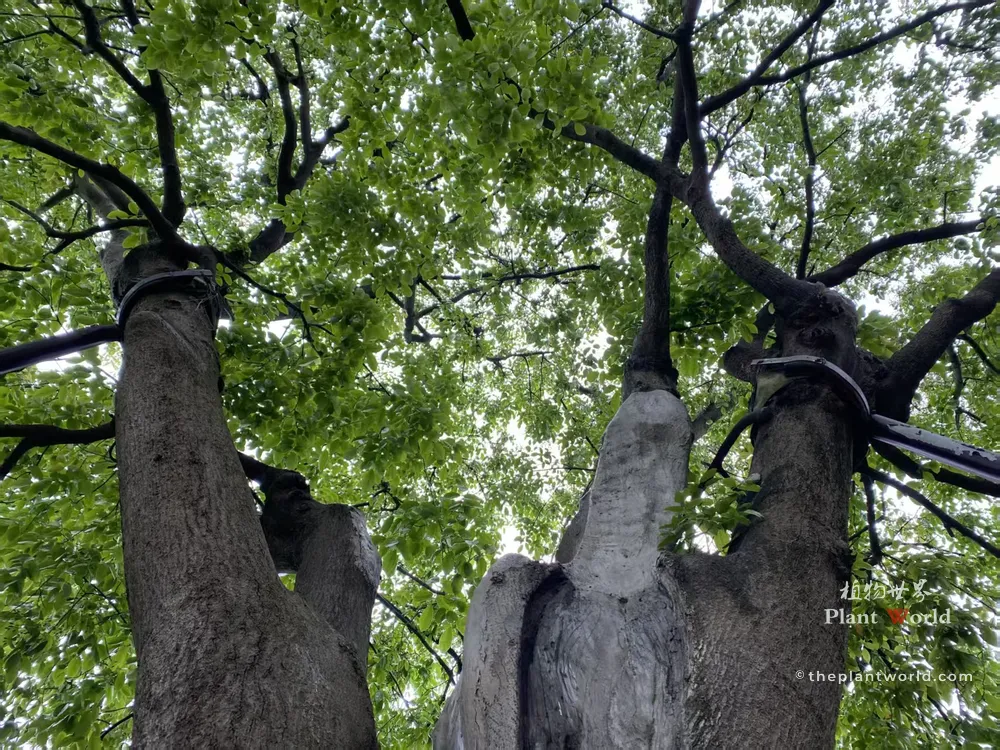
The famous 1,500‑year‑old ancient Ormosia hosiei in Hongdou Courtyard, Gushan Town, Jiangyin. Five trunks grow from one shared ancient root system, a legendary tree linked to Prince Xiao Tong of the Southern Liang Dynasty and the folklore of the Red Bean Hut.
Common Names: Red Bean Tree, Chinese Ormosia, Hosie’s Ormosia, Jiangyin Red Bean Tree
Family: Fabaceae (Pea/Legume Family)
Conservation Status: China’s National Class II Protected Wild Plant
Ormosia hosiei is a massive, slow-growing native Chinese deciduous or semi-evergreen tree. Wild populations naturally inhabit river valleys and mountain slopes south of the Yellow River, spanning across Fujian, Zhejiang, Hubei, Sichuan, Jiangsu, and southern Shaanxi.
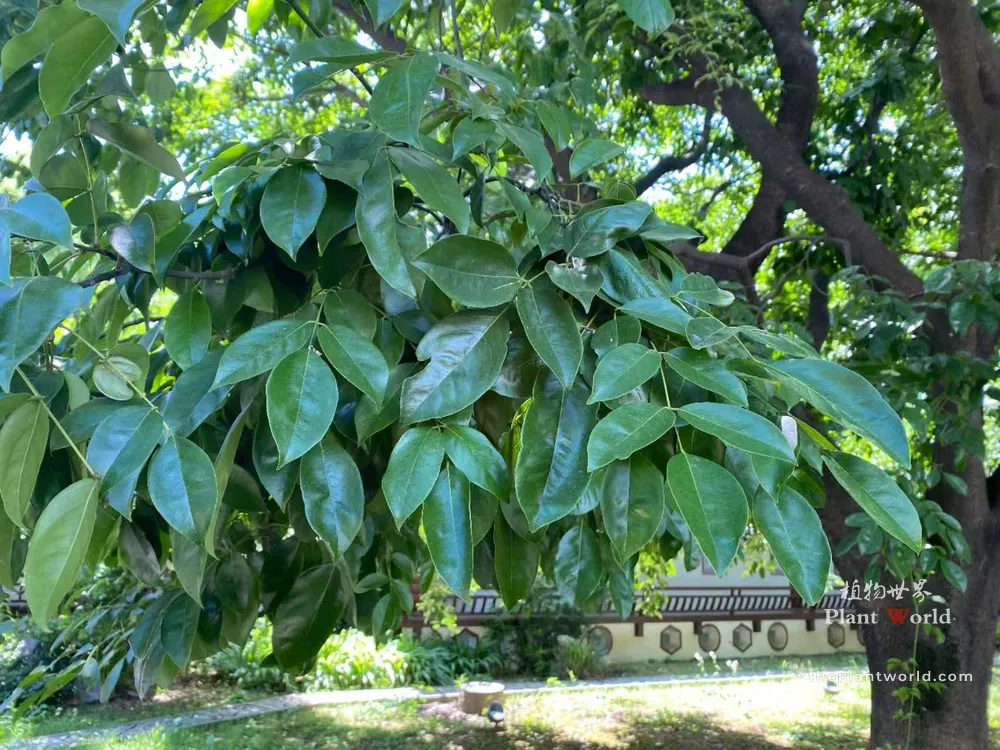
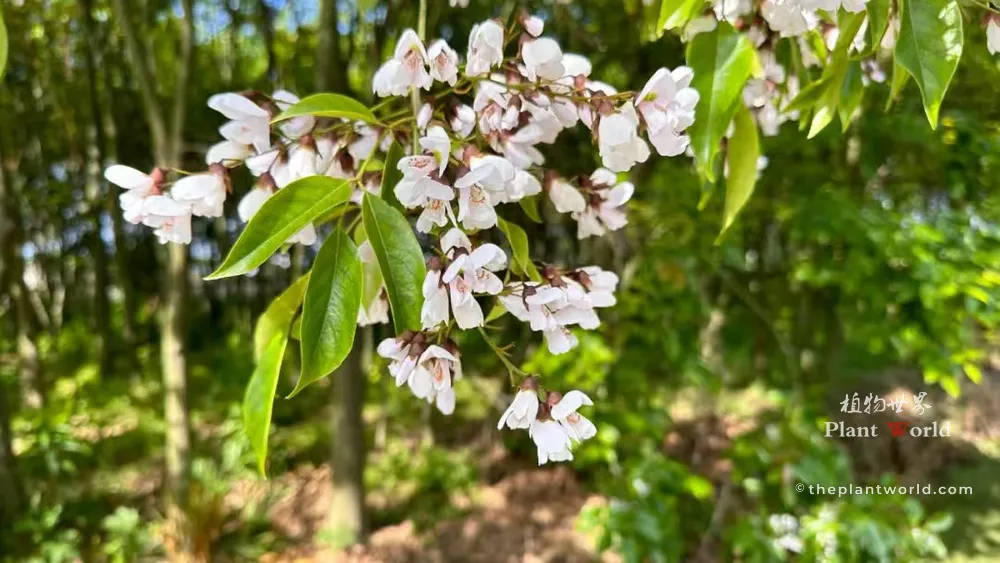
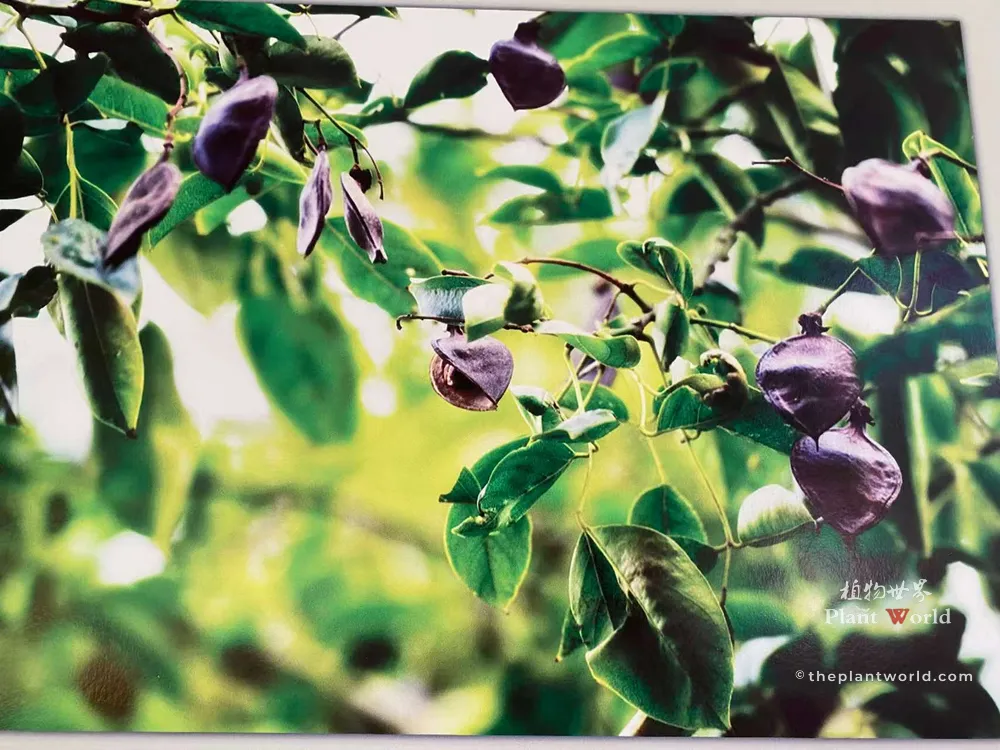
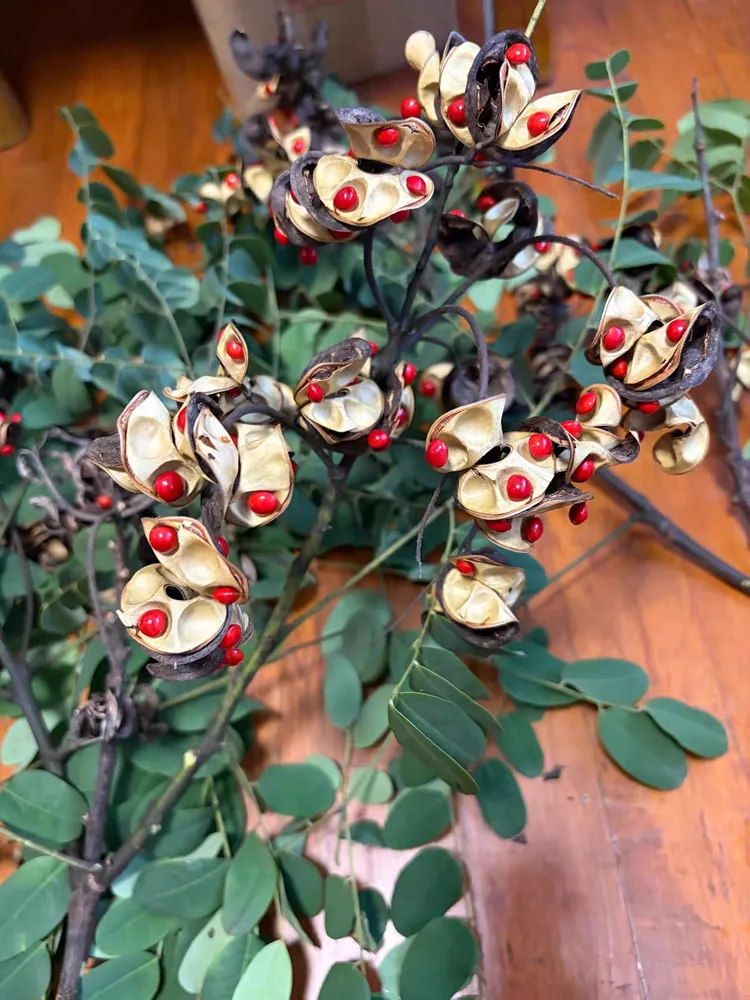
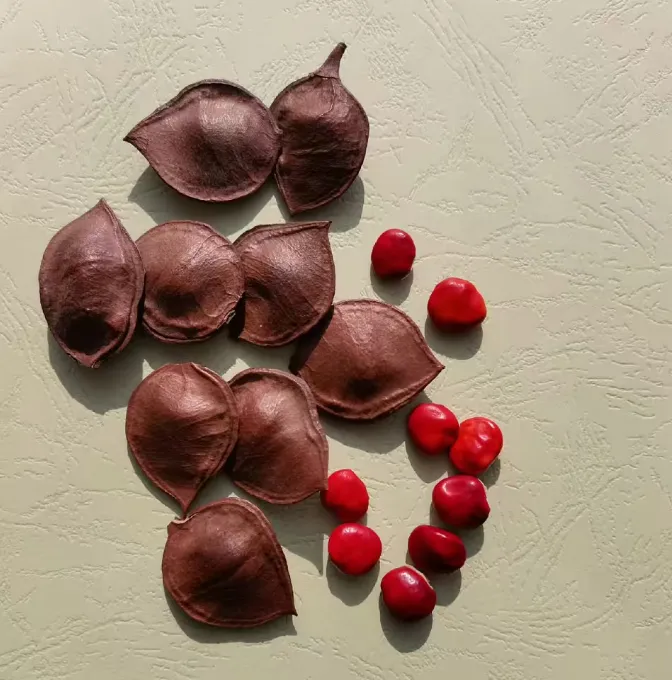
The tree bears elegant oval leaves with glossy, thinly leathery surfaces. In April and May, it produces drooping panicles of pale‑white to soft‑pink butterfly‑shaped pea blossoms, releasing a faint, delicate fragrance reminiscent of black locust blooms. Flat, nearly rounded seed pods form throughout the summer heat, ripening to a rich tawny‑brown from October into November. Each pod contains one or two firm, flattened seeds cloaked in a vivid, long‑lasting scarlet seed coat.
Lush glossy compound leaves of Ormosia hosiei, captured from the legendary 1500‑year‑old ancient tree at Hongdou Courtyard, Gushan, Jiangyin. The ever‑semi‑deciduous foliage forms a dense summer canopy.Drooping raceme of fully open blossoms of Ormosia hosiei. The delicate white papilionaceous flowers carry subtle pink markings at the centre, paired with smooth, shiny pinnate leaves typical of the Chinese Red Bean Tree.Dark purple mature seed pods of the 1500-year-old Ormosia hosiei in Gushan, Jiangyin.
The Mystery of the Unpredictable Bloom
Many people wonder why these red seeds are historically regarded as so incredibly precious. Ormosia hosiei exhibits a frustrating, unpredictable biological blooming and fruiting rhythm. A mature tree may remain entirely vegetative and dormant for 3 to 5 years, or in some historical records, up to 10 to 20 years before suddenly bursting into flower. Furthermore, a successful bloom does not guarantee mature seed pods. To find a wild, ripe scarlet seed requires immense luck, which has deeply heightened its sentimental value as a rare, sacred token exchanged between lifelong friends and lovers.
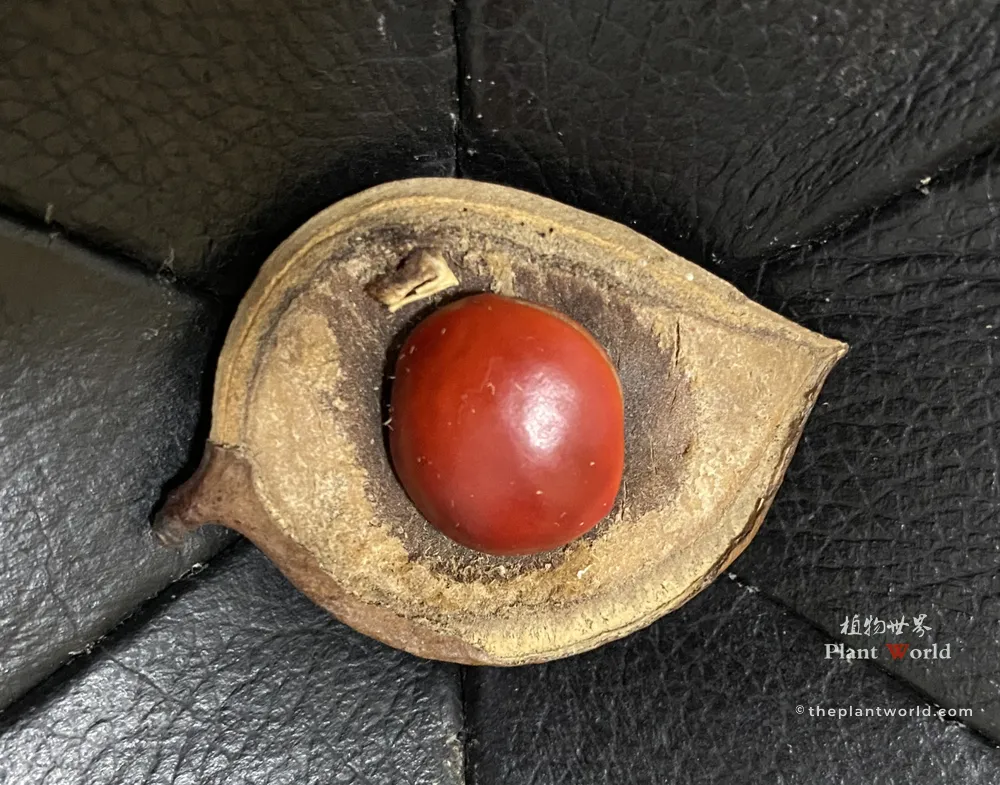
Shiny bright‑red seed of Ormosia hosiei, nestled within its dried split seed pod. This seed originates from the famous 1500‑year‑old ancient tree at Hongdou Courtyard, Gushan, Jiangyin, the iconic “Xiangsi” red bean celebrated in classical Chinese poetry.
📌 Three Kinds of “Red Beans” – Critical Distinction
Three entirely unrelated plant species are casually called “red bean” worldwide. To ensure garden safety and botanical accuracy, do not confuse them:
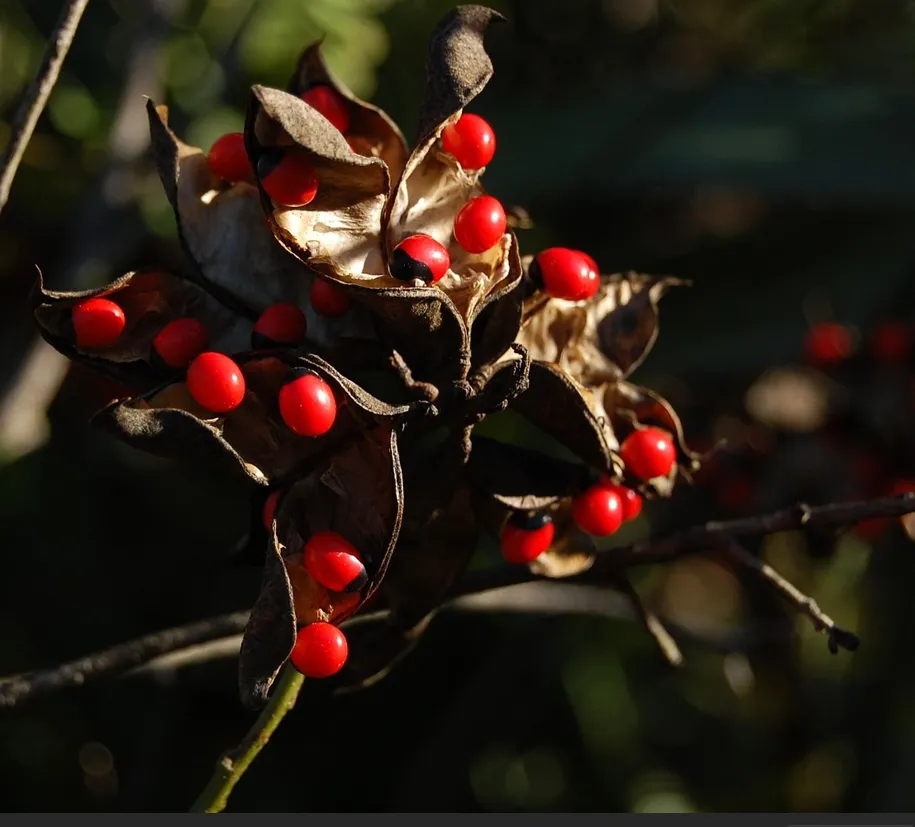
Saga TreeAdenanthera pavoninaRosary Pea (Toxic)Abrus precatoriusTrue Red Bean TreeOrmosia hosiei
Ormosia hosiei (Red Bean Tree): A large, majestic deciduous Chinese native tree. The seeds are fully scarlet. This is the authentic plant celebrated in Wang Wei’s classical literature. It is not violently toxic, though dietary consumption is not advised.
Abrus precatorius (Rosary Pea): A slender, twining climbing vine. The seeds are half red and half black. Highly, violently poisonous. Widely listed as an aggressive invasive weed in warm zones. It has no connection to the literary red bean.
Adenanthera pavonina (Saga Tree): A tropical evergreen tree native to Southeast Asia. It produces all-red seeds often used for prayer beads. It is extremely rare in the temperate Jiangnan region and completely unrelated to ancient Chinese love poetry.
The Living Legends of Jiangsu’s Ancient Trees
Jiangsu Province serves as the absolute epicentre for historical, ancient specimens of Ormosia hosiei, with eight registered ancient trees surviving today, each wrapped in its own moving local lore.
The Zeng Garden Specimen (Changshu)
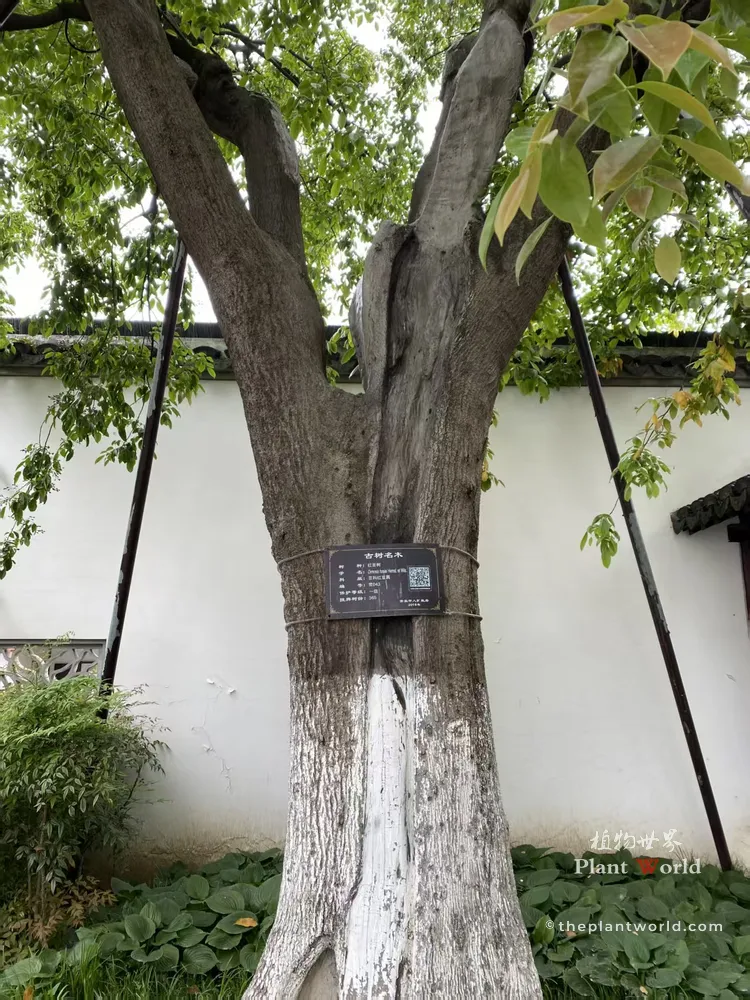
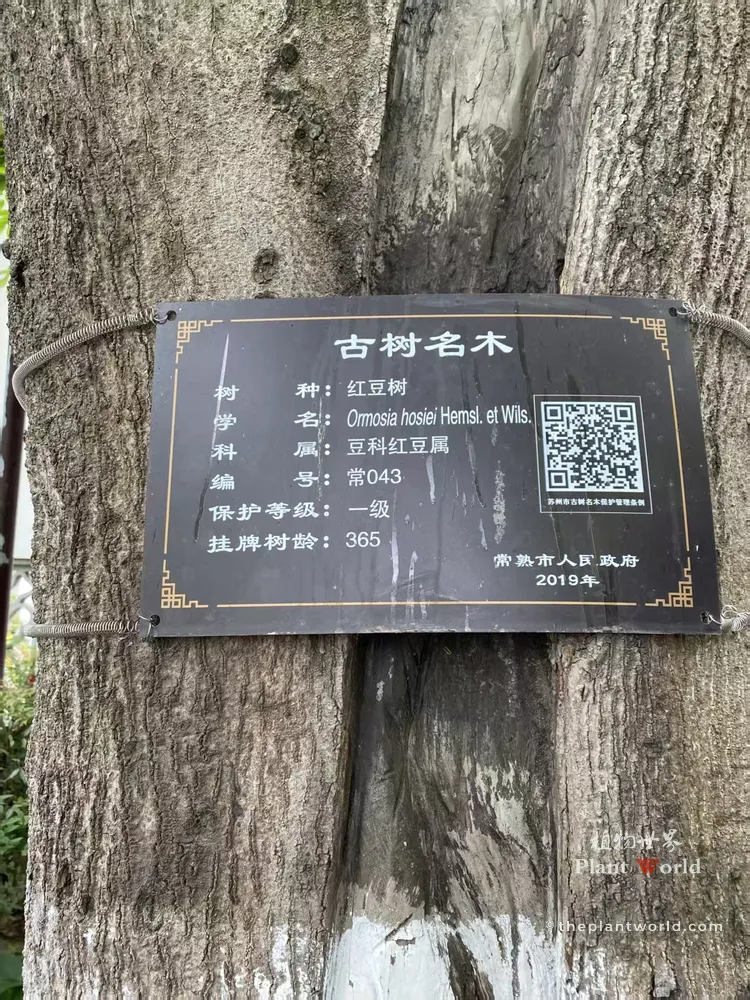
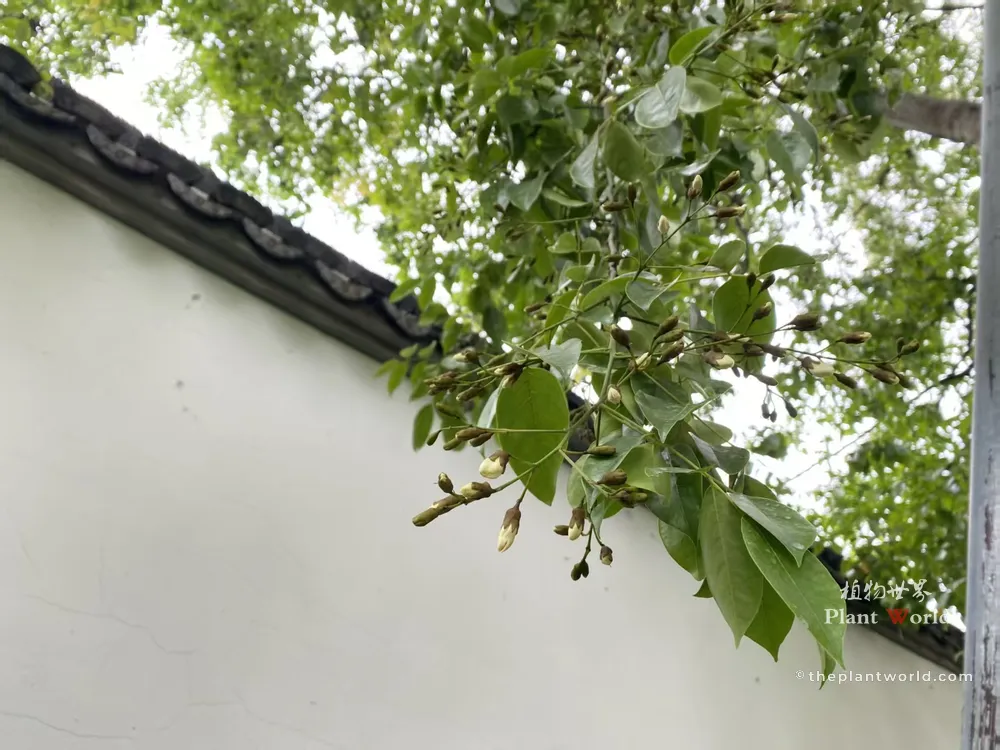
One highly revered specimen grows within the historic Zeng Garden in Changshu. It was planted during the late Ming Dynasty by the imperial censor Qian Dai over 300 years ago. Standing over 10 metres tall, it forms a dense, lush canopy. When I visited the garden in late April, the fresh yellow-green new leaves were just unfurling, and I was fortunate enough to spot rare developing flower buds. Because this specific tree last bloomed back in 2015, encountering its reproductive cycle felt exceptionally auspicious.
Zeng Garden Specimen (365 years old)Official Protection PlaqueFlower Buds (April)
The 1,500-Year-Old Prince’s Tree (Jiangyin)
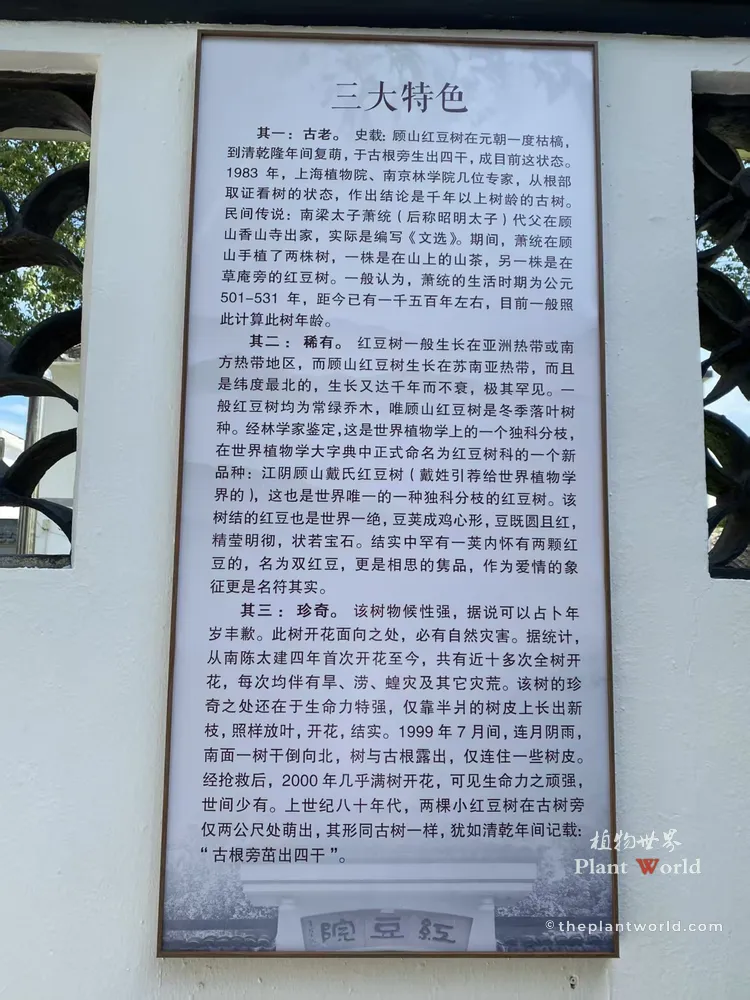
The most renowned ancient Red Bean Tree lives within the Hongdou Courtyard in Gu Shan Town, Jiangyin. Local historical archives trace its lineage directly back to Prince Xiao Tong of the Southern Liang Dynasty, the compiler of the monumental literary anthology Wen Xuan.
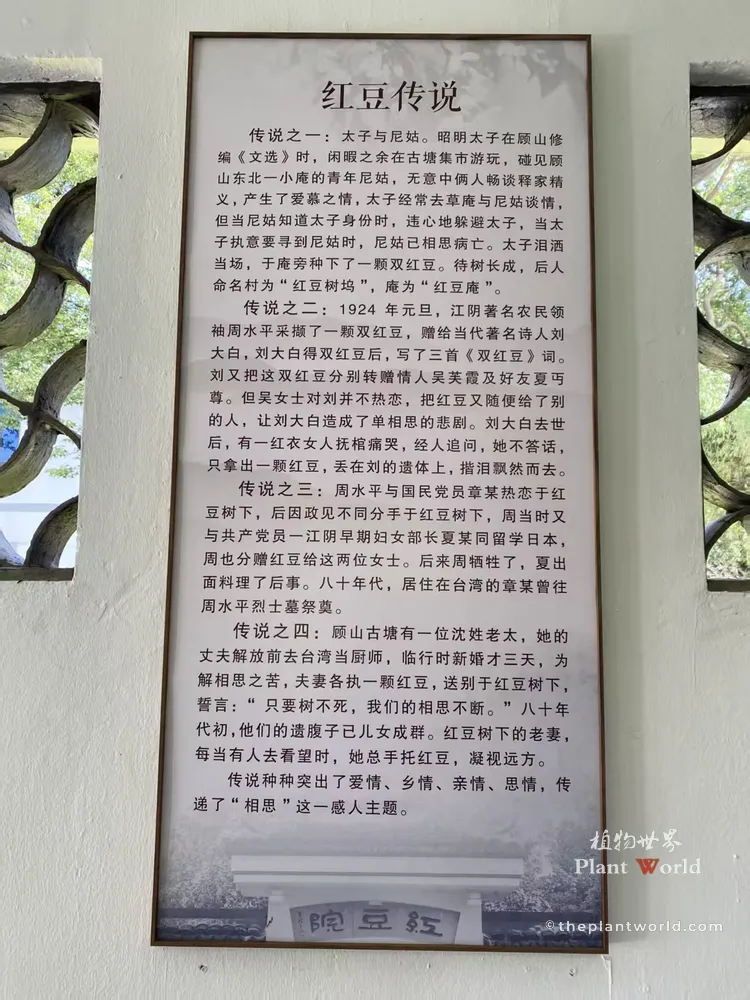
According to local folklore, the young crown prince fell into a forbidden romance with a brilliant Buddhist nun named Huiru. Separated by rigid feudal social barriers, Huiru eventually wasted away from intense longing. Grieving her passing, Xiao Tong planted this specific tree beside her former hermitage, naming the dwelling the Red Bean Hut.
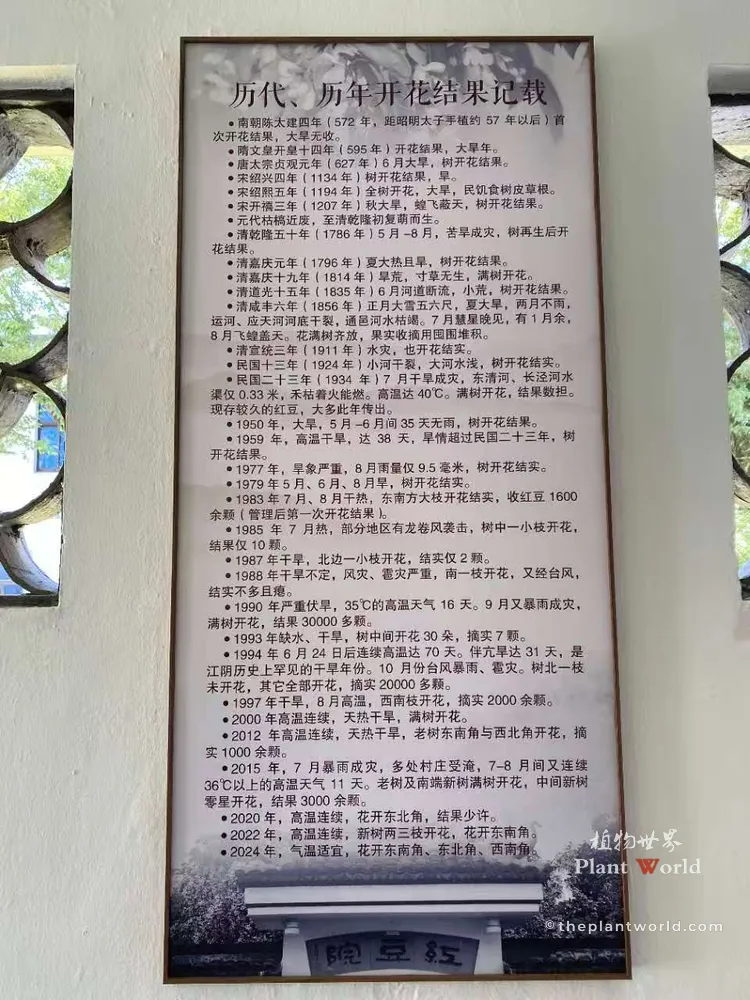
Historical sign in Jiangyin detailing the ancient tree’s unique botanical traits, northern growth limit, and resilience.Cultural display board recording the romantic legends and symbolic meanings of love attached to this ancient tree.Historical archive board documenting the erratic flowering patterns of the tree aligned with past climate extremes since 572 AD.
Botanical surveys confirm the tree trunk is roughly 1,500 years old, matching the exact historical era of Prince Xiao Tong. After nearly dying back during the Yuan Dynasty, the ancient root system miraculously sent up four secondary trunks, meaning the tree stands today as a magnificent formation of five interconnected stems sharing a single root system.
This ancient giant demonstrates unparalleled hardiness. It grows further north than almost any other wild Ormosia hosiei, surviving subtropical Jiangsu winters for fifteen centuries. Following severe storm damage in 1999 that completely exposed its ancient main root structure, it displayed extraordinary survival resilience and burst into a record‑breaking, heavy bloom the very next spring.
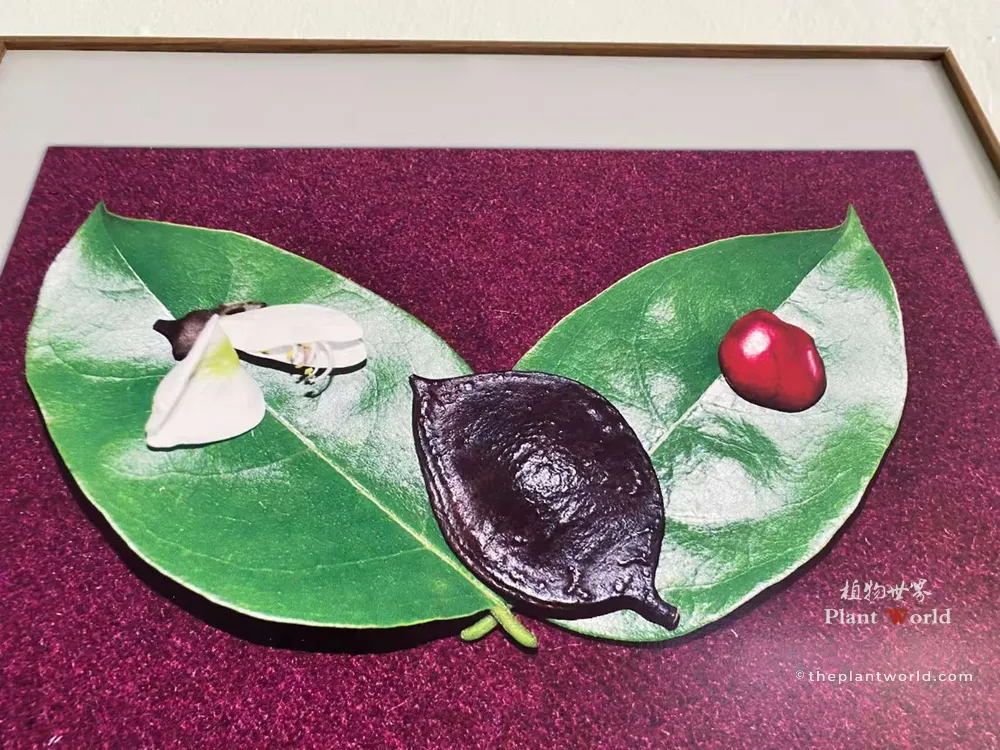
Looking up at the lush canopy of the ancient 1,500-year-old Hongdou tree (Ormosia hosiei) in Jiangyin, Jiangsu, China.Official exhibit photograph of Ormosia hosiei from Gushan Red‑Bean Village, Jiangyin. Displayed elements include compound leaf, white flower, mature dark seed pod and the iconic bright‑red symbolic seed known in Chinese poetry as Xiangsi.
Cultivation & Care Guide for the Red Bean Tree
Hardiness & Climate
USDA Hardiness Zones: 7–10. It tolerates light seasonal winter frosts easily; however, protect young trees with a thick layer of organic root mulch in Zone 7. Gardeners living in colder zones can successfully cultivate it in large containers and move it indoors during freezing weather. It prefers warm temperate and subtropical conditions and struggles in extremely cold continental climates.
Light & Placement
Requirements: Needs full sun to light partial shade. It develops its strongest structural wood and experiences optimal flowering when bathed in ample, unobstructed sunlight. Given its immense long-term scale, it makes a magnificent, long-lived specimen tree for large yards, oriental landscape designs, and quiet courtyard focal points.
Soil & Water
Requires deep, highly fertile, well-drained loamy soil that is neutral to slightly acidic. Avoid compacted grounds and permanently waterlogged sites, which quickly trigger fatal root rot. Water young trees regularly through dry summer spells; mature specimens develop moderate drought tolerance.
Maintenance & Propagation
Carry out light structural pruning exclusively in late winter during dormancy to remove damaged or crossed branches. Avoid heavy canopy cutting, which slows its already deliberate growth rate significantly.
Note: Seed germination is exceptionally slow and requires mechanical scarification followed by cold stratification. Always source certified nursery-grown stock responsibly, as wild trees are strictly protected under national environmental laws. It develops full fruiting ability only once mature, often after many years.
Cultural Heritage & Poetic Symbolism
The Red Bean Tree carries unmatched emotional weight in Chinese tradition. It stands as the ultimate oriental symbol of affection, quiet longing (Xiangsi), faithfulness, good fortune, and longevity.
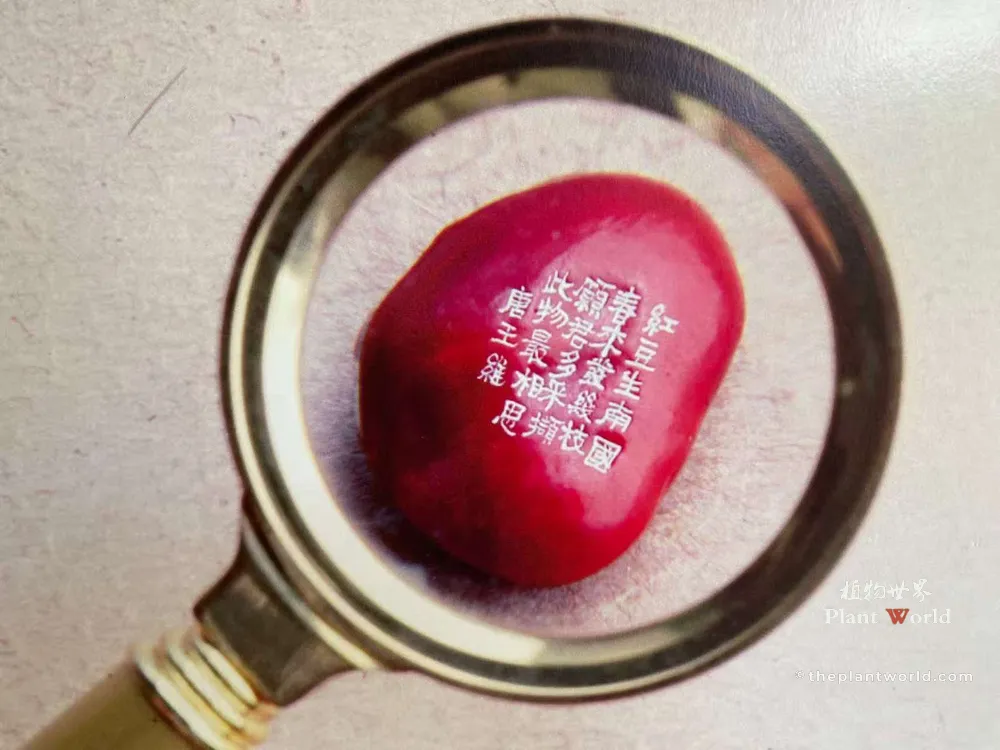
A glossy red seed of Ormosia hosiei under magnifying glass, finely micro‑carved with the famous Tang‑Dynasty poem Red Bean by Wang Wei. This cultural exhibit comes from Gushan Red‑Bean Village, Jiangyin.
The most enduring connection comes from the Tang Dynasty poet Wang Wei, whose piece 相思 (Longing) cemented the plant into the fabric of Asian literature forever:
“Red beans grow in the southern land, When spring arrives, they sprout their lush new shoots. Gather a few more of them, I beg of you, For they best represent longing in this world.”
The poem ensured that these scarlet seeds became a classic token quietly exchanged between separated lovers and lifelong friends. Countless writers from the Song, Yuan, and Qing dynasties continued to weave the Ormosia seed into their lyrical masterworks:
“The exquisitely carved dice hold a red bean safely inside; Who truly understands that my longing for you reaches just as deep into the bone?”
“Red beans are hard and painful to gaze upon, As silent tears of longing fill the eyes.”
“Red bean branches meet amid the misty rain, As if shedding every single drop of longing blood for you.”
“South of the Yangtze, the bitter red bean longing lingers, Every single bloom reminds me of you year after year.”
From ancient temple courtyards to rural homesteads, the tree was admired for its quiet, unrestrained grace. Poets loved comparing its glossy, permanent scarlet seeds to sincere, undying devotion that never fades with time.
Practical Traditional Uses
Artisanal Timber: The dense, beautifully patterned heartwood of Ormosia hosiei is exceptionally durable and highly resistant to rot and wood-boring insects. Historically, it was highly prized for high-end furniture, detailed architectural wood carvings, and traditional craftwork.
Handicrafts: The hard, naturally glossy red seeds are carefully gathered by regional artisans to drill and string into elegant, long-lasting handmade bead bracelets and symbolic amulets.
⚠️ Ethnobotanical Identity Disclaimer: All botanical and cultural information is shared for historical reference only. This content does not constitute medical advice. While the seeds of Ormosia hosiei do not contain the violently lethal compounds found in the unrelated rosary pea (Abrus precatorius), wild plant material should never be consumed. Always identify plants correctly before handling.
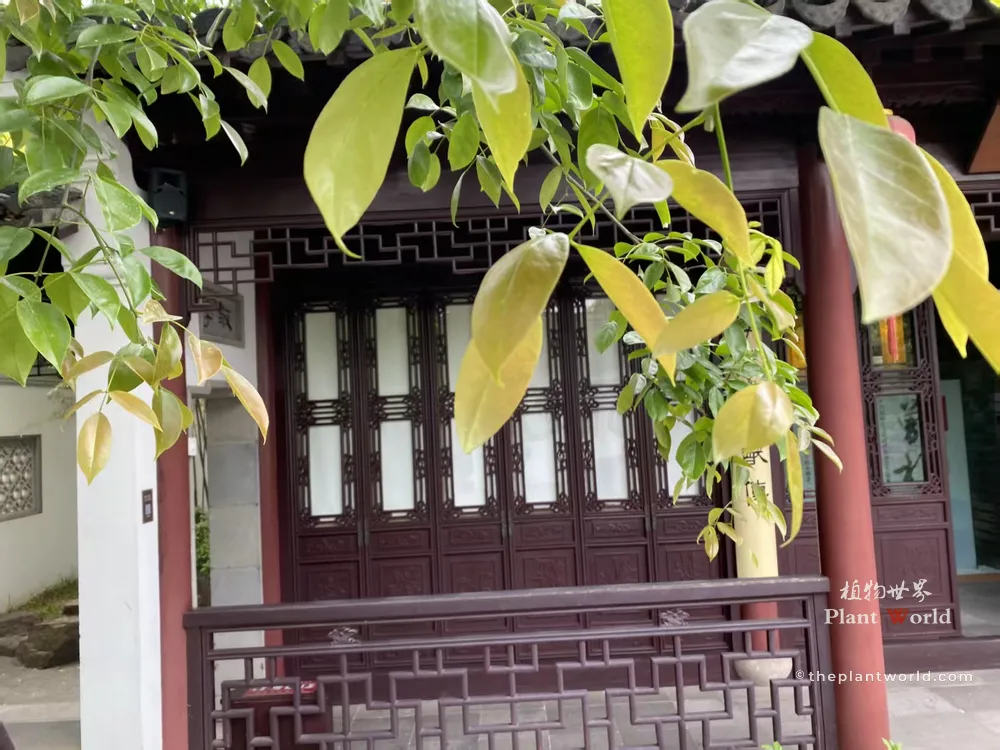
Young leaves of the ancient Ormosia hosiei frame classic Jiangnan courtyard architecture in Zeng Garden.
Final Conclusion
Ormosia hosiei, the Chinese Red Bean Tree, is far more than a standard ornamental shade tree. With its striking ruby-red seeds, slow stately growth, thousand-year temple heritage, and world-famous poetic symbolism, it remains one of the most emotionally resonant native trees from China. If you are searching for a long-lived legacy specimen tree with timeless oriental charm and rich cultural stories, the Red Bean Tree is an exceptional choice.