
Introduction
If someone asks me what flower to grow in winter, I always recommend the Chinese sacred lily. It needs nothing more than a shallow bowl of water and a few pebbles to root, sprout, and bloom.
The narcissus lives up to its name. With green skirts and jade ribbons, it stands gracefully above clear water. Its pure white blossoms are otherworldly, refined and fragrant, utterly captivating — like a fairy stepping lightly across the waves. No wonder Huang Tingjian called it the “Fairy of the Rippling Waves.”
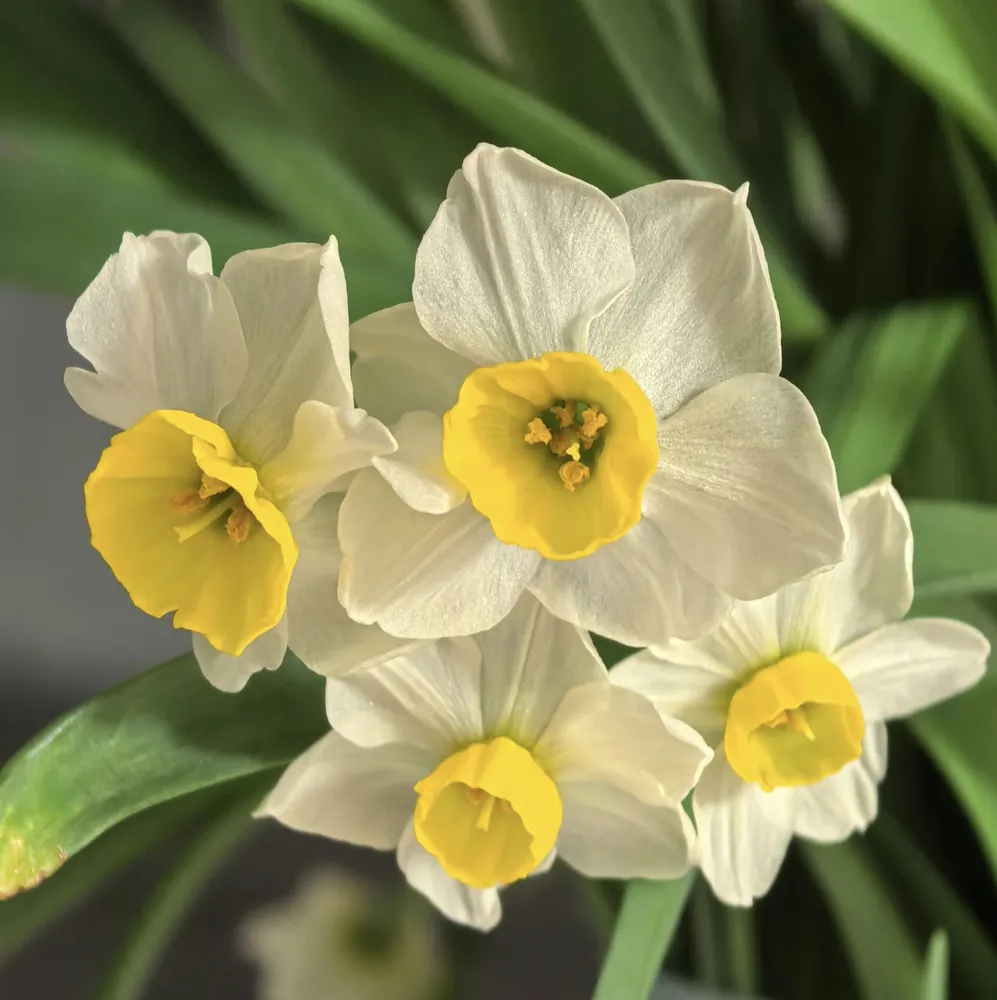
What may come as a surprise is that China’s most beloved winter flower is not native to China at all. It is a subspecies of the bunch-flowered daffodil (Narcissus tazetta), native to the Mediterranean coast. It was brought to China around the Tang Dynasty, cultivated and acclimated for centuries around Zhangzhou in Fujian, and eventually became the distinct Chinese sacred lily (Narcissus tazetta subsp. chinensis).
Not only is it a classic Chinese Garden Plant, it is also one of China’s Ten Famous Flowers. To understand the Chinese narcissus, we need to begin with its classification, varieties, cultural meaning, and care.
- Introduction
- Plant Profile
- Forms: The Standard Single Form and the Double Cultivar
- History and Arrival: From "Naidī" to the Chinese Sacred Lily
- Chinese Sacred Lily Meaning: Good Fortune, Purity, and the New Year Offering
- Narcissus in Poetry: From Huang Tingjian to Yang Wanli
- Uses: Ornamental and Medicinal
- Toxicity and Pet Safety: A Beautiful "Trap"
- Cultivation and Care Guide: The Winter Magic of a Bowl of Water
- Final Thoughts
- References
- More from The Plant World:
Plant Profile
- Scientific Name: Narcissus tazetta subsp. chinensis (syn. N. tazetta var. chinensis)
- Common Names: Chinese Sacred Lily, Chinese Narcissus, Chinese Paperwhite (loose trade name; strictly, “paperwhite” refers to the all-white N. papyraceus)
- Chinese Name: 水仙 (shuǐ xiān); also 凌波仙子 (“Fairy of the Rippling Waves”), 金盏银台 (“Golden Cup on Silver Platform”), 玉玲珑 (“Jade Exquisite”), 落神香妃,雪中花,天蒜,俪兰,女星
- Family: Amaryllidaceae (石蒜科) → Genus Narcissus
- Native Origin: Mediterranean coast (the parent species Narcissus tazetta); introduced to China around the Tang Dynasty and acclimated for centuries around Zhangzhou, Fujian, forming the Chinese subspecies
- Growth Form: Perennial bulbous herb with an ovoid bulb; broad, flat, glaucous-green leaves; umbels of fragrant white flowers
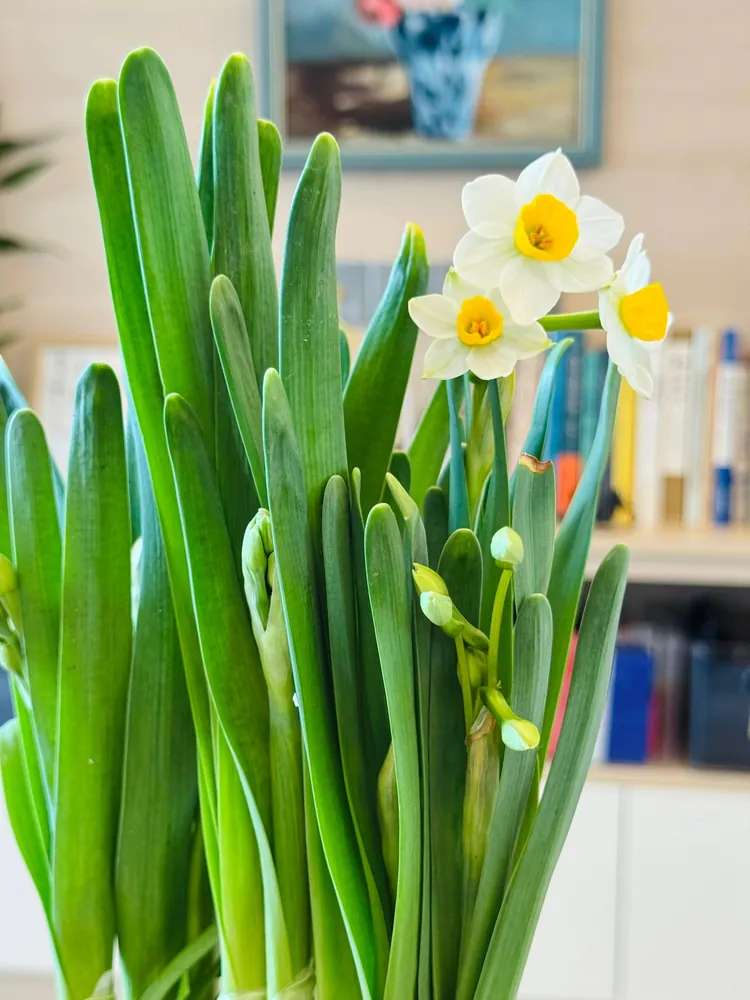
The Chinese sacred lily is a perennial bulbous herb. Its underground bulb is ovoid, resembling an onion or a garlic clove, and stores abundant nutrients — this is precisely why the narcissus can grow and bloom on nothing but clear water. The leaves emerge from the top of the bulb: broad, linear, flat, blunt-tipped, entire, and a distinctive glaucous green. The flowering scape rises almost to the height of the leaves, bearing an umbel of four or more flowers at its apex.
The flower structure is exquisite: six pure white tepals, spreading or slightly nodding, surround a cup-shaped corona (副冠) of bright yellow — white petals with a golden heart, like a golden cup set upon a silver platform. Hence the single-petaled form is called “Golden Cup on Silver Platform” (金盏银台). The fragrance is delicate and refreshing, composed primarily of phenylethyl alcohol, indole, and green-leaf aldehydes — giving a soft white-floral note, a faint animalic warmth, and a vivid green freshness. It blooms in late winter and early spring (January to March), right around the Lunar New Year.
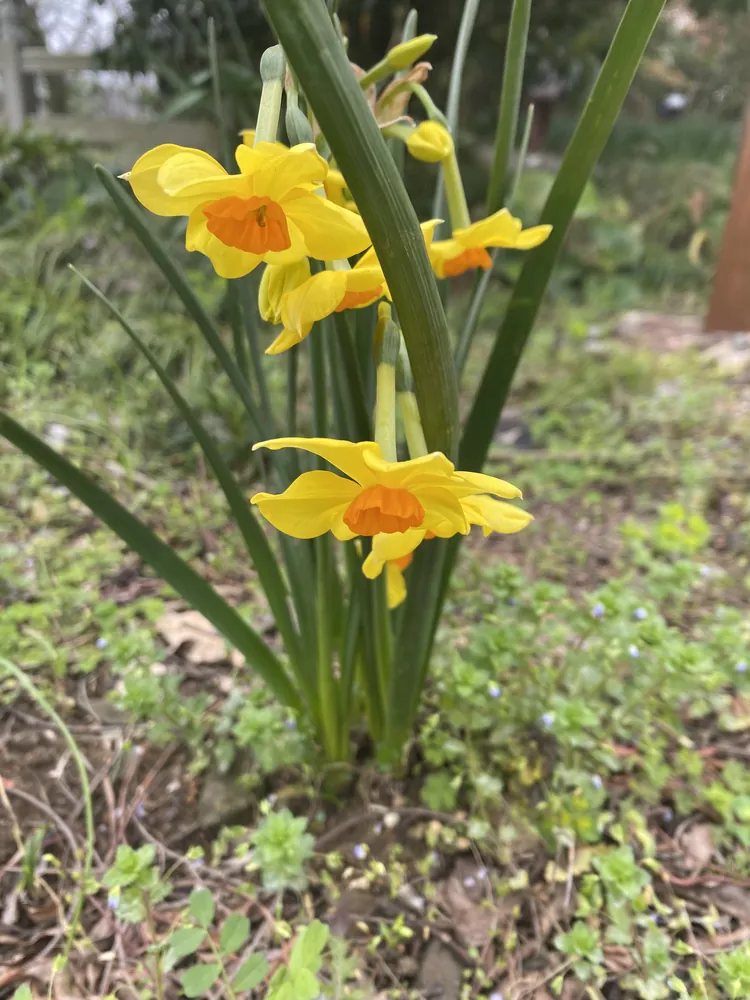
It is worth noting that the Chinese sacred lily differs from the yellow daffodil or trumpet daffodil (Narcissus pseudonarcissus, also called “洋水仙” or Western narcissus). The Chinese sacred lily is a subspecies of N. tazetta, with small, numerous flowers, white petals and a yellow corona, and a rich fragrance. The Western daffodil was introduced from Europe only in the late 19th century; it bears large, solitary flowers in soft, harmonious colors with a lighter scent. Through extensive breeding in the Netherlands, Belgium, and Britain, it now has over 26,000 cultivated varieties, with new ones appearing every year.
Forms: The Standard Single Form and the Double Cultivar
The Chinese sacred lily occurs in two principal horticultural forms. It is important to distinguish them botanically: the single-petaled form is the standard expression of Narcissus tazetta subsp. chinensis, while the double-petaled form is a derived double-flowered cultivar in which the corona and stamens have become petaloid.
Single-Petaled: Golden Cup on Silver Platform (金盏银台) — The Standard Form
The single-petaled form, named “Golden Cup on Silver Platform” (also called 玉台金盏,”Jade Platform Golden Cup”), is the standard botanical form of Narcissus tazetta subsp. chinensis. The six tepals are pure white and spreading; the cup-shaped corona is bright golden yellow, set in the center of the flower — like a golden cup resting on a silver platform. The form is elegant and the fragrance rich. This is the most common and most widely cultivated Chinese sacred lily.
Double-Petaled: Jade Exquisite (玉玲珑) — The Double Cultivar
The double-petaled form, called “Hundred-Petal Narcissus” (百叶水仙) or “Jade Exquisite” (玉玲珑), is a double-flowered cultivar (often listed botanically as Narcissus tazetta ‘Flore Pleno’ or N. tazetta subsp. chinensis var. plena). In this form, the corona and stamens have become petaloid, producing more than ten petals curled into a cluster; the lower part of the corolla is pale yellow and the upper part pale white. The flower form is more elaborate and full, but the fragrance is slightly lighter than the single-petaled standard form.
Zhangzhou Narcissus: The Standard of Chinese Sacred Lilies
China’s most famous narcissus-producing region is Zhangzhou in Fujian Province. Zhangzhou’s unique geography — the alluvial plain of the Jiulong River, a mild and humid climate, and fertile soil — is ideal for outdoor narcissus cultivation. As a result, Zhangzhou narcissus bulbs are large, produce multiple flower scapes, and have an intense fragrance unmatched by bulbs from other regions. The Zhangzhou narcissus carving technique is even a national intangible cultural heritage: by carving the bulb, artisans can shape the plant into intricate forms. Besides Zhangzhou, Zhoushan in Zhejiang and Shanghai are also important producing regions.
History and Arrival: From “Naidī” to the Chinese Sacred Lily
The Chinese sacred lily is not native to China, and its introduction has a clear historical trail.
The Earliest Record: “Naidī” in the Tang Dynasty Youyang Zazu
The earliest Chinese record of the narcissus appears in the Tang Dynasty compilation Youyang Zazu (《酉阳杂俎》) by Duan Chengshi, where it is called “naidī” (奈袛):
“Naidī comes from the country of Fulin. Its root is as large as an egg; its leaves are three to four chi long, resembling garlic. A stalk rises from the center, and at its tip flowers bloom — six-petaled, red-white, with a yellow-red heart. It does not set seed; it grows in winter and dies in summer.”
“Naidī” may be a transliteration of the Persian name “Nargi” or the Arabic name “Narkim,” while “Fulin” refers to the Eastern Roman Byzantine Empire (in present-day Turkey). This passage accurately describes the narcissus’s bulb (root as large as an egg), leaves (resembling garlic), six-petaled flowers, yellow-red heart, and winter-growth, summer-dormancy cycle — the earliest clear record of the narcissus in Chinese literature.
Introduction and Acclimation: From the Mediterranean to Zhangzhou
The parent species Narcissus tazetta is native to the Mediterranean coast and is common in Italy and Spain. Around the Tang or Tang-Song period, it was brought to China via maritime trade and cultivated for centuries around Zhangzhou in Fujian, eventually forming a stable local strain — the Chinese sacred lily (Narcissus tazetta subsp. chinensis).
Compared with the Mediterranean parent species, the Chinese sacred lily has changed significantly: the original N. tazetta has relatively large, bright yellow flowers with a faint scent, while the Chinese subspecies has white flowers and a rich fragrance — the result of centuries of artificial selection. The Chinese sacred lily reproduces mainly by bulb division and has rarely participated in modern horticultural hybridization, so it has retained relatively stable strain characteristics.
Today, the narcissus is a traditional Chinese ornamental flower and one of the Ten Famous Flowers of China. Worldwide, the Chinese sacred lily is found only in the warm, humid coastal regions of China, Japan, and Korea.
Chinese Sacred Lily Meaning: Good Fortune, Purity, and the New Year Offering
In Chinese culture, the meaning of the narcissus is multilayered — it is the Lunar New Year flower of good fortune and reunion, the pure and elegant Fairy of the Rippling Waves, and the scholar’s desk companion of refined simplicity.
One of the Four Refined Flowers and the Four Friends of Snow
The narcissus holds a special place in traditional Chinese flower culture:
- The “Four Refined Flowers” (花中四雅): The narcissus, together with the orchid, chrysanthemum, and calamus, is known as one of the “Four Refined Flowers” — four flowers celebrated for their elegance, representing the noble character the literati aspired to.
- The “Four Friends of Snow” (雪中四友): The narcissus, together with the plum blossom, camellia, and winter jasmine, is known as one of the “Four Friends of Snow” — four flowers that bloom in the depths of winter, symbolizing resilience and hope.
Both groupings highlight the narcissus’s unique position among winter flowers: it unfurls its green leaves and releases its fragrance in the coldest months, when all other flowers have faded, bringing life and scent to a desolate season.
The New Year Offering: The Lunar New Year Flower
The narcissus’s most important cultural identity is as the “year-end offering” (岁朝清供) flower of the Lunar New Year.
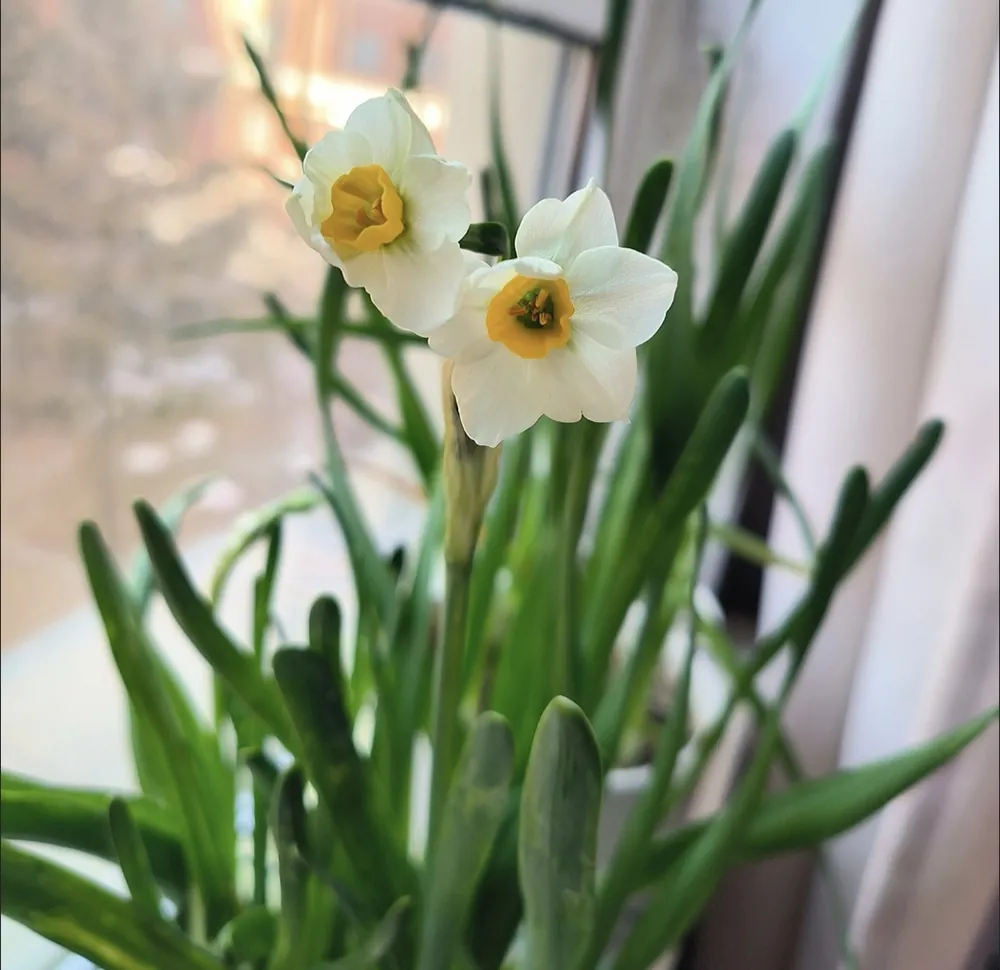
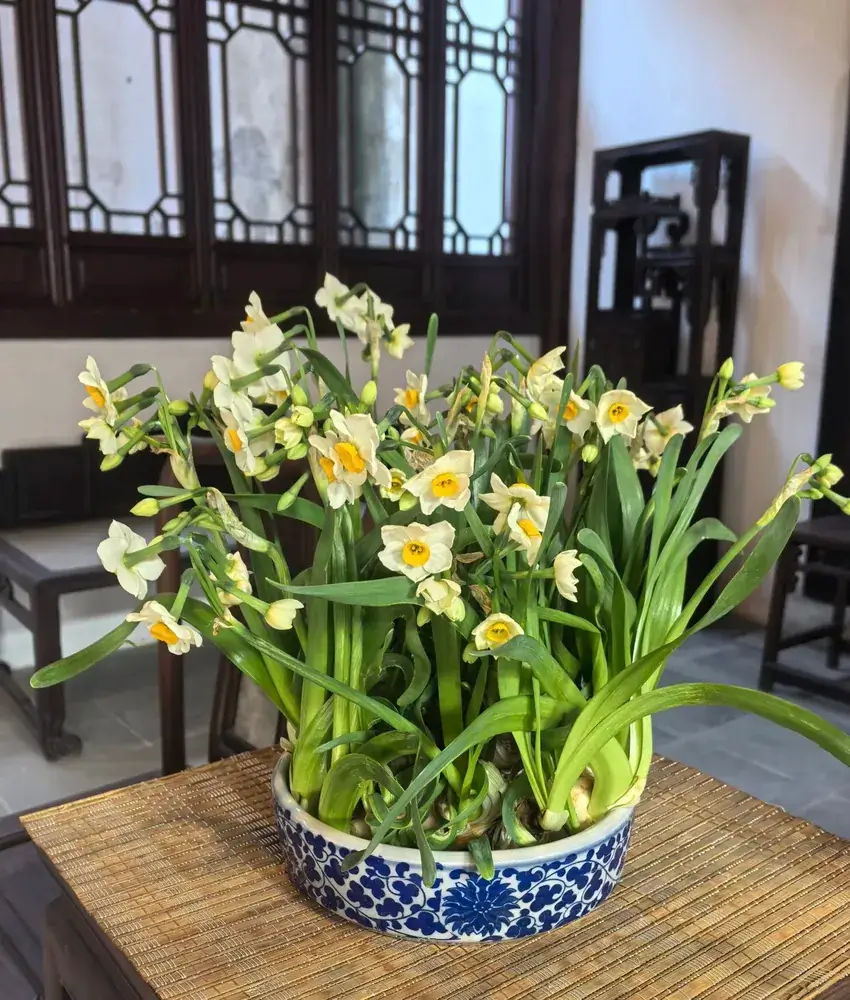
“Sui chao” refers to the first day of the lunar new year, and “qing gong” means a refined offering. Every Spring Festival, Chinese people traditionally place a bowl of narcissus on their desk or windowsill — it needs only a dish of clear water and a few pebbles to bloom in the depths of winter, filling the room with spring vitality and auspicious warmth. People use it to celebrate the new year, symbolizing good fortune, family reunion, purity, and nobility.
If the narcissus happens to bloom precisely during the Lunar New Year, it is considered an especially auspicious sign of good luck and prosperity for the coming year. For this reason, every winter, households buy narcissus bulbs to grow in water, carefully timing the bloom so that the flowers open on New Year’s Day — a uniquely Chinese winter ritual.
The Fairy of the Rippling Waves: A Symbol of Purity and Elegance
The narcissus’s form — standing gracefully above clear water, its pure white blossoms otherworldly — naturally connects with the imagery of “purity,” “elegance,” and “transcendence.”
The Northern Song poet Huang Tingjian loved narcissus more than any other flower and wrote many poems in its praise. In his “Fifty Sprays of Narcissus Sent by Wang Chongdao,” he wrote:
“The Fairy of the Rippling Waves rises in socks of dust, / stepping lightly across the water beneath a faint moon.”
Comparing the narcissus to a fairy stepping lightly across the waves — this metaphor has since become the narcissus’s most classic cultural symbol. The “Fairy of the Rippling Waves” describes not only the flower’s physical beauty but also endows it with a spiritual quality of being otherworldly and untouched by mortal concerns.
The Southern Song poet Yang Wanli praised the narcissus in his poem “Narcissus”:
“Its charm is supreme, its fragrance supreme; / the flower is clearer than the moon’s clarity. / A heavenly fairy walks not upon the earth, / but borrows water as her name.”
“A heavenly fairy walks not upon the earth, but borrows water as her name” — the fairy does not set foot on the ground, but takes her name from water. The narcissus’s very name combines “water” (水) and “fairy” (仙); it needs no soil, blooming on nothing but clear water, just as a fairy needs no mortal sustenance. This unique way of growing makes the narcissus a symbol of purity, elegance, and transcendence.
It is one of the most beloved subjects in all of Chinese flower symbolism.
Narcissus in Poetry: From Huang Tingjian to Yang Wanli
After its introduction to China, the narcissus was beloved by literati and poets, who left many verses praising its beauty.
Huang Tingjian (Northern Song): The Fairy of the Rippling Waves
Huang Tingjian was history’s most devoted narcissus lover. Besides the famous line about the “Fairy of the Rippling Waves,” he also wrote:
“Fragrant and pure of form, it would outshine a city; /the sweet box (山矾) is its younger brother, the plum its elder. / Sitting before it, I am truly vexed by the flower; /stepping out, I laugh — and the great river stretches across the horizon.”
“Fragrant and pure of form, it would outshine a city” — the narcissus, bearing fragrance and a pure form, is beautiful enough to outshine an entire city. “The sweet box is its younger brother, the plum its elder” — placing the narcissus alongside the sweet box (Symplocos) and the plum blossom shows its standing in the poet’s heart.
Yang Wanli (Southern Song): A Heavenly Fairy Walks Not Upon the Earth
Yang Wanli’s “Narcissus” is short and powerful:
“Its charm is supreme, its fragrance supreme; / the flower is clearer than the moon’s clarity. / A heavenly fairy walks not upon the earth, / but borrows water as her name.”
In twenty characters, he captures the narcissus’s charm and the origin of its name.
Jiang Teli (Song): Its Fragrance Confidently Surpasses All Flowers
Jiang Teli’s “Narcissus” reads:
“Six-petaled jade plate with a golden curved cup, / a flowering stalk rises from a grove of green jade. / Its pure fragrance confidently surpasses all flowers, / so it blooms alongside the red plum.”
“Six-petaled jade plate with a golden curved cup” — the six tepals form a jade plate, and the golden corona is a curved cup. “Its pure fragrance confidently surpasses all flowers” — the narcissus’s confidence in its own fragrance is precisely the literati’s self-portrait of noble character.
These poems, whether describing the narcissus’s charm or praising its character, flow with elegant grace, adding luster to this famous flower.
Uses: Ornamental and Medicinal
The narcissus is not only an ornamental flower but also has some medicinal value — but it must be emphasized that the entire plant is toxic, and medicinal use requires strict medical supervision and should never be self-administered internally.
Ornamental
The narcissus is one of China’s most important winter indoor ornamental flowers. A single bowl in a room — with its verdant leaves, white flowers like jade, golden hearts like gold, and a refreshing fragrance filling the air — brings life and the feeling of spring to a desolate winter. Narcissus can be grown in water and displayed in studies, living rooms, and on desks; it can also be carved and shaped (the Zhangzhou narcissus carving technique) into intricate bonsai forms. During the Lunar New Year, the narcissus is an indispensable “year-end offering.”
Medicinal (Traditional)
The flowers and bulbs of the narcissus are used in traditional Chinese medicine, but because of their toxicity, they are mostly applied externally:
- Narcissus flower (水仙花): Pungent in flavor, cool in nature, mildly toxic. Functions: clears heat and resolves toxins, disperses nodules and reduces swelling. Indications: early-stage boils and sores with redness, swelling, heat, and pain.
- Narcissus bulb /root (水仙根): Bitter, slightly pungent, cold in nature, toxic. Functions: clears heat and resolves toxins, disperses nodules and reduces swelling. External use for carbuncles, sores, insect bites, breast abscesses, and scrofula.
⚠️ Important safety disclaimer: The entire narcissus plant is toxic, with the bulb being the most poisonous part. It must never be ingested internally. Traditional medicinal use is almost exclusively external and should be done only under the guidance of a qualified healthcare professional. Accidental ingestion of the bulb can cause severe poisoning — see the “Toxicity and Pet Safety” section below.
Toxicity and Pet Safety: A Beautiful “Trap”
The narcissus may be beautiful and elegant, but it is a plant toxic in all its parts — in recent years, it has been listed by multiple regional CDC centers as a key monitored plant-borne foodborne illness during the Spring Festival season.
Toxic Compounds
The entire plant is toxic, but the most poisonous part is the bulb — that white, onion- or garlic-like sphere. It contains a variety of steroidal alkaloids, primarily:
- Lycorine (石蒜碱): The primary toxic compound, causing vomiting and diarrhea; at high doses, it can lead to neurological and cardiac toxicity.
- Pseudolycorine, narcissine (多花水仙碱), galantamine (加兰他敏), narciclasine (水仙克拉辛), and others.
These alkaloids are present throughout the plant, but in the highest concentration in the bulb. The leaves, flowers, stems, sap, and even the water from a forced-bulb display also contain toxins.
Poisoning Symptoms in Humans
Common symptoms after accidental ingestion include: drooling, nausea, vomiting, diarrhea, abdominal pain, loss of appetite, lethargy, and dehydration. Severe poisoning can cause: profound weakness, hypothermia, low blood pressure, bradycardia (slow heart rate), respiratory depression, convulsions, coma, and even death. Symptoms may appear within 15 minutes of ingestion or be delayed for several hours.
The narcissus bulb is often mistaken for an onion or garlic and eaten — this is the most common cause of poisoning. For this reason, when growing narcissus at home, the bulb should be kept out of reach of children and pets and never stored with food.
Pet Safety
The American ASPCA (American Society for the Prevention of Cruelty to Animals) explicitly lists the genus Narcissus spp. as toxic to dogs, cats, and horses.
- Toxic compounds: Lycorine and other phenanthridine alkaloids.
- Most dangerous part: The bulbs (“bulbs are the most poisonous part”).
- Clinical symptoms: Drooling, vomiting, diarrhea, abdominal pain, lethargy, low blood pressure, bradycardia, convulsions, and potentially death in severe cases.
- Cats are particularly sensitive to narcissus toxins; there are documented cases of cats ingesting dried narcissus stems and developing severe hypothermia, bradycardia, and hypotension.
⚠️ Pet safety note: Households with cats or dogs should place narcissus completely out of pets’ reach. The water from a forced-bulb display also contains toxins — prevent pets from drinking it. If you suspect your pet has ingested any part of a narcissus (including the bulb, leaves, flowers, or the water), contact your veterinarian or the ASPCA Animal Poison Control Center immediately.
Cultivation and Care Guide: The Winter Magic of a Bowl of Water
Caring for the narcissus is among the simplest of all bulb flowers — with nothing more than a bowl of water, you can enjoy a winter of fragrance.
Choosing the Bulb
Select plump, firm bulbs with no mold or mechanical damage, ideally 4 cm or more in diameter. Zhangzhou-produced bulbs are of the highest quality and typically produce multiple flower scapes from a single bulb. When buying, distinguish between “single-scape” and “multi-scape” bulbs — multi-scape bulbs produce more flowers.
Water-Growing Steps
- Prepare the bulb: Peel off the dry, brown outer skin to reveal the white bulb. Soak the bulb in clean water for 1 to 2 days to let it absorb water fully and to wash away the mucus from any cuts.
- Potting: Place the bulb in a shallow narcissus bowl with the root plate facing down. You can fill pebbles, rainflower stones, or quartz sand around the bulb to hold it upright and add decorative appeal.
- Adding water: Add clean water so that the level just covers the root plate by 1 to 2 cm. Never submerge the bulb itself — this will cause rot. Tap water should be left to stand for 24 hours to dechlorinate before use.
Daily Care
- Water changes: In the early stage (before roots form), change the water once a day to keep it clean. Once roots are established, change the water every 2 to 3 days. When changing water, gently rinse the bulb and roots to remove mucus.
- Temperature: The narcissus prefers cool conditions, with an optimal growing temperature of 10 to 18°C, and should not exceed 20°C. Excessively high temperatures cause leggy growth, weak flower scapes, easy lodging, and a shortened bloom period. It can tolerate temperatures around 0°C.
- Light: Provide at least 4 to 6 hours of light per day. Adequate light produces short, sturdy leaves, upright flower scapes, and vivid flower colors; insufficient light causes leggy, lodging growth and sparse flowering. In autumn and winter, when sunlight is gentle, place it on a sunny windowsill.
- Ventilation: Keep the environment well-ventilated to reduce disease and leggy growth.
Controlling the Bloom Time
From water-growing to flowering, it generally takes 30 to 45 days, depending on temperature. You can control the bloom time using temperature:
- Higher temperature = earlier bloom: If you want it to flower early for the Lunar New Year, slightly raise the ambient temperature (but not above 20°C).
- Lower temperature = later bloom: If you want to delay flowering, lower the ambient temperature.
- After flowering, lowering the temperature can extend the bloom period (at around 10°C, flowers can last 2 to 3 weeks).
Carving and Shaping (Advanced)
The Zhangzhou narcissus carving technique is a national intangible cultural heritage. By using a carving knife to remove parts of the bulb scales and leaves, artisans can control the direction of leaf growth and shape the plant into various forms (baskets, roosters, peacocks, etc.). Carved bulbs must be soaked and rinsed to remove mucus before water-growing. Beginners can start with the simple “crab claw” form.
After-Flower Care
After a water-grown Chinese sacred lily blooms, the bulb’s nutrients are depleted, and it is usually discarded. If you wish to keep it, cut off the flower scape after blooming, continue water-growing the leaves until they wither, then remove the bulb, dry it, and replant in autumn — but water-grown bulbs usually produce inferior flowers the second year, so buying fresh bulbs each year is generally simpler.
Final Thoughts
The narcissus is a flower that perfectly unites elegance, good fortune, and practicality.
It is the “naidī” from the country of Fulin in the Tang Dynasty Youyang Zazu; it is Huang Tingjian’s “Fairy of the Rippling Waves rising in socks of dust”; it is Yang Wanli’s “heavenly fairy who walks not upon the earth, but borrows water as her name”; it is the auspicious “year-end offering” flower on the Lunar New Year desk; and it is the ever-changing carving art in the hands of Zhangzhou artisans.
The meaning of the Chinese sacred lily in China lies in the Lunar New Year blessing of good fortune and reunion, the pure and elegant Fairy of the Rippling Waves, the literati’s character among the Four Refined Flowers, and the winter miracle that blooms from nothing but a bowl of water. It can be admired, used medicinally (externally), and carved into art — but it is also toxic in all its parts, with the bulb being the most poisonous, requiring us to maintain a measure of reverence even as we enjoy its beauty.
“Fragrant and pure of form, it would outshine a city; the sweet box is its younger brother, the plum its elder.” In the depths of winter, when all flowers have faded, the narcissus stands gracefully in a dish of clear water, its pure white blossoms releasing a delicate fragrance — this is the uniquely Chinese romance of winter, and the gentle greeting of the Fairy of the Rippling Waves across a thousand years. It remains a timeless chapter in Chinese plant culture.
References
Plants of the World Online (POWO). Narcissus tazetta subsp. chinensis (Roem. & Schult.) Masam. & Yanagita. Royal Botanic Gardens, Kew. — Authoritative taxonomic database.
Duan Chengshi, Youyang Zazu (《酉阳杂俎》, Tang Dynasty) — Earliest Chinese historical record documenting the arrival of “naidī” from Fulin (Byzantine Empire).
Huang Tingjian & Yang Wanli, Song Dynasty Poetry Collections — Historical literary source introducing the timeless metaphor “Fairy of the Rippling Waves” (凌波仙子).
ASPCA Animal Poison Control Center. “Daffodil (Narcissus spp.) Toxic Plant Database” — Official veterinary reference for pet toxicity and lycorine poisoning.
Beijing Municipal Health Commission. “Spring Festival Health Advisory: Plant Toxicity & Food Safety” — Public safety guidance on indoor narcissus positioning and ingestion risks.
More from The Plant World:
- Chinese Wingnut: The Romantic “Ingot Tree” and Its Cultural Charm
- Plum Blossom Meaning: Symbolism & Cultural Significance
- The Hidden Meanings Behind Red Plum Blossoms
- Chinese Wisteria: History, Symbolism, and Identification
- Peach Blossoms in China: History, Culture, and Symbolism
- Chinese Crepe Myrtle: Guide to Origins & Symbolism
- Ginkgo Leaf Meaning: 5 Secrets of This Ancient Fossil
- Chinese Loquat Tree: Guide to Benefits & History
- Rose of Sharon Tree: Guide to Meaning & Care
- Hosta Plant Benefits: 5 Surprising Uses & Planting Guide
- Strawberry Begonia Care: How to Grow Saxifraga Stolonifera
Discover more from The Plant World
Subscribe to get the latest posts sent to your email.