
Introduction
Summer marks the blooming season of daylilies. With orchid‑like foliage, elegant upright flower scapes, slender buds, and wide‑open blossoms, daylilies come in brilliant golden‑yellow, soft buttery yellow, and warm orange‑red hues. Graceful and charming, they hold an important place among Chinese garden plants.
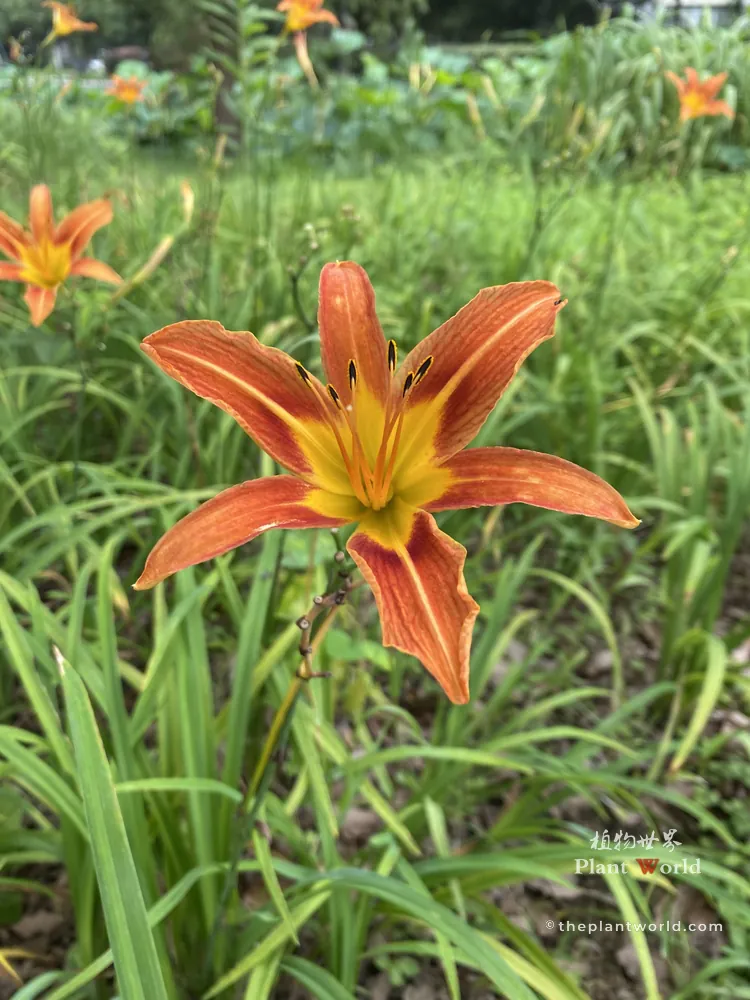
The daylily has a well-known English name — Daylily, literally “lily of a day” — because each individual flower blooms for only one day: it opens at dawn and withers at dusk, while new buds take their place the next morning. A single daylily plant can bloom for over forty days, with fresh flowers every day, in an endless cycle of renewal.
But few people know that this common summer flower is China’s mother flower, with a cultural tradition spanning three thousand years — predating the Western carnation as a symbol of motherhood by more than two millennia. It is also called the “forget-sorrow grass” (忘忧草), planted by a son in his mother’s courtyard before he departs on a long journey; and the “boy-bringing grass” (宜男草), an auspicious symbol of fertility and longevity in traditional Chinese art. To understand the daylily and its symbolism and Chinese meaning, you have to start with its taxonomy, the critical distinction between ornamental daylilies and edible yellow daylilies, its cultural symbolism, and its care.
- Introduction
- Plant Profile
- A Critical Distinction: Daylily Is Not the Edible "Yellow Daylily"
- Daylily Chinese Meaning: Mother Flower, Forget-Sorrow Grass, and Boy-Bringing Grass
- Daylilies in Poetry: From Xu Mian to Su Shi
- Uses: Ornamental, Edible, and Medicinal
- Toxicity and Pet Safety: Deadly to Cats, Non-Toxic to Dogs
- Cultivation and Care Guide
- Final Thoughts
- References
- More from The Plant World:
Plant Profile
- Scientific Name: Hemerocallis fulva L. (orange daylily / 萱草); the edible species is Hemerocallis citrina Baroni (yellow daylily / 黄花菜,golden needles)
- Common Names: Daylily, Orange Daylily, Tiger Lily (loose)
- Chinese Name: 萱草 (xuān cǎo); also 忘忧草 (“forget-sorrow grass”), 宜男草 (“boy-bringing grass”), 谖草,鹿葱,金针菜 / 黄花菜 (edible yellow daylily)
- Family: Asphodelaceae (阿福花科;formerly placed in Liliaceae, the lily family) → Genus Hemerocallis
- Native Range: Native to south-central China and distributed across East Asia; widely introduced and naturalized in Europe and North America
- Growth Form: Perennial herbaceous clump-forming plant with long, basal, strap-like leaves; erect flower scapes; each individual flower blooms for only one day (hence “Daylily”)
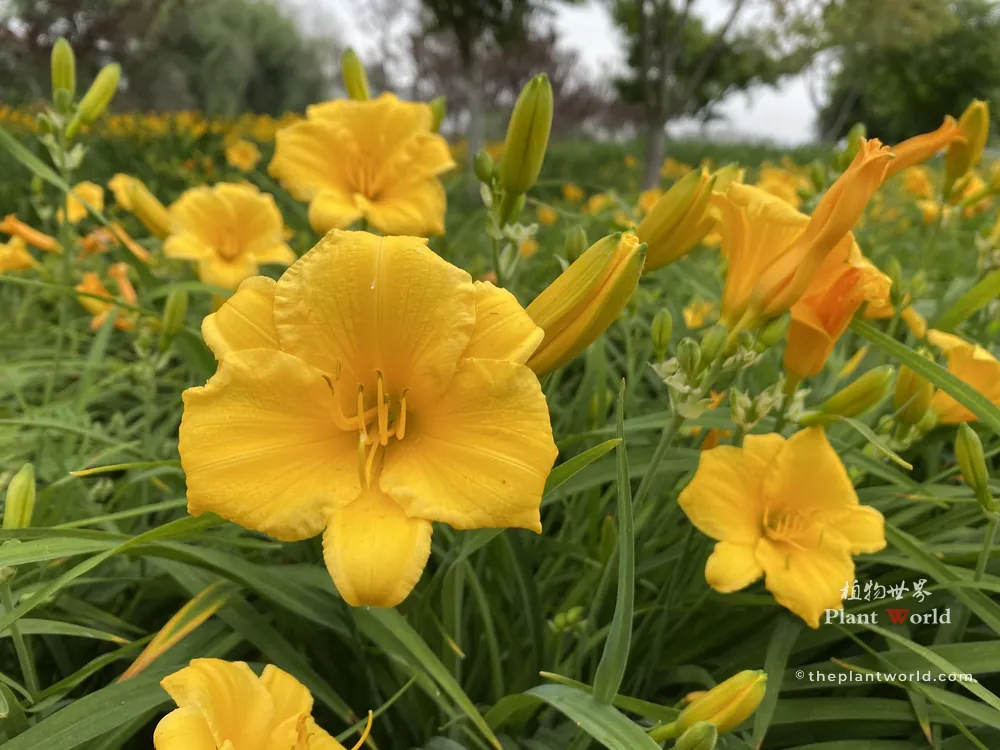
The daylily is a perennial herbaceous plant. Its leaves grow in dense clumps from the base — long, strap-like, resembling orchid leaves, soft and emerald green. The flower scape rises from among the leaves, tall and graceful, bearing a raceme or panicle of several to a dozen or more flowers at its apex. The buds are slender; when open, the six tepals spread wide in a funnel or trumpet shape.
The daylily’s most distinctive biological trait is that each flower blooms for only one day: opening at dawn and fading at dusk, with new buds taking over the next morning. This is precisely how it got its English name, Daylily (“lily of a day”). The overall bloom period of a single plant can last from June through August, with fresh flowers every day for over forty days. Flower colors are rich — gold, butter-yellow, orange-red, tangerine — and horticultural varieties now number in the tens of thousands.
It is worth noting that the daylily’s taxonomic placement has shifted over time: traditionally, the genus Hemerocallis was placed in the lily family (Liliaceae). In 1985, the Danish botanist Dahlgren and colleagues proposed moving it to its own family, Hemerocallidaceae. The modern APG classification system places it in the Asphodelaceae (asphodel family).
A Critical Distinction: Daylily Is Not the Edible “Yellow Daylily”
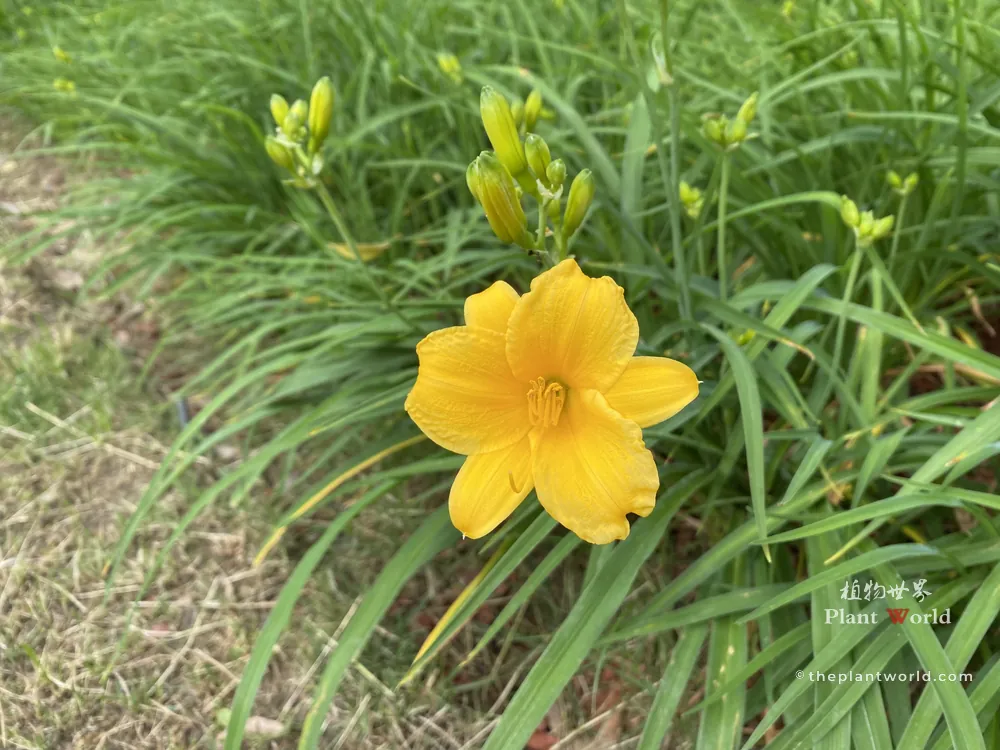
This is the most important clarification in any article about daylilies. Many people confuse the ornamental daylily with the edible yellow daylily, and some even pick daylily flowers from roadside plantings to eat — this is extremely dangerous.
The ornamental daylily (Hemerocallis fulva) and the edible yellow daylily (Hemerocallis citrina, also called golden needles or 黄花菜) are close relatives in the same genus Hemerocallis and look similar, but they are different species. The key differences are:
| Trait | Ornamental Daylily (H. fulva) | Edible Yellow Daylily (H. citrina) |
|---|---|---|
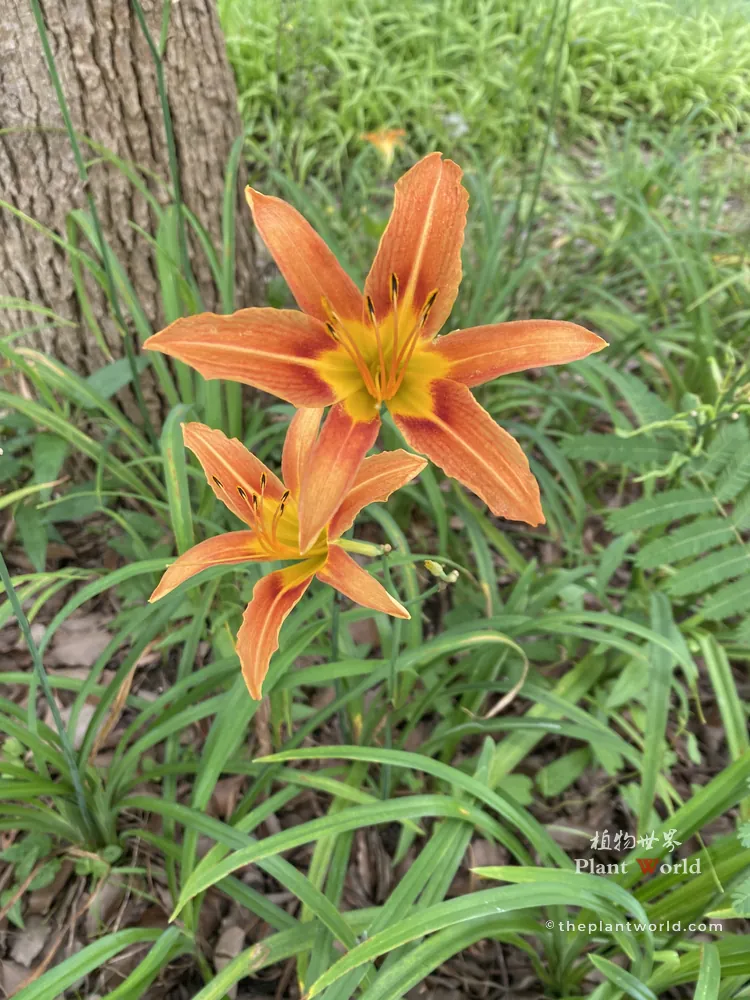
| Flower color | Orange-red to tangerine, more vivid | Pale yellow |
| Bloom time | Opens at dawn, closes at dusk (day-blooming) | Opens 2–8 PM, closes by 11 AM next day |
| Fragrance | Generally fragrance-free (a few garden cultivars have a faint scent) | Generally fragrant |
| Primary use | Ornamental | Edible (dried buds = golden needles / 金针菜) |
| Colchicine content | Higher; not edible | Fresh buds contain colchicine; must be dried or blanched and cooked thoroughly |
The Institute of Botany, Chinese Academy of Sciences, explicitly states: “Because the flowers look similar, many people confuse daylily with yellow daylily, but they are different species in the same genus.” The daylilies planted in urban landscaping have more vivid colors and higher colchicine content — they must never be eaten.
Additionally, the Qing Dynasty horticultural treatise The Flower Mirror (《花镜》) specifically notes that double-flowered daylily blossoms are toxic and must not be eaten. Therefore, neither ornamental daylilies nor fresh yellow daylilies should be picked and eaten casually.
Daylily Chinese Meaning: Mother Flower, Forget-Sorrow Grass, and Boy-Bringing Grass
In Chinese culture, the daylily’s meaning is unique — it is a cultural symbol that unites three identities: the mother flower, the forget-sorrow grass, and the boy-bringing grass.
The Mother Flower: China’s “Carnation”
The daylily is China’s traditional mother flower, predating the Western carnation as a symbol of motherhood by more than two thousand years.
This tradition can be traced back to the Book of Songs (《诗经》), in the poem “Bo Xi” (《卫风・伯兮》):
“Where can I find the xuan grass? / I would plant it by the northern hall. / Longing for my husband, / my heart aches with sorrow.”
“Xuan grass” (谖草) is the daylily (“谖” is interchangeable with “萱,” and the Erya dictionary defines it as “to forget”). “Northern hall” (背) refers to the room where the mother lived — the traditional women’s quarters at the north side of the house. The poem speaks of a wife longing for her husband away at war, wishing she could plant the forget-sorrow grass by the northern hall to ease her grief.
From this poem, the daylily became linked with mothers, the northern hall, and longing. Over time, it evolved into a custom: before a son departed on a long journey, he would plant daylilies in the courtyard of his mother’s northern hall, hoping that the sight of the blooming flowers would ease her sorrow and help her forget the pain of missing her child. When spring came and the flowers bloomed, the mother would see the flowers as if seeing her son — an expression of Eastern familial love so subtle and profound.
The Tang Dynasty poet Meng Jiao (孟郊) elevated this image to its pinnacle in his poem “The Wanderer” (《游子》):
“Daylilies grow on the hall steps, / the wanderer travels to the ends of the earth. / The loving mother leans by the hall door, / but she cannot see the daylily flowers.”
The daylilies have grown over the hall steps, yet the wanderer is still far away. The loving mother leans by the door, straining her eyes, but she cannot see her child in the distance — not even the daylily flowers can ease her longing. This poem complements Meng Jiao’s better-known “Song of the Wanderer” (《游子吟》), with its famous line “Who says the heart of a single inch of grass /can repay the warmth of a whole spring’s sun?” — the “inch of grass” here is also understood to be the daylily.
From then on, the daylily became a metonym for mother:
- A mother is called xuan qin (萱亲,”daylily parent”)
- A mother’s birthday is xuan chen (萱辰,”daylily birthday”)
- A mother’s residence is xuan tang (萱堂,”daylily hall,” from the “northern hall”)
- Birthday couplets for mothers often read “Xuan tang ri yong” (萱堂日永,”May the daylily hall have endless days”)
In 2021, during the celebrations of the 100th anniversary of the founding of the Communist Party of China, daylilies appeared in a large flower display called “Opening a New Era” at Jianguomen in Beijing — expressing the meaning of “dedicated to the mother.” The theme song of the film Hi, Mom (《你好,李焕英》), titled “Daylily Flower” (《萱草花》) — “Far away at the edge of the sky, daylilies bloom; is each flower the face of the one I miss?” — brought this “Chinese mother flower” into the hearts of people across the nation.
The Forget-Sorrow Grass: From Personal Sorrow to National Remembrance
The daylily’s oldest name is forget-sorrow grass (忘忧草). The character “谖” is defined in the ancient dictionary Erya as “to forget,” so “谖草” literally means “the grass that makes one forget.”
The Western Jin scholar Zhang Hua wrote in his Records of the Extraordinary (《博物志》):
“The daylily, when eaten, makes one feel joyful and forgets sorrowful thoughts — hence it is called the forget-sorrow grass.”
While modern science does not support the claim that eating daylilies brings joy (on the contrary, daylilies are toxic), the cultural image of “forgetting sorrow” has taken deep root in the Chinese mind. From the personal sorrow of a lonely wife in the Book of Songs to the patriotic grief of scholars and poets in later dynasties, the daylily has always been a symbol onto which people project their emotions and seek relief from sorrow.
The Song Dynasty poet Jia Xuanweng (家铉翁) wrote in his “Ode to the Daylily” (《萱草篇》):
“Poets praise the daylily, / saying it can make one forget sorrow. / Sons cherish this flower, / planting it abundantly by the northern hall.”
Poets praise the daylily because it helps one forget sorrow; sons cherish it and plant it all around their mother’s hall — because they wish their mothers a life free of worry. Here, “forgetting sorrow” has been elevated from a personal emotional release to the simplest blessing a child can give a mother: may mother have no worries.
It is one of the most moving subjects in all of Chinese flower symbolism.
The Boy-Bringing Grass: Auspicious Symbolism of Fertility and Longevity
The daylily is also called boy-bringing grass (宜男草). During the Three Kingdoms period, Cao Zhi (曹植), the prince of the Wei state, wrote in his “Hymn to the Boy-Bringing Flower” (《宜男花颂》):
“The grass called boy-bringing / is both radiant and chaste.”
The Jin Dynasty text Records of Local Customs (《风土记》) by Zhou Chu also records: “A pregnant woman who wears its flower will surely give birth to a boy.” While this is a folk belief of its time (with the limitations of that era), the symbolism of “boy-bringing” as an auspicious motif was widely used in traditional Chinese art:
- Daylily + pomegranate: symbolizes “fertile and many sons” (宜男多子)
- Daylily + longevity stone: symbolizes “fertile and long-lived” (宜男多寿)
- Daylily + peony: symbolizes “fertile and prosperous” (宜男富贵)
These combinations appear frequently in traditional New Year paintings, embroidery, and porcelain patterns — expressing the Chinese people’s wishes for family happiness, many children, and long life.
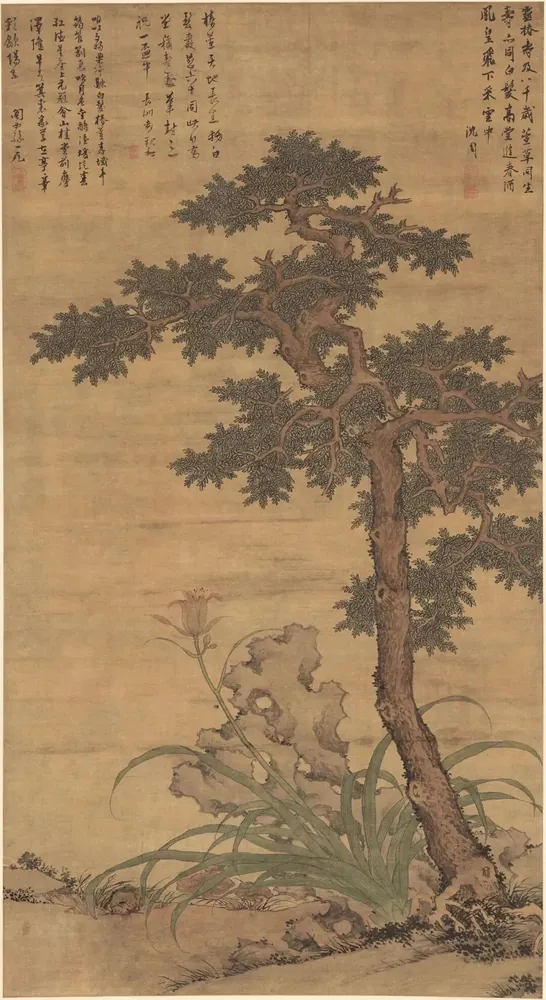
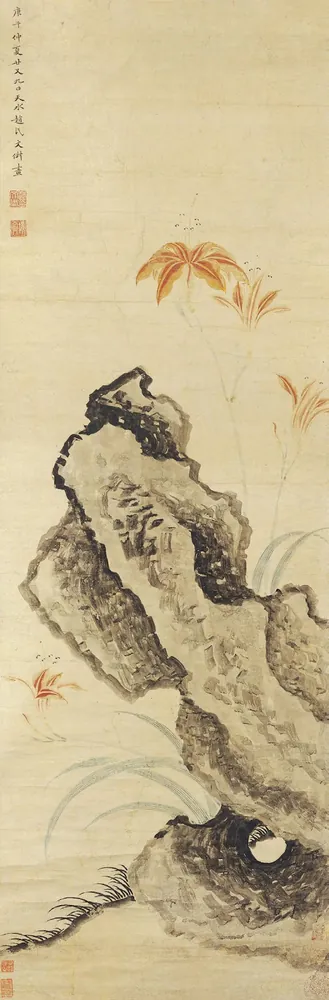
Ancient Chinese paintings and porcelain artefacts preserve long‑standing daylily symbolism. Ming‑dynasty painter Shen Zhou’s Chun‑Xuan Tu pairs the toona tree (symbol of father) with daylily, making it the iconic visual representation of the “xuan‑tang” or mother’s hall motif. Porcelain from Song through Qing dynasties frequently uses daylily patterns: daylily combined with pomegranate stands for fertility, while paired with scholar’s rock it conveys wishes for longevity. These surviving artworks offer tangible proof of daylily’s deep‑rooted place within Chinese plant culture.
Daylilies in Poetry: From Xu Mian to Su Shi
The daylily’s bright, charming blossoms have inspired countless poems of appreciation and praise throughout Chinese history.
Xu Mian (Northern and Southern Dynasties): “Ode to the Daylily Flower”
“Gorgeous but not gaudy, / elegant but not plain. / It unfurls and curls with the light and dark, / and thrives and fades with the wind and frost.”
Gorgeous without being gaudy, elegant without being plain. It opens and closes with the changing light, and flourishes and withers through wind and frost. This is the most concise distillation of the daylily’s character.
Xu Sidao (Song Dynasty): “Daylily Flower”
“Do not marvel that the daylily stem is small — / it can wear the makeup of the palace. / Only because it is steeped in enough grace, / it is utterly like the fairy Du Lanxiang.”
Don’t be surprised that the daylily’s stem is small — it can wear the most elegant palace-style makeup. Steeped in enough celestial grace, it is nothing less than the fairy Du Lanxiang descending to earth.
Ni Qian (Ming Dynasty)
“The daylily leans against the filial bamboo, / its color vying with the orchid for beauty.”
The daylily flower leans against the bamboo of filial piety, its color competing with the orchid for beauty. Here, the daylily is paired with “filial bamboo” (慈竹), further reinforcing its association with motherhood.
Su Shi (Song Dynasty)
“The daylily, though a small flower, / rises alone and graceful from the tangle. / Amid the disordered leaves, each tall stem / holds a fragrant heart, one by one.”
The daylily may be a small flower, yet it rises alone and graceful among the tangled leaves. Each tall stem holds a “fragrant heart” — and by “fragrant heart” (芳心), Su Shi refers to the loving heart of a mother.
Uses: Ornamental, Edible, and Medicinal
The daylily is a plant that unites ornamental, edible, and medicinal uses — but the species and preparation method must be strictly distinguished.
Ornamental
The daylily is an important summer ornamental flower. It is highly adaptable, has a long bloom period, rich colors, and elegant flower forms, and is widely used in landscaping, flower borders, and courtyard planting. With over tens of thousands of horticultural varieties, it is one of the most popular perennial flowers internationally. The traditional Chinese daylily (orange-red) is one of the most common flowers in summer gardens.
Edible (Dried Yellow Daylily Only)
The edible daylily is the dried flower bud of the yellow daylily (Hemerocallis citrina), also called golden needles (金针菜), which, together with wood ear mushrooms and shiitake mushrooms, is known as one of the “Three Treasures of Vegetarian Cuisine” (素三珍). Dried yellow daylily has a soft, sweet flavor and is a traditional dried ingredient in Chinese cuisine.
The Compendium of Materia Medica (《本草纲目》) records the daylily flower: “Aids digestion, drains damp-heat, harmonizes the five organs, lightens the body, and brightens the eyes.”
Qidong County in Hunan Province is a famous yellow daylily-producing region in China. There is an interesting origin for a common saying there: at banquets, the last dish served is yellow daylily soup. If you arrive so late that even the last dish has gone cold, people will say, to spare your feelings, “You’re so late the yellow daylily has gone cold” — and this phrase came to mean “waiting far too long.”
⚠️ Important food safety note: Fresh yellow daylily contains colchicine and is toxic if eaten directly. It must be dried, or blanched in boiling water and soaked in clean water, then cooked at high temperature before eating. The ornamental daylily (H. fulva) has higher colchicine content and is not edible. Double-flowered daylily blossoms are toxic and must never be eaten.
Medicinal (Traditional)
The daylily root is used in traditional Chinese medicine, but because it is toxic, it must be properly prepared and used only under a qualified practitioner’s guidance:
- Daylily root (萱草根): Sweet in flavor, cool in nature, toxic. Functions: clears heat and promotes urination, cools blood and stops bleeding. Indications: edema, difficult urination, urinary dribbling, leukorrhea, jaundice, nosebleed, bloody stool, uterine bleeding, breast abscess, insufficient lactation.
- Dried yellow daylily (黄花菜): Nourishes blood and soothes the liver, promotes urination and reduces swelling.
⚠️ Medicinal safety disclaimer: Daylily root is highly toxic and can cause severe reactions including dilated pupils, blindness, and paralysis of the hind limbs. Traditional medicinal use requires proper processing and must be done only under the guidance of a qualified healthcare professional. Never dig up and consume daylily root on your own.
It is a valued member of the Chinese herbaceous plants tradition.
Toxicity and Pet Safety: Deadly to Cats, Non-Toxic to Dogs
The daylily may be beautiful, and its yellow relative may be edible, but the ornamental daylily is toxic in all its parts — and it has a particularly unusual distinction where pets are concerned: it is deadly to cats, but non-toxic to dogs.
Toxicity in Humans
The entire plant is toxic, with the flowers and roots being the most poisonous parts. The primary toxic compounds include:
- Colchicine: A highly toxic substance that converts to dicaffeine (dicolchicine) in the body. Ordinary cooking cannot fully destroy it. There is currently no specific antidote for colchicine poisoning.
- Hemerocallin A/B, hemerocallin, and other compounds.
Symptoms of accidental ingestion include: burning sensation in the mouth and throat, upper abdominal pain, nausea, vomiting, diarrhea, bloody stool, hematuria, dizziness. In severe cases: difficulty breathing, acute kidney damage, convulsions, and even death. Symptoms typically appear within 2 to 5 hours.
Livestock such as cattle and sheep that graze on daylily roots can develop blindness (dilated pupils, loss of light reflex, vision loss).
Pet Safety (Critical Distinction)
The American ASPCA explicitly lists the genus Hemerocallis spp. (Daylilies) as: Toxic to Cats, Non-Toxic to Dogs.
- Cats: Extremely dangerous. Ingesting any part — even licking pollen — can cause acute kidney failure and death. Clinical signs include: vomiting, loss of appetite, lethargy, kidney failure, death. The toxic principle is currently unknown. A cat that has ingested daylily must receive veterinary fluid therapy within 24 hours to significantly improve its chance of survival.
- Dogs: Listed as non-toxic by the ASPCA. Ingestion typically causes only mild gastrointestinal upset (vomiting, diarrhea) that generally resolves on its own within 24 hours. However, eating large quantities may still cause discomfort.
⚠️ Critical pet safety note: Households with cats should absolutely not grow or display daylilies (including cut flowers). Even placed out of a cat’s reach, falling pollen can be licked off and cause poisoning. If you suspect your cat has ingested any part of a daylily, seek veterinary care immediately — time is life. Dog households are relatively safe, but large ingestion should still be avoided.
Cultivation and Care Guide
The daylily is one of the easiest perennial flowers to grow — highly adaptable and suitable even for beginners.
Environmental Requirements
- Light: Prefers full sun but tolerates partial shade. It blooms most abundantly in full sun; in partial shade it will still grow but with fewer flowers.
- Temperature: Highly cold-hardy; can overwinter outdoors in most regions of China (tolerating -20°C or lower). Tolerates summer heat well.
- Soil: Not fussy about soil, but prefers well-drained, fertile, loose sandy loam. Tolerates poor soil and can survive in less-than-ideal conditions.
- Water: Relatively drought-tolerant; keep the soil moist during the growing season. Avoid waterlogging.
Planting
- Planting time: Can be planted in spring or autumn; autumn division and transplanting is best.
- Method: Select healthy root clumps, each with 2–3 buds. Plant at a depth where the root crown is level with the soil surface, spaced 30–50 cm apart. Water thoroughly after planting.
- Propagation: Primarily by division every 3–5 years, done in early spring before growth starts or in autumn after flowering. Can also be grown from seed, but seedlings take 2–3 years to bloom.
Daily Care
- Watering: Keep soil moist during the growing season; water during dry spells. Ensure good drainage in the rainy season to avoid root rot from standing water.
- Fertilizing: Apply well-rotted organic fertilizer or compound fertilizer in early spring before growth starts to promote vigorous growth; apply a phosphorus-potassium top-dressing before flowering to promote blooms.
- Pruning: Promptly remove spent flower scapes after blooming to keep the plant tidy. In autumn, after the foliage dies back, cut away the dead leaves and apply a light mulch for winter.
- Pests and diseases: Daylilies have relatively few pest and disease problems. Occasionally affected by leaf spot, rust, aphids, and spider mites. Ensure good ventilation and promptly remove affected leaves.
Bloom Period
The natural bloom period is June through August. Each flower lasts only one day, but a single plant can bloom continuously for over forty days. By selecting varieties with different bloom times, you can extend the overall display season.
Final Thoughts
The daylily is a flower that unites maternal love, forgetting sorrow, and auspicious blessing.
It is the “xuan grass” planted by the northern hall in the Book of Songs; it is Meng Jiao’s “daylilies grow on the hall steps, the wanderer travels to the ends of the earth”; it is Cao Zhi’s “grass called boy-bringing, both radiant and chaste”; it is Su Shi’s “amid the disordered leaves, each tall stem holds a fragrant heart”; and it is the “daylilies bloom far away at the edge of the sky” from the theme song of Hi, Mom.
The Chinese meaning of the daylily lies in the gratitude planted by a son in his mother’s courtyard before departing, the simplest blessing of “may mother have no worries,” the auspicious wish for “fertility and longevity,” and the life wisdom of each flower blooming for only one day yet renewing itself every morning. It can be admired, eaten (as dried yellow daylily), and used medicinally — but it is also toxic in all its parts, and deadly to cats, requiring us to maintain a measure of reverence even as we enjoy its beauty.
“Bright, bright daylily flowers — at a single glance, one forgets sorrow.” In summer, when daylilies bloom vibrantly in courtyards, along roadsides, and in flower beds, each small flower that lives for only one day carries three thousand years of cultural heritage and tender, romantic poetry — and the deepest love the Chinese people have for their mothers. It remains a timeless chapter in Chinese plant culture.
References
Plants of the World Online (POWO). Hemerocallis fulva L. Royal Botanic Gardens, Kew. — Authoritative taxonomic database.
Institute of Botany, Chinese Academy of Sciences. “China’s Mother Flower & The Forget-Sorrow Grass” — Botanical distinction between ornamental daylilies and edible yellow daylilies.
The Book of Songs (《诗经》) & Tang Poetry Collections — Historical literary sources establishing the daylily as China’s original mother’s flower (“xuan grass”).
ASPCA Animal Poison Control Center. “Day Lilies (Hemerocallis spp.) Toxic Plant Database” — Official veterinary reference on feline toxicity and canine safety.
Chinese Center for Disease Control and Prevention (China CDC). “Public Health Advisory: Colchicine Toxicity in Wild and Fresh Daylilies.”
More from The Plant World:
- Chinese Wingnut: The Romantic “Ingot Tree” and Its Cultural Charm
- Plum Blossom Meaning: Symbolism & Cultural Significance
- The Hidden Meanings Behind Red Plum Blossoms
- Chinese Wisteria: History, Symbolism, and Identification
- Peach Blossoms in China: History, Culture, and Symbolism
- Chinese Crepe Myrtle: Guide to Origins & Symbolism
- Ginkgo Leaf Meaning: 5 Secrets of This Ancient Fossil
- Chinese Loquat Tree: Guide to Benefits & History
- Rose of Sharon Tree: Guide to Meaning & Care
- Hosta Plant Benefits: 5 Surprising Uses & Planting Guide
- Strawberry Begonia Care: How to Grow Saxifraga Stolonifera
Discover more from The Plant World
Subscribe to get the latest posts sent to your email.