
Introduction
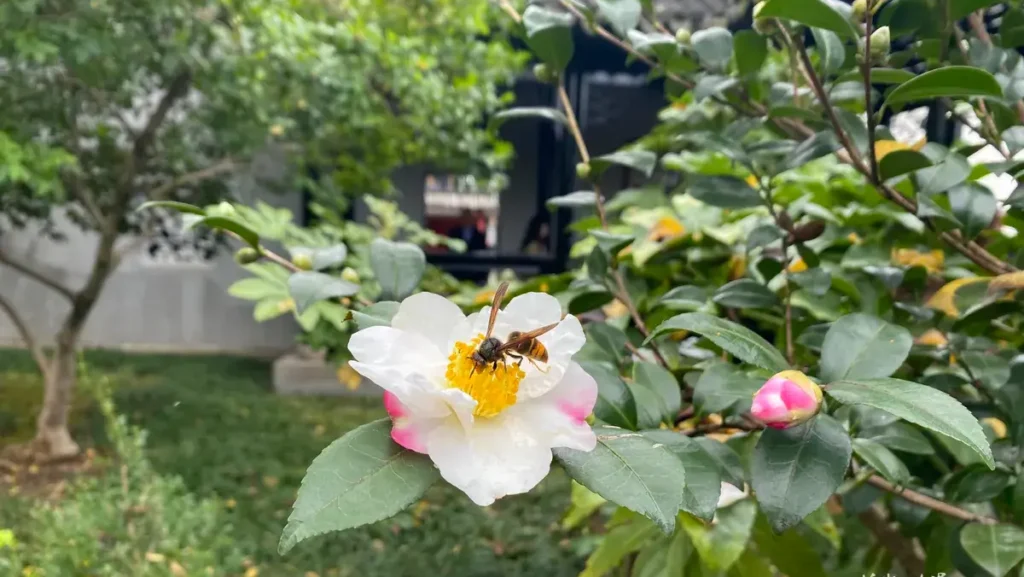
As the chill of late autumn deepens and flowers fade one by one, a certain bloom quietly opens in the garden. Its leaves are glossy and evergreen, resembling those of the tea plant; its flowers are delicate and exquisite, like those of the plum blossom; and its fragrance is like a well-steeped cup of green tea — neither heavy nor cloying, quiet and restrained, with a lingering aftertaste. This is Chamei (Camellia sasanqua), an evergreen small tree in the tea family (Theaceae), one of the most important autumn and winter flowering plants within Chinese Garden Plants.
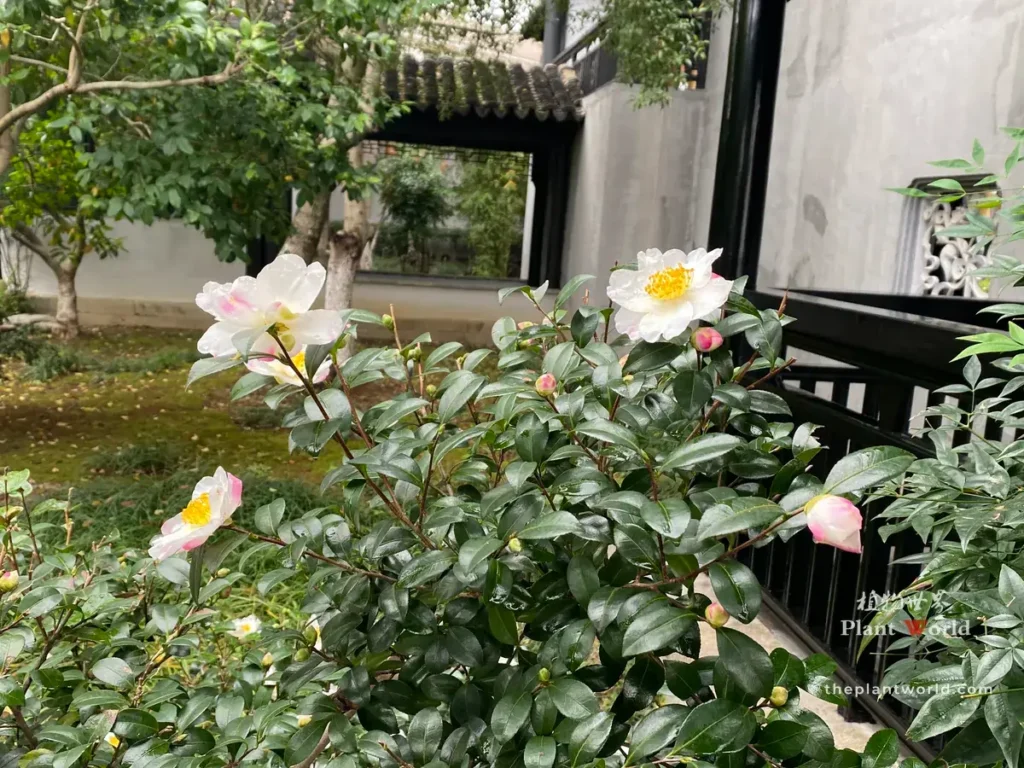
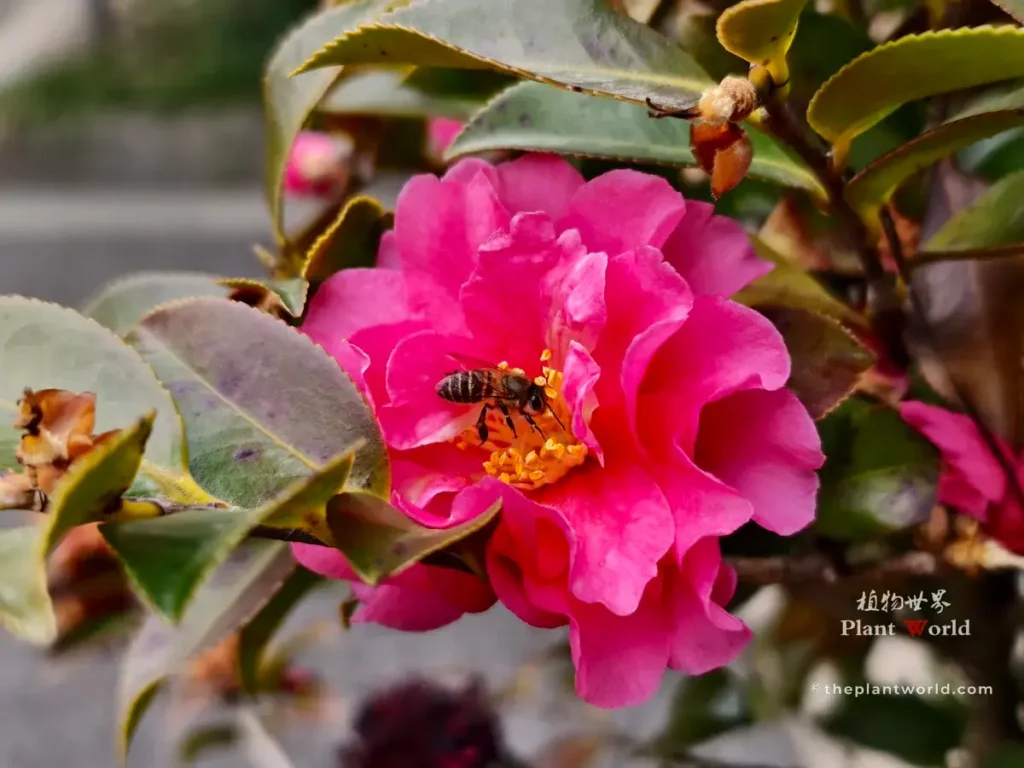
Chamei flowers are small and refined, most varieties fragrant, with colors ranging from white and white-blushed-pink to rose pink and, less commonly, red. Its leaves resemble tea leaves and its flowers resemble plum blossoms — combining the spirit of the camellia with the grace of the plum — hence its Chinese name Chamei (茶梅), literally “tea-plum.” To bear the character “plum” in its name is a sign of its refined character and elegant form. In the desolate seasons of autumn and winter, Chamei brings a warm splash of color with its graceful form and distant fragrance.
- Introduction
- Name Origin: Leaves Like Tea, Flowers Like Plum
- Plant Profile
- Cultivar Groups: Three Main Groups
- History and Literature: From "Haihong" to Chamei
- Cultural Symbolism: Elegance, Resilience, and the Beauty of Winter
- Chamei vs. Camellia: How to Tell Them Apart
- Garden Use and Care
- Final Thoughts
- References
- More from The Plant World:
Name Origin: Leaves Like Tea, Flowers Like Plum
The name Chamei derives from its morphological features. Its leaves are leathery, elliptical, and finely serrated at the margins, closely resembling those of the tea plant (Camellia sinensis). Its flowers, meanwhile, are delicate and exquisite, blooming from autumn through early spring — a season that overlaps with the flowering time of the plum blossom — and their form carries something of the plum’s elegant poise. The ancients therefore named it “tea-plum,” taking “leaves like tea, flowers like plum” as its defining essence.
Gu Qiyuan, writing in the Ming Dynasty, put it more precisely in his Shuo Lue (Essays on Curiosities): “Chamei is simply the small pink-flowered variety of camellia, originally called Haihong (海红,’sea red’). Because it blooms from the twelfth month to the second month, at the same time as the plum, it is called tea-plum.” This passage not only explains the origin of the name but also records its ancient name — Haihong — and its phenological characteristic of blooming alongside the plum.
In the Qing Dynasty, Chen Haozi, in his classic horticultural work The Flower Mirror (Hua Jing), took care to clarify: “Chamei is not a plum blossom.” He warned readers not to mistake it for a variety of plum simply because of its name. In fact, Chamei belongs to the genus Camellia in the tea family, while the plum belongs to the genus Prunus in the rose family — the two are far apart in botanical classification.
Plant Profile
| Attribute | Details |
|---|---|
| Botanical name | Camellia sasanqua |
| Family | Theaceae (tea family) |
| Genus | Camellia |
| Plant type | Evergreen small tree or shrub |
| Mature height | 3–5 m in the wild; 1–2 m for most garden cultivars |
| Leaves | Leathery, elliptical, finely serrated, glossy dark green above |
| Flower colors | White, pink, rose-red, bicolor; rarely red |
| Petals | 6–11 (single); 15–40+ in double cultivars |
| Flower size | 4–7 cm across |
| Fragrance | Most cultivars have a delicate, sweet fragrance |
| Bloom time | October through April (varies by cultivar group) |
| Native range | Japan (Ryukyu Islands, Kyushu), southern China |
| Hardiness | USDA zones 7–9 |
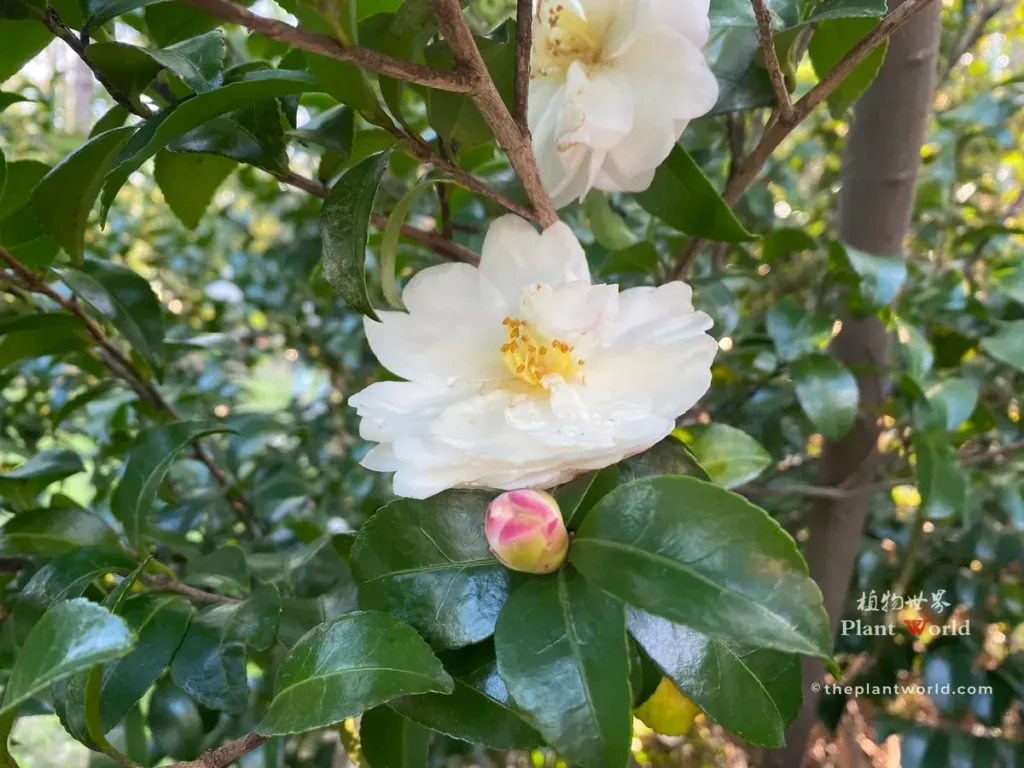
While modern nursery cultivars were heavily selection-bred in Japan, wild and early cultivated forms of Camellia sasanqua have a deep-rooted history in Southern China, where it was historically known as ‘Haihong’ (海红). Wild Chamei is a small tree or shrub with hairy young branchlets. Wild populations still exist in the Ryukyu Islands, Kyushu, and the Korean Peninsula. Through long natural evolution, intraspecific hybridization, and modern horticultural breeding, the number of cultivars has grown steadily — today there are more than 500 cultivars worldwide, with roughly 100 in China.
Cultivar Groups: Three Main Groups
Based on evolutionary stage, flowering period, floral and foliar characteristics, and ecological differences, Chamei cultivars are divided into three groups: the Sasanqua Group, the Hiemalis Group, and the Oleifera Group.
Sasanqua Group (Common Chamei)
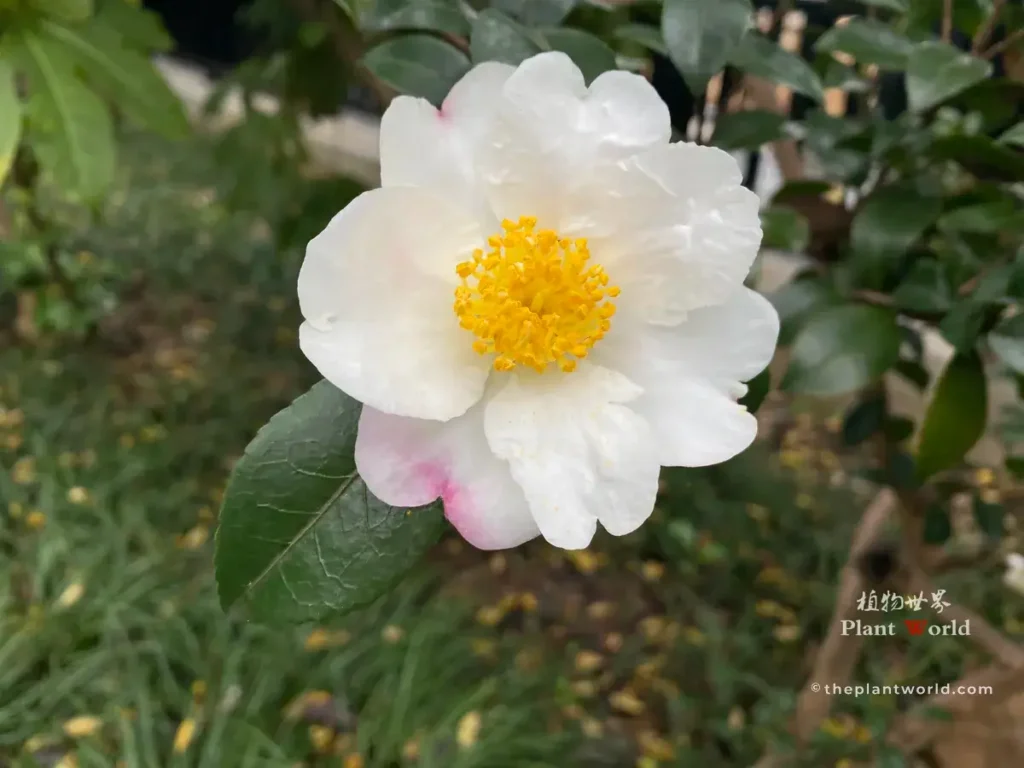
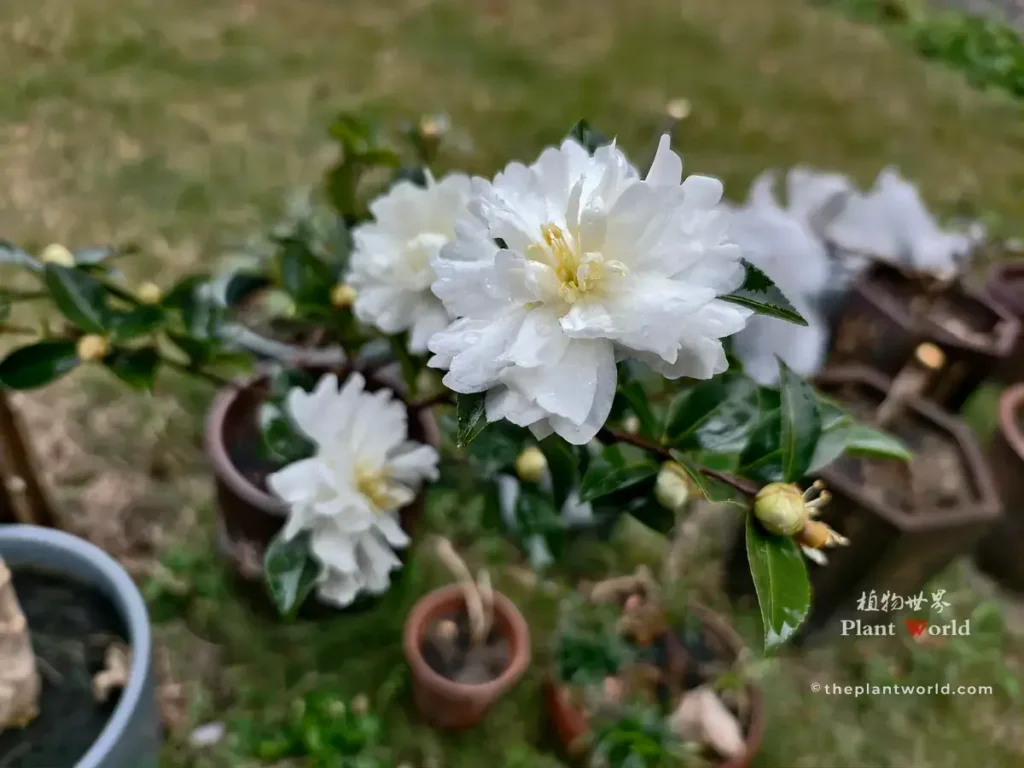
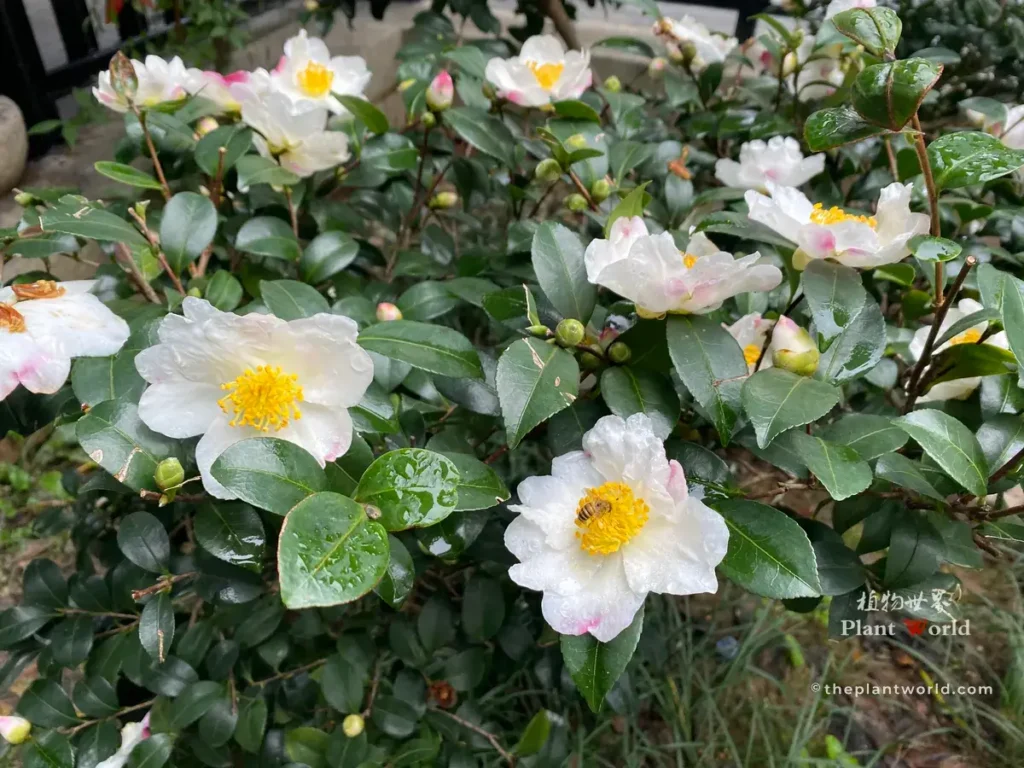
Upright in habit and vigorous in growth, this group produces a profusion of fragrant flowers covering the entire tree when in bloom. Flowers are mostly white or white with a pink blush, with 6–7 petals and a diameter of 4–7 cm. Blooming from October to December, it is an important autumn flowering shrub. It works well in garden landscaping, whether planted in groups or as a specimen. Representative cultivars include ‘Dingziche,’ ‘Bai Letian,’ ‘Cotton Candy,’ ‘Shuangbanmei,’ and ‘Feihouying.’
Among these, ‘Bai Letian’ is a classic — its flowers are as white as snow, medium in size, with a fresh fragrance, blooming from October to December. It is widely used in landscaping.
Hiemalis Group (Winter Chamei)
Low-growing with spreading branches and dense foliage, this group features mostly rose-red flowers, with a few bicolor and white cultivars. The stamens are partially or fully petaloid, forming semi-double to double flowers with 15–40 or more petals. Many cultivars are fragrant. Blooming from November to March, it is an important winter-flowering ornamental shrub. Its low, spreading habit makes it especially suitable for container growing. Representative cultivars include ‘Xiaomeigui,’ ‘Caishen,’ ‘Houli,’ ‘Asakura,’ and ‘Feiyinv.’
Oleifera Group (Spring Chamei)
Derived from interspecific hybrids between Chamei and Japanese camellia (Camellia japonica), this group is intermediate in size and height between Chamei and camellia, with relatively larger leaves. Flowers are mostly red and pink, with a few white cultivars; most are semi-double, with some double and anemone-form types. Blooming from December to April, this group offers the greatest diversity of flower color and form, and is equally charming in containers or as a garden accent. Representative cultivars include ‘Jiaoxiaoyan,’ ‘Yang Guifei,’ ‘Gujinlan,’ ‘Xingshangxing,’ and ‘Guangyuanshi.’
History and Literature: From “Haihong” to Chamei
Chamei was known in ancient China as Haihong (海红). Written records of Chamei in China can be traced back to the mid-Tang Dynasty.
The Tang Dynasty poet Liu Changqing (刘长卿,c. 726–c. 786) wrote a five-character regulated verse titled Seeing a Single Haihong Flower Blooming Amid Fallen Blossoms at Vice-Prefect Cui’s Residence in Midsummer:
Why does one flower linger on, / In the idle court where all grasses fade? / Green lushness springs forth after rain, / Red brilliance glimpsed through the trees. / All day its lingering fragrance remains, / Past its season, alone it is hard to shine. / Together we pity its late-blooming heart, / Autumn dew need not yet gather in drops.
This poem not only captures Chamei’s red flowers and green leaves but also pinpoints its blooming season in late autumn — when “all grasses fade” and “autumn dew gathers” — and highlights its delicate fragrance. The word “residence” in the title indicates that Chamei was already cultivated in gardens by this time. The “Haihong” in the poem is the ancient name for Chamei, as confirmed by Gu Qiyuan’s Shuo Lue in the Ming Dynasty.
In the Northern Song Dynasty, the poet Tao Bi (陶弼,1015–1078) wrote in the first of his Two Poems on Camellias:
Pale is Yuming, deep is Dusheng, / Large are called camellia, small is Haihong. / Its fame spreads far but few companions stand by, / Year after year it dwells amid snow and frost.
The “small Haihong” in this poem refers to Chamei. It is worth noting that different editions of this poem show slight variations: the Comprehensive Treatise on Flowering Plants (Guang Qunfang Pu) records it as “large are called camellia, small is Haihong,” while some editions read “small tree-red.” However, the identification of “small Haihong” as Chamei is consistent across later sources.
The Song Dynasty also saw poems dedicated specifically to Chamei. Liu Shiheng wrote Ode to the Chamei Flower:
When the small courtyard is still cold and not yet warm, / Haihong flowers bloom slowly in the dusk. / Half deep, half pale in the east wind, / Like Xu Xi’s branches dusted with snow.
This poem evokes the elegant image of Chamei blooming amid lingering spring cold and snow.
In the Ming Dynasty, the painter-poet Chen Daofu (陈淳,1483–1544), also known as Chen Chun, captured Chamei’s delicacy in his poem Chamei:
Flowers open amid spring snow, / Their form smaller than the camellia’s. / The old gardener calls it tea-plum, / A name well and properly given.
This poem not only places Chamei’s bloom in the “spring snow” season but also, by comparing it with the camellia, highlights its smaller, more delicate form.
In the Qing Dynasty, the self-styled “West Lake Flower Hermit” Chen Haozi (陈淏子) gave a vivid description in his horticultural classic The Flower Mirror:
“Chamei is not a plum blossom. Because it blooms in the winter months, precisely when all other flowers fade. Without this flower to adorn the garden here and there, the eleventh lunar month would be almost wasted. Its leaves resemble those of the camellia but are smaller; its flowers are like goose-eye coins, pink in color with deep yellow centers. There are also white-flowered varieties. It blooms for a very long time, and at a distance it appears elegantly plain and delightful.”
This passage both clarifies that Chamei is not a plum and praises its preciousness in blooming alone amid winter’s fading flowers, as well as its elegantly plain and charming appearance.
Cultural Symbolism: Elegance, Resilience, and the Beauty of Winter
Although Chamei is not as celebrated in Chinese culture as the plum blossom or the camellia, it has won the affection of literati through its unique temperament, giving rise to a rich body of cultural symbolism.
Elegant and Refined
Chamei flowers are small and exquisite, with a fragrance that is delicate and far-reaching — neither heavy nor cloying, with a quiet, restrained quality. Its colors, predominantly white and pink, are not as vivid and intense as the camellia’s; rather, they are elegantly plain and understated, like a beautiful woman wearing no makeup. Chen Haozi’s description in The Flower Mirror — “at a distance it appears elegantly plain and delightful” — is the perfect summation of this elegant quality.
Resolute and Unyielding
Chamei blooms from autumn through early spring, precisely the season when “all other flowers fade.” It continues to bloom through frost and snow, with a long flowering period spanning from October to April — across autumn, winter, and spring. This characteristic of blooming in the midst of cold makes Chamei a symbol of resilience and unyielding spirit in the face of harsh conditions. Tao Bi’s line — “year after year it dwells amid snow and frost” — describes both Chamei’s growing environment and a tribute to its resilient character.
The Indispensable Accent of Winter Beauty
Chen Haozi wrote that “without this flower to adorn the garden here and there, the eleventh lunar month would be almost wasted” — a statement that captures Chamei’s irreplaceable role in the winter garden. In a season when all flowers have faded, Chamei brings vitality and charm to the desolate winter garden with its blooms and fragrance. It is not the most dazzling flower of winter, but it is the most indispensable accent.
Different Aesthetics in Chinese and Japanese Culture
Japan is another country that holds Chamei in high esteem. The history of cultivated Chamei in Japan dates back to the 14th century, with written records beginning around the 17th century. In Japanese culture, the way Chamei’s petals fall one by one when the flower fades resonates with the beloved image of “cherry blossom snow” — pink or white petals drifting down, offering a final beauty that is, at the same time, a source of infinite melancholy. This aesthetic of mono no aware (the pathos of things) has given Chamei a different cultural dimension in Japan from the one it holds in China.
Chamei vs. Camellia: How to Tell Them Apart
Chamei and the Japanese camellia (Camellia japonica) are very similar — they are “sister flowers” in the same family and genus, and it is easy to confuse them without careful observation. Once you master the following key points, however, telling them apart becomes straightforward.
1. Different Blooming Seasons
Chamei generally blooms earlier than the camellia. The Sasanqua Group blooms from October to December, the Hiemalis Group from November to March, and the Oleifera Group from December to April. The Japanese camellia, by contrast, typically blooms from December to March. Chamei not only flowers earlier but also has a wider spread of bloom times across its cultivar groups.
2. Different Ways of Fading
This is the most distinctive difference. Chamei’s petals are nearly free at the base, so when the flower fades, the petals fall one by one — ethereal and lingering. The Japanese camellia’s petals, however, are highly fused at the base, so when the flower fades, the entire flower head drops off at once — a phenomenon sometimes called “decapitation.”
3. Different Flower Shapes
The Japanese camellia’s flowers are bowl-shaped, with compact petals forming a regular geometric form. Chamei’s petals, by contrast, are loose and dynamic, spreading flat like a saucer. Single Chamei flowers spread their petals flat, almost all in the same horizontal plane.
4. Different Fragrance
Most Chamei cultivars have a delicate, elegant fragrance, while the Japanese camellia is essentially scentless.
5. Different Leaves and Young Branches
Chamei’s leaves are generally smaller with finer serrations, and its young branches, leaf midribs, and petioles are hairy. The Japanese camellia’s leaves are larger with coarser serrations, and its young branches are hairless.
| Feature | Chamei (Camellia sasanqua) | Japanese Camellia (Camellia japonica) |
|---|---|---|
| Bloom time | Oct–Apr (varies by group) | Dec–Mar |
| Fading | Petals fall one by one | Entire flower drops at once |
| Flower shape | Saucer-shaped, flat and loose | Bowl-shaped, compact |
| Fragrance | Most have delicate fragrance | Essentially scentless |
| Leaves | Smaller, finer serrations | Larger, coarser serrations |
| Young branches | Hairy | Hairless |
Both Chamei and camellia are beautiful. If we become too preoccupied with classifying and naming them, our capacity to appreciate their beauty is actually diminished. As the Indian philosopher Jiddu Krishnamurti wrote in The Book of Life: “When you look at a small flower, you cannot name it, you cannot categorize it, you cannot say what species it belongs to — if you are busy doing all these things, you will not see the flower at all.”
Garden Use and Care
Garden Applications
Chamei is one of the most important ornamental flowering shrubs of the autumn and winter seasons, with a wide range of garden uses:
- Garden landscaping: Plant as a specimen or in groups in courtyards, at lawn edges, or at woodland margins. When in bloom, the entire tree is covered with fragrant flowers.
- Hedges and flowering hedges: Chamei’s low growth, dense foliage, and tolerance of pruning make it an excellent hedge or flowering hedge material — the Hiemalis Group is especially suitable.
- Container growing: The Hiemalis and Oleifera Groups, with their low, spreading habits, are ideal for containers on balconies, windowsills, or indoors.
- Rock gardens and waterside planting: Chamei thrives in partially shaded, moist environments and can be planted in rock gardens or beside streams and ponds, where it complements rocks and water beautifully.
Care Tips
- Light: Prefers partial shade; avoid direct strong sunlight. Thrives in bright, filtered light. Provide shade in summer; increase light in winter.
- Temperature: Prefers a warm, humid climate. Reasonably cold-hardy, tolerating temperatures down to about -5°C (some cultivars to -10°C). In northern regions, provide winter protection or move indoors.
- Soil: Prefers loose, fertile, well-drained, slightly acidic soil (pH 5.5–6.5). Avoid alkaline or heavy clay soils. For containers, use a mix of leaf mold, peat, and perlite.
- Watering: Prefers moisture but hates waterlogging. Keep soil evenly moist during the growing season; reduce watering in winter. Use rainwater or aged tap water to avoid soil alkalization.
- Fertilizing: Apply a dilute liquid fertilizer monthly during the growing season (spring to autumn), using organic or balanced fertilizer. Increase phosphorus and potassium before blooming to promote flower bud formation. Stop fertilizing during summer heat and winter dormancy.
- Pruning: Lightly prune after flowering, removing spent blooms, dead branches, and overcrowded growth to maintain an attractive shape. Chamei grows slowly and should not be heavily pruned.
- Pests and diseases: Common diseases include anthracnose and leaf spot; common pests include aphids, spider mites, and scale insects. Ensure good air circulation and treat promptly.
Final Thoughts
Chamei — this winter bloom with leaves like tea and flowers like plum — has earned a unique place in Chinese Flower Symbolism through its small, exquisite flowers, its delicate and far-reaching fragrance, and its resilient character. From Liu Changqing’s “Haihong” in the Tang Dynasty, to Tao Bi’s “small Haihong” in the Song, from Chen Daofu’s admiration — “flowers open amid spring snow, their form smaller than the camellia’s” — to Chen Haozi’s cherished observation — “without this flower to adorn the garden here and there, the eleventh lunar month would be almost wasted” — it has won the affection of generations of literati with its elegantly plain and understated grace.
It is not the most dazzling flower of winter, but it is the most indispensable accent. In the desolate seasons of autumn and winter, Chamei blooms quietly, using its flowers and fragrance to add a warm splash of color to an otherwise barren time. It reminds us that beauty need not be vivid and intense — elegance and restraint can be equally moving; and that resilience need not be loud and outward — blooming silently through frost and snow is itself a form of strength.
As autumn deepens and winter approaches, Chamei cultivars are coming into bloom one after another. After an autumn rain, fallen petals scatter across the ground — a scene with its own unique charm. Consider planting a Chamei in your garden, and in the cold of winter, savor that special quality of elegance and warmth that belongs to Chamei alone.
References
- Plants of the World Online (POWO): Camellia sasanqua Thunb. Species Account. Royal Botanic Gardens, Kew.
- International Camellia Society: Growing Sasanquas & Cultivar Registration Database.
- Kunming Institute of Botany, CAS: Research and Prospect on Camellia Germplasm Resources. Academic Review on Historical Literature.Book of Songs (Shi Jing, 《诗经》) — “Han Yi” & “Ze Bei”: Earliest literary records of pucai shoots.
- World Forestry Research: Origins and Cultural Differences of Camellias between China and Japan (Vol. 28, No. 4). Chinese Academy of Forestry.
- Scientific Data (Nature Portfolio): The Dataset of Camellia Cultivars Names in the World (Vijayan et al., 2021). Global Taxonomy Reference.
More from The Plant World:
- Chinese Wingnut: The Romantic “Ingot Tree” and Its Cultural Charm
- Plum Blossom Meaning: Symbolism & Cultural Significance
- The Hidden Meanings Behind Red Plum Blossoms
- Chinese Wisteria: History, Symbolism, and Identification
- Peach Blossoms in China: History, Culture, and Symbolism
- Chinese Crepe Myrtle: Guide to Origins & Symbolism
- Ginkgo Leaf Meaning: 5 Secrets of This Ancient Fossil
- Chinese Loquat Tree: Guide to Benefits & History
- Rose of Sharon Tree: Guide to Meaning & Care
- Hosta Plant Benefits: 5 Surprising Uses & Planting Guide
- Strawberry Begonia Care: How to Grow Saxifraga Stolonifera
Discover more from The Plant World
Subscribe to get the latest posts sent to your email.