
Introduction
We wait and wait, and then the osmanthus blooms.
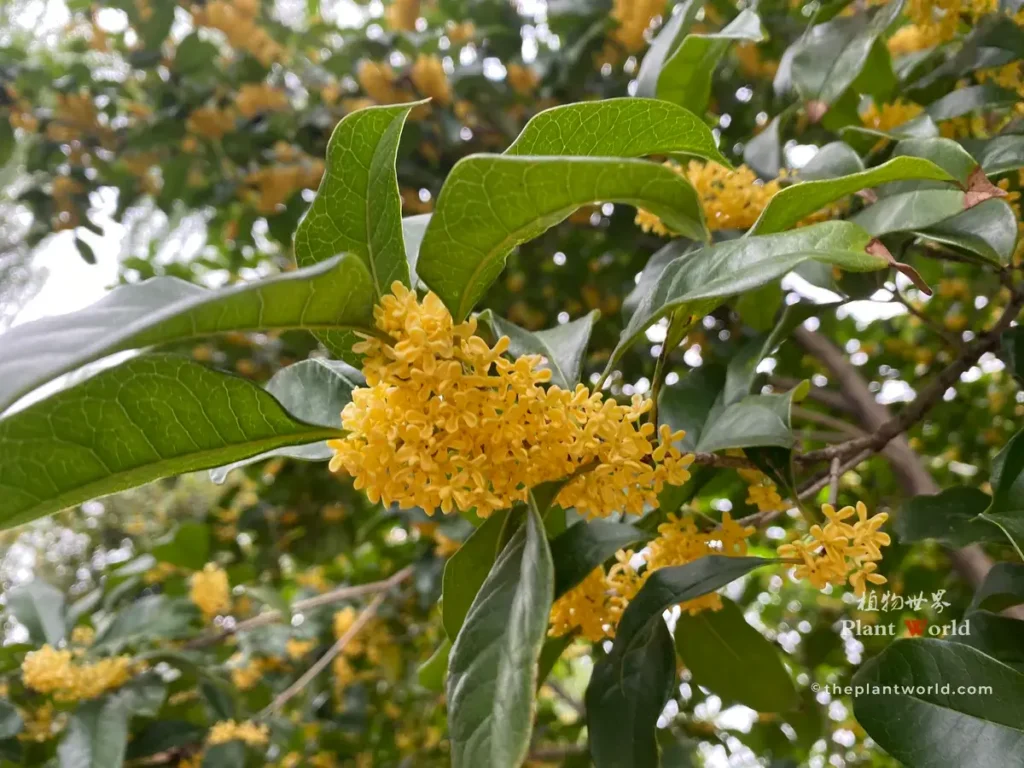
When one osmanthus tree flowers, its fragrance carries for miles. Only when the osmanthus blooms has autumn truly begun. Amid the jade‑green foliage, tiny yellow flowers hang like grains of millet — not exactly stunning to look at, but their scent is unforgettable, seeping into the heart.
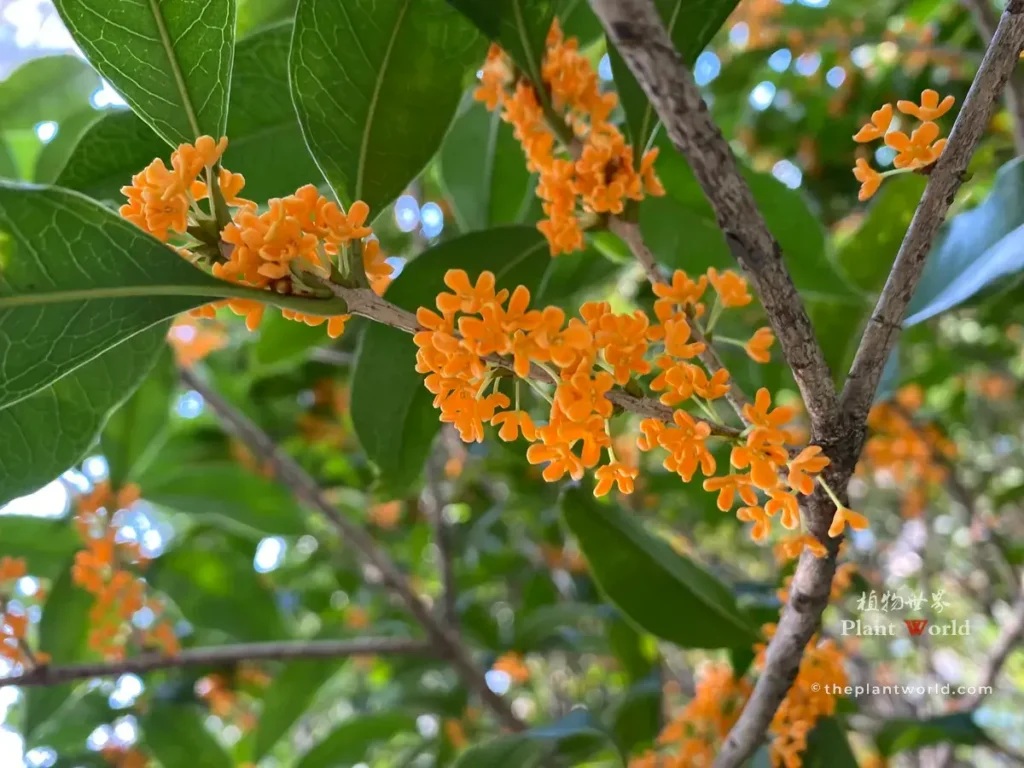
In Jiangnan, south of the Yangtze, osmanthus trees are everywhere. Sometimes, on a street corner or along a road, you walk straight into a cloud of osmanthus fragrance before you even see the tree. That scent — sometimes rich, sometimes delicate, sometimes sweet, sometimes clear — soaks into every cell of your body and ripples into happiness.
Osmanthus is to autumn what snow is to winter and lotus is to summer: indispensable. It is one of China’s Ten Traditional Famous Flowers, prized for ornamental, culinary, and medicinal value. It is even the city flower of four Chinese cities: Suzhou, Hangzhou, Guilin, and Xianning. To understand osmanthus, you have to start with its name, its myth, its taste, and what it is good for.
- Introduction
- Plant Profile: What is osmanthus called in Chinese?
- The Four Cultivar Groups: Gold, Silver, Vermilion, and Four-Season
- The Chinese Myth: Wu Gang and the Moon Cassia — What is the Chinese myth about osmanthus?
- Cultural Symbolism: Cassia Means Nobility and Good Fortune
- Osmanthus in Poetry: No Need for Pale Blue or Deep Red — It Is First-Rank Among Flowers
- What Does Osmanthus Taste Like?
- What is Osmanthus Good For?
- Final Thoughts
- References
- More from The Plant World:
Plant Profile: What is osmanthus called in Chinese?
Scientific Name:Osmanthus fragrans (Thunb.) Lour.
English Names: Osmanthus, Sweet Osmanthus, Sweet Olive, Fragrant Olive, Tea Olive,
Chinese Name: 桂花 (guìhuā); also 木犀 (mùxī), 岩桂 (yánguì), 九里香 (jiǔlǐxiāng, “fragrance for nine miles”), 仙客 (xiānkè, “immortal guest”)
Family: Oleaceae (Olive Family) → Genus Osmanthus
Native Range: Southwestern and central China; also found in Nepal, India, and Cambodia
Cultivation History in China: Clearly documented cultivation and naming from the Song Dynasty (10th century) onward; native to southwestern China, where it has existed as a wild species far longer than written records
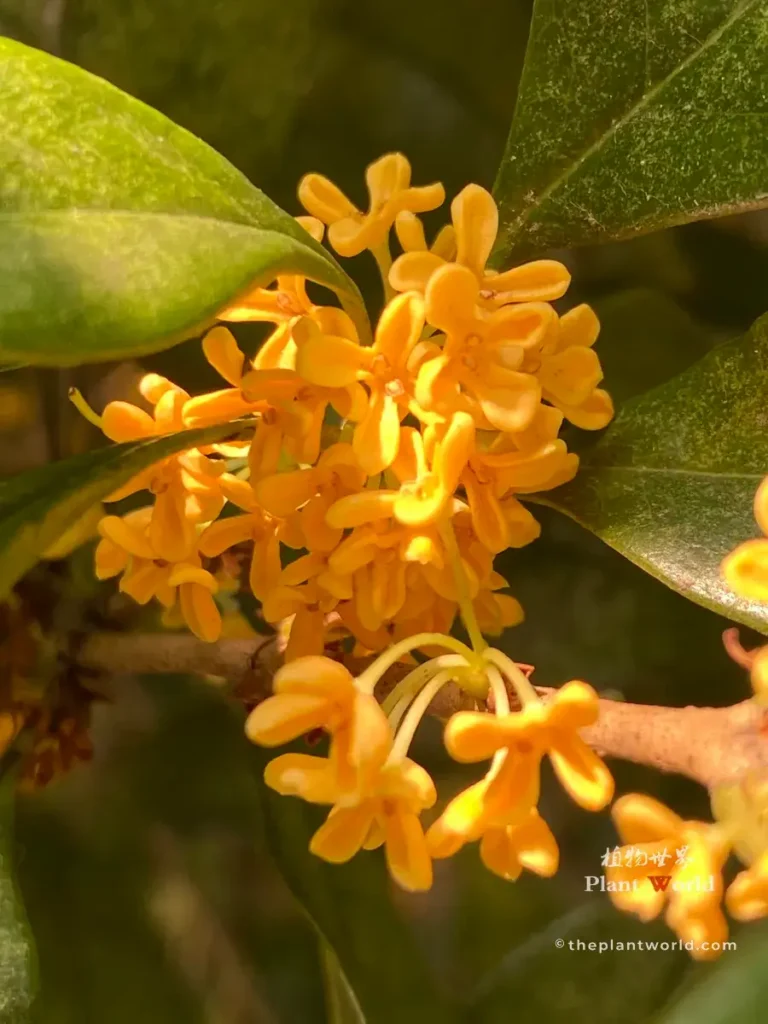
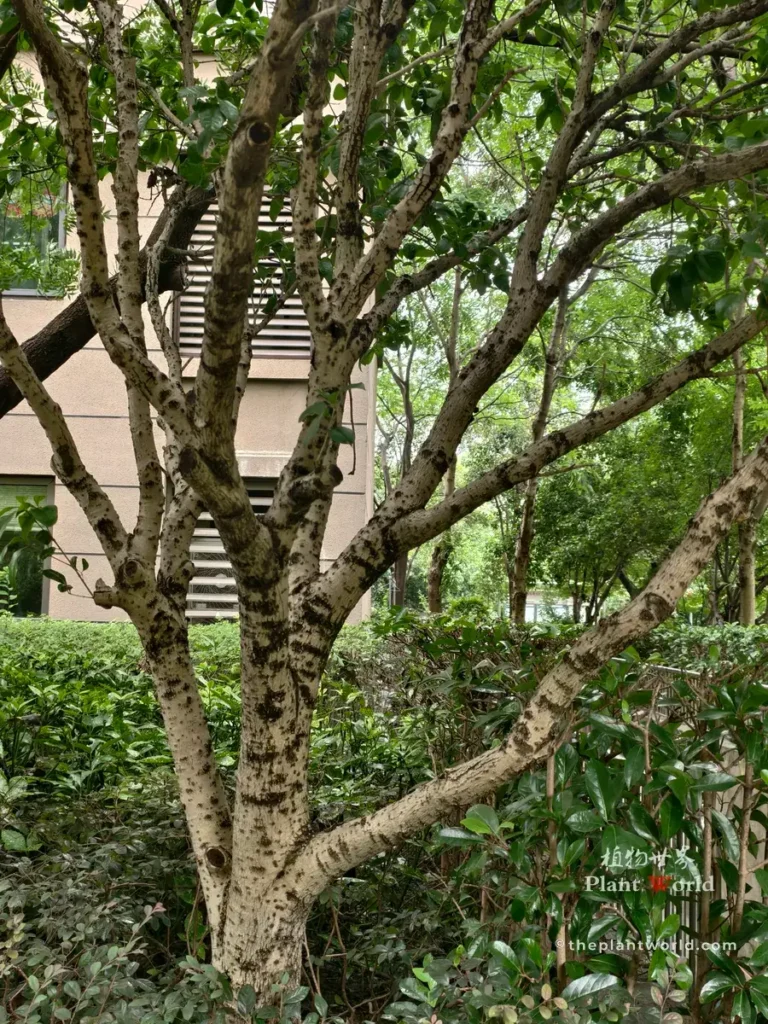
Osmanthus is an evergreen shrub or small tree, ranging from 1.5 to 18 meters tall. Its leaves are leathery, elliptical, and opposite, staying green through winter — which is where the name mùxī (木犀, “wood rhinoceros”) comes from: the wood grain is as fine and hard as rhinoceros horn. The flowers are tiny, clustered in cymes at the leaf axils, with a four-lobed corolla, each bloom no bigger than a grain of millet. It flowers mainly from September to October, and its fragrance is so strong that it earned the name “fragrance for nine miles.” After flowering, it produces oval drupes that turn purplish-black when ripe.
“Plant an osmanthus in the courtyard; its leaves stay evergreen. In autumn it blooms, some deep yellow, some pale yellow. Whenever a breeze passes, the rich fragrance greets the nose, and everyone loves it. When the flowers fall, gather them and mix with sugar, store in a bottle — even after a long time, the fragrance remains intense.” This passage from a Republican-era textbook captures the osmanthus’s character simply and vividly.
The osmanthus is native to southwestern and central China, but its early documentary history is complicated by a naming confusion that lasted over a thousand years. In pre-Song Chinese literature, the character guì (桂) was used primarily for cinnamon and cassia trees (Cinnamomum spp.) — valued as “the chief of a hundred medicines” and a precious spice — rather than for the flowering osmanthus. The ancient dictionary Erya (《尔雅》) entry “梫,木桂” (qǐn, mùguì ), with Guo Pu’s commentary describing a thick-barked tree with leaves “like loquat but larger,” refers to Cinnamomum cassia, not Osmanthus fragrans. Likewise, the Classic of Mountains and Seas (《山海经》) record that “Mount Zhaoyao has many guì” refers to cinnamon, which was a famous tribute product of that region.
It was not until the Song Dynasty that the flowering osmanthus was clearly distinguished from cinnamon by the name mùxī (木犀,”wood rhinoceros” — so called because its fine, hard wood grain resembles rhinoceros horn). The earliest unambiguous attestation of this name appears in the early Song Qingyi Lu (《清异录》, “Records of Strange and Elegant Things”), and it is systematically recorded in the Song floral compendium Complete Ancestry of Aromatic Plants (《全芳备祖》). From the Song onward, osmanthus cultivation flourished, and it rapidly became one of China’s most beloved autumn flowers.
A Note on Botanical Nomenclature
In ancient Chinese literature, the character guì (桂) was historically used for cinnamon/cassia trees (Cinnamomum spp.), prized as “the chief of a hundred medicines” and a precious spice. The sweet osmanthus (Osmanthus fragrans) was long conflated with these aromatic trees under the same character. It was not until the Song Dynasty that the flowering osmanthus was clearly distinguished by the name mùxī (木犀,”wood rhinoceros,” referring to its fine, hard wood grain), as recorded in the early Song Qingyi Lu (《清异录》) and the Song compendium Complete Ancestry of Aromatic Plants (《全芳备祖》). Thus, pre-Song references to “guì” in texts such as the Erya (《尔雅》) and the Classic of Mountains and Seas (《山海经》) generally refer to Cinnamomum cassia, not Osmanthus fragrans.
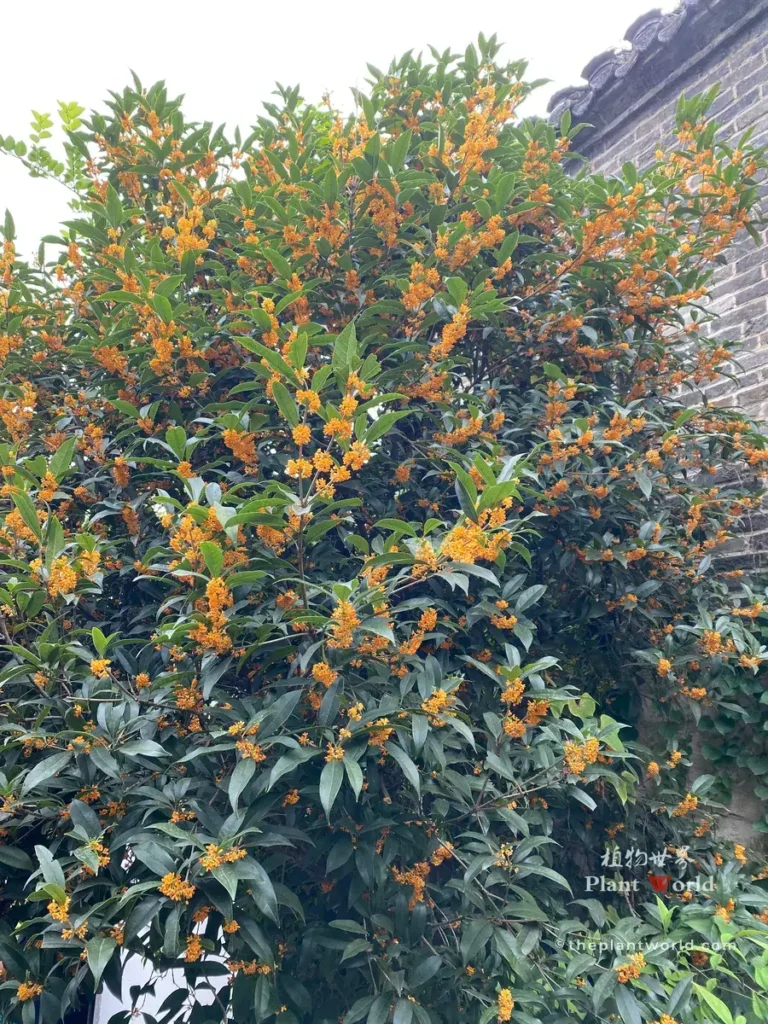
The Four Cultivar Groups: Gold, Silver, Vermilion, and Four-Season
Osmanthus has over 180 cultivated varieties in China. Based on flower color and blooming habit, they are divided into four main cultivar groups:
Gold Osmanthus (O. fragrans var. thunbergii)
Golden or lemon-yellow flowers — the classic, most fragrant osmanthus. Gold osmanthus has the highest β-ionone content (the key sweet-aroma compound) of all four groups, around 15.7%, and linalool (the main aroma compound) reaches 48.3%. Its fragrance is the richest and sweetest. It blooms from September to October and is the first choice for osmanthus tea and osmanthus cake.
Silver Osmanthus (O. fragrans var. latifolius)
Pale, near-white or yellowish-white flowers, with a lighter, more elegant and delicately sweet fragrance than gold osmanthus. Silver osmanthus has the highest total flavonoid content (around 243.7 mg/g rutin equivalent), making it outstanding for medicinal use. It blooms from September to October.
Vermilion Osmanthus (O. fragrans var. aurantiacus)
Orange-yellow to orange-red flowers, deep and striking — the most prized and expensive group. Its fragrance is slightly less intense than gold osmanthus, but it has the strongest antioxidant capacity (ORAC value around 1,842 μmol TE/g). Though lower in β-ionone than gold osmanthus, it is rich in total flavonoids and phenolics. Representative cultivars include “Cinnabar Osmanthus” (朱砂桂), “Top Scholar Red” (状元红), and “Weir Red” (堰红桂). It blooms from late September to early October.
Four-Season Osmanthus (O. fragrans var. semperflorens)
Blooms multiple times throughout the year, with the lightest fragrance — almost no strong aroma. Representative cultivars include “Monthly Osmanthus” (月月桂), “Heavenly Fragrance Pavilion” (天香台阁), and “Daily Fragrant Osmanthus” (日香桂). Four-season osmanthus is ideal for hedges and bonsai; what it lacks in fragrance it makes up for in a long blooming season.
The Chinese Myth: Wu Gang and the Moon Cassia — What is the Chinese myth about osmanthus?
If osmanthus is the messenger of autumn on earth, then in myth it is the immortal tree of the moon.
From Huainanzi to Youyang Zazu: The Birth of the Moon Cassia
The earliest mention of a cassia tree on the moon comes from the Western Han Huainanzi (《淮南子》): “On the moon there is a cassia tree.” By the Tang Dynasty, that simple moon tree had become the center of a complete myth.
The Tang Dynasty writer Duan Chengshi recorded the full story of “Wu Gang chopping the cassia” in his Miscellaneous Morsels from Youyang (《酉阳杂俎・天咫》):
“It is said that on the moon there is a cassia tree and a toad. An unusual book says the moon cassia is five hundred zhàng tall (about 1,500 meters). Beneath it, a man constantly chops at it, but the tree’s wounds heal immediately. The man’s surname is Wu, given name Gang, from Xihe. He committed a fault while studying immortality, and was sentenced to chop the tree as punishment.”
In other words: on the moon stands a cassia tree 1,500 meters tall. A man named Wu Gang chops at it endlessly, but every cut heals instantly — the tree can never be felled. Wu Gang, a man from Xihe, had erred in his pursuit of immortality and was condemned by the Heavenly Emperor to this eternal labor.
From then on, the cassia tree was inextricably linked with Chang’e (the moon goddess), Wu Gang, and the Moon Palace. Poems like “The immortal register floats with cassia fragrance,” “The hare is cold, the toad is cold, the cassia fragrance is white,” “Cassia seeds fall from the moon, heavenly fragrance drifts beyond the clouds,” and “Chop down the moon cassia, and the clear light grows brighter” — all are literary echoes of the moon cassia myth.
Plucking the Cassia in the Toad Palace: From Myth to Academic Glory
The moon cassia myth also gave rise to one of the most important cultural images in China: “plucking the cassia in the Toad Palace” (蟾宫折桂,chángōng zhéguì).
The “Toad Palace” is the Moon Palace (named for the toad said to live on the moon), and “plucking the cassia” means breaking off a branch of the moon cassia tree. The phrase came to mean passing the imperial civil service examination with high honors — the greatest glory a scholar could achieve. After the Tang Dynasty, as the examination system flourished, “plucking the cassia in the Toad Palace” became the most common blessing for students. And so the osmanthus rose from a mere fragrant flower to a symbol of academic success and honor.
Cultural Symbolism: Cassia Means Nobility and Good Fortune
In traditional Chinese culture, “cassia” (桂, guì ) is a homophone for “noble/expensive” (贵,guì), so osmanthus symbolizes wealth, honor, and good fortune.
Auspicious Layout in the Garden
In traditional garden design, the osmanthus is an indispensable auspicious tree:
- Two cassias in the courtyard (两桂当庭): Two osmanthus trees planted symmetrically in a courtyard, meaning “two cassias leave their fragrance” — a wish for family prosperity passed down through generations.
- Jade Hall, Wealth and Honor (玉堂富贵): Osmanthus planted together with yulan magnolia (玉兰), crabapple (海棠), and peony (牡丹) — the four names combine to spell yù táng fù guì, “wealth and honor in the Jade Hall,” the most classic auspicious garden arrangement.
- Early birth of a noble son (早生贵子): Jujubes (枣,zǎo) paired with osmanthus (桂,guì) form the homophone zǎo shēng guì zǐ, “early birth of a noble son” — a common wedding and fertility blessing.
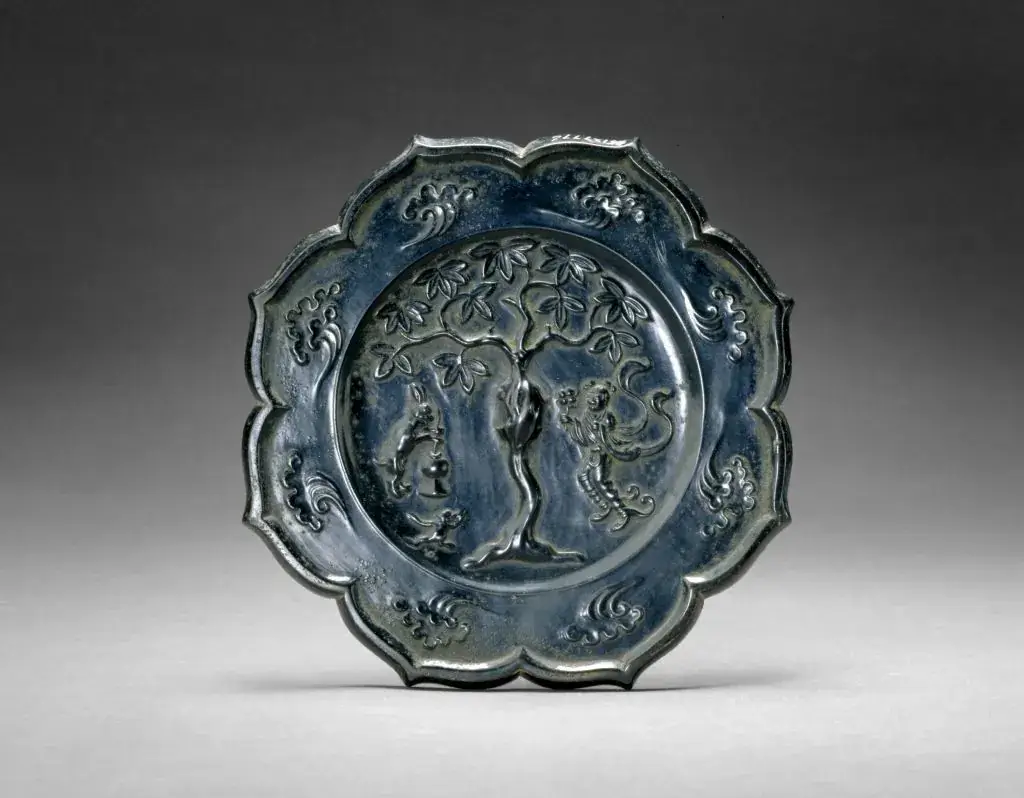
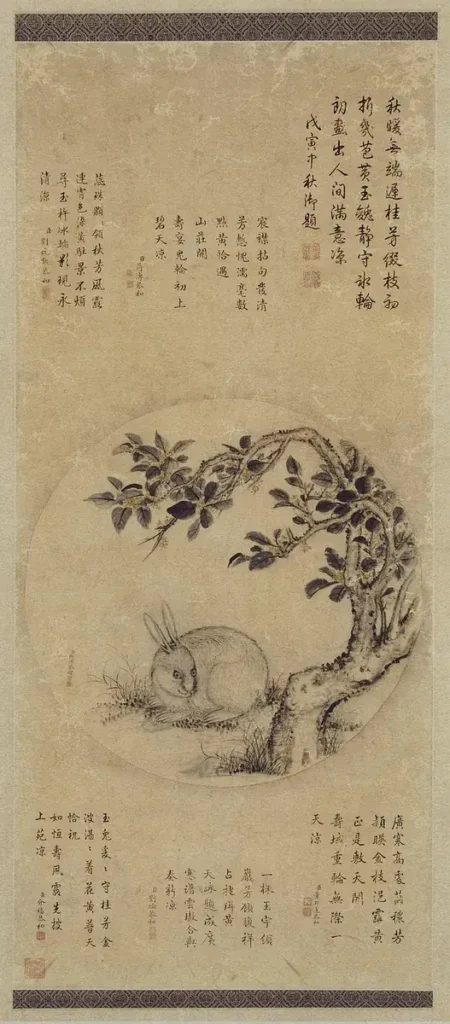
The Palace Museum holds numerous textiles, porcelain, bronze mirrors, scrolls, and fans featuring osmanthus tree and flower motifs — exquisitely crafted, expressing the ancients’ love for the tree. Notable works include the Qing Dynasty Osmanthus and Moon Rabbit by Li Shizhuo and the Ming Dynasty Osmanthus, Chrysanthemum, and Mountain Birds by Lü Ji.
It is one of the richest subjects in all of Chinese flower symbolism.
Osmanthus in Poetry: No Need for Pale Blue or Deep Red — It Is First-Rank Among Flowers
Osmanthus is one of the most evocative autumn images in classical Chinese poetry.
The Song Dynasty poet Li Qingzhao’s Partridge Sky · Osmanthus (《鹧鸪天・桂花》) is the greatest poem ever written about the flower:
Pale and light yellow, its nature gentle,
Distant in feeling, remote in trace — only its fragrance remains.
What need for pale blue or deep crimson?
It is naturally first-rank among flowers.
The plum must envy it, the chrysanthemum should feel shame,
By the painted railing it crowns Mid-Autumn.
The poet Qu Yuan was truly lacking in feeling —
Why did he never include it in his verses?
The poet uses the osmanthus as a metaphor for herself. Pale yellow, gentle in form, it does not compete with other flowers for beauty — it leaves only its fragrance to the world. This is Li Qingzhao’s self-portrait: elegant, pure, steadfast, and noble. The line “What need for pale blue or deep crimson? It is naturally first-rank among flowers” captures the essence of the osmanthus — it wins not by appearance, but by fragrance.
The Tang Dynasty poet Song Zhiwen wrote, “Cassia seeds fall from the moon, heavenly fragrance drifts beyond the clouds” — merging the moon cassia myth with the earthly fragrance of osmanthus. The phrase “heavenly fragrance” (天香) has since become the exclusive praise for osmanthus scent.
An anonymous Song Dynasty poem, Golden Coin (《金钱子》), reads:
Leaning alone on the railing, only the mùxī is elegant.
It breathes a pure fragrance, surpassing orchid and musk.
Like gold piled and shaped, even painting cannot capture it.
A slender hand plucks a branch,
In a crystal vase, one sprig, free and easy.
“Who soaks mùxī yellow by the window? The flowers are fragrant, and so are dreams.” The fragrance of osmanthus is the most nostalgic taste of Jiangnan.
What Does Osmanthus Taste Like?
The taste of osmanthus is a complex sweetness that no single word can capture.
Aroma: A Blend of Apricot, Peach, Jasmine, and Honey
Professional perfumers describe osmanthus aroma as a blend of apricot, peach, jasmine, and honey, with subtle green-tea notes and a warm, leathery undertone. It is one of the rare flowers that “smells more like fruit than petal” — the sweet ripeness of stone fruit, layered with delicate jasmine-like florality, wrapped in a warm, honeyed sweetness.
The characteristic osmanthus fragrance comes from the synergy of three core compounds:
- Linalool (the main aroma compound, around 48% in gold osmanthus): brings fresh floral and citrus notes;
- α-ionone and β-ionone (the key sweet-fruity aroma compounds): present elegant violet-like florality and apricot-peach fruitiness;
- γ-decalactone (the sweet creamy note): brings coconut and cream-like richness.
In addition, benzaldehyde adds a bitter-almond nuance, α-pinene brings pine-freshness, and limonene adds citrus brightness — together they compose the complex layers of osmanthus fragrance.
Taste: Slight Bitterness, Sweet Aftertaste, Sweetness and Umami Dominate
Fresh osmanthus blossoms have a slight bitterness on the tongue, but this is quickly replaced by a sweet aftertaste. Electronic tongue measurements show that, whether heated or not, the pleasant tastes — sweetness, saltiness, and umami — are significantly stronger than bitterness and astringency, and dominate the profile. Low-to-moderate heat has little effect on bitterness and actually reduces astringency; high heat increases both bitterness and astringency. This is why osmanthus in cooking is usually candied or steeped at low temperatures, rather than boiled at high heat for long periods.
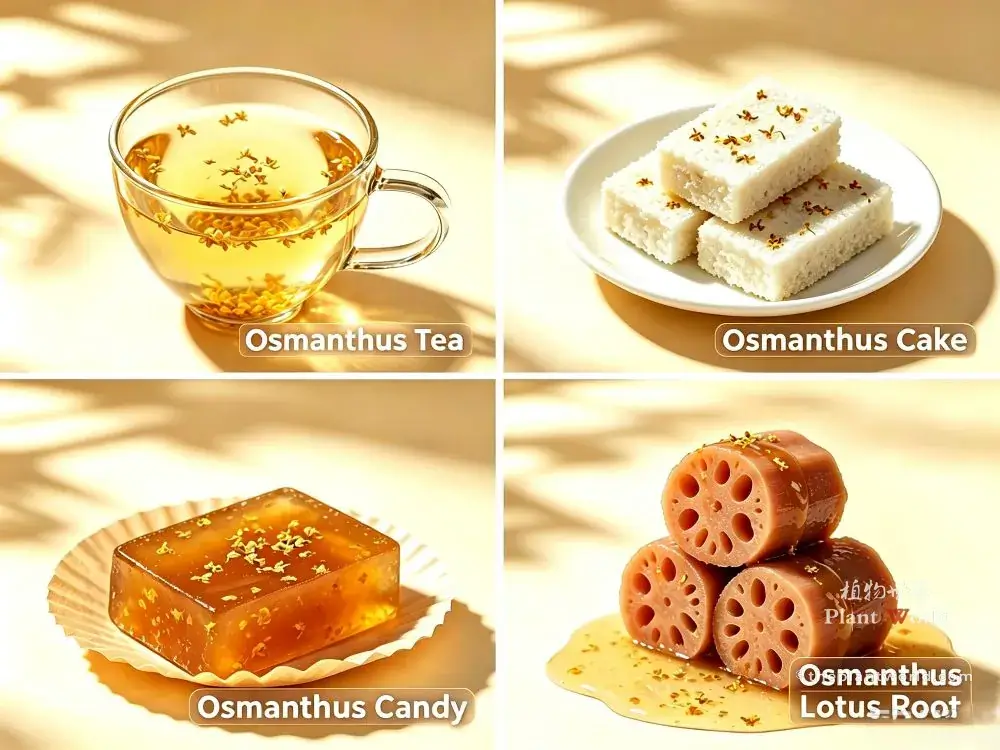
When candied with sugar, the bitterness is neutralized and the sweet fragrance fully released — becoming the soul of osmanthus cake, osmanthus tangyuan (glutinous rice balls), and osmanthus-glazed lotus root. A cup of osmanthus tea enters warm and sweet, lingers with a long fruity-floral finish — as if you have drunk the whole of autumn.
What is Osmanthus Good For?
The happiness osmanthus brings goes far beyond sight and smell. Brew a cup of osmanthus tea, eat a piece of osmanthus cake, let an osmanthus candy melt on your tongue — and your mouth is filled with the taste of osmanthus. It can be admired, eaten, used as medicine, and made into fragrance — a plant where every part serves a purpose.
Culinary: The Taste of Autumn
Osmanthus is one of the most representative floral ingredients in traditional Chinese cuisine:
- Osmanthus tea: Dried osmanthus scented with green or oolong tea — richly fragrant, warming to the stomach, one of the most popular floral teas of autumn.
- Osmanthus cake: Steamed glutinous rice flour with candied osmanthus — soft, sticky, and sweetly fragrant, a classic Jiangnan pastry.
- Osmanthus sugar / osmanthus jam: Fresh osmanthus layered alternately with sugar and sealed — can be stored long-term, used for drinks, porridge, and dessert fillings.
- Osmanthus wine: Osmanthus steeped in rice wine or baijiu — golden in color, rich in aroma; drinking osmanthus wine at Mid-Autumn is a traditional custom.
- Osmanthus-glazed lotus root: Lotus root stuffed with glutinous rice, slowly simmered in osmanthus syrup — the iconic autumn dish of Jiangnan.
Medicinal: Warming the Lungs, Dispelling Cold, Relieving Pain
Osmanthus is a classic medicine-food homology herb. Its medicinal use has been documented in traditional Chinese medicine for over a thousand years, and it was comprehensively described by Li Shizhen in the Compendium of Materia Medica (《本草纲目》) under the name mùxī.
- Nature and flavor: Pungent, warm; enters the lung, spleen, and kidney meridians.
- Functions: Warms the lungs and resolves phlegm-fluid, dispels cold and relieves pain.
- Indications: Cough and asthma due to phlegm-fluid, cold pain in the abdomen, bloody dysentery, amenorrhea and dysmenorrhea, cold hernia pain, toothache, bad breath.
- Folk use: Osmanthus decocted as a mouthwash treats toothache and bad breath; osmanthus combined with ginger, decocted and taken, warms the meridians and relieves cold-type menstrual pain.
Modern research shows osmanthus contains volatile oils (linalool, ionones, etc.), flavonoids (luteolin, quercetin), and polysaccharides — with antitussive and expectorant effects, promotion of gastric juice secretion, relief of gastrointestinal spasms, sedative and calming effects, antioxidant activity, and antibacterial properties. The linalool and other volatile compounds in osmanthus, when inhaled through the nasal cavity, enter the limbic system and promote serotonin secretion — with an aromatherapeutic effect that soothes anxiety and tension.
⚠️ Ethnobotanical disclaimer: The above is for historical and cultural reference only and does not constitute medical advice. Consult a qualified healthcare professional before use.
It holds a respected place within traditional Chinese plant‑based medicine.
Ornamental and Fragrance
- Ornamental: The osmanthus has an elegant form, stays evergreen, and fills the air with fragrance in autumn — it is the most common fragrant flowering tree in traditional Chinese gardens. It can be planted alone, in pairs, in clusters, or used as hedges and bonsai. It remains one of the most beloved Chinese garden plants.
- Fragrance: Osmanthus essential oil is a precious ingredient in high-end perfumery and aromatherapy — its unique sweet-fruity fragrance has no equivalent in the perfumer’s palette. Osmanthus sachets, soaps, and diffusers are popular autumn aromatic products.
Final Thoughts
Osmanthus is like an honored guest, arriving punctually every autumn, bringing warm comfort to those of us living our hardworking lives on earth.
It is the 1,500-meter immortal tree that Wu Gang can never chop down in the Moon Palace; it is the pale-yellow fragrance that Li Qingzhao called “naturally first-rank among flowers”; it is the academic dream of “plucking the cassia in the Toad Palace”; it is the “two cassias in the courtyard” of family prosperity; it is the warm sweetness in a cup of osmanthus tea; and it is the autumn that walks into you unawares on a Jiangnan street corner.
Osmanthus in China was never just an ordinary flower. Its Chinese name is guìhuā; its myth lives on the moon; its taste is the sweet aroma of apricot, peach, and honey; its uses stretch from dining table to apothecary, from garden to perfume bottle — it has condensed all the beauty of autumn into tiny, millet-grain yellow flowers.
“Year after year, when the green cassia blooms, yellow snow clusters the branches — a wonder of its own.” “On a jade-green branch, one grain of yellow; in a gauze curtain, dreams are fragrant.” The fragrance of osmanthus is the most nostalgic taste of Jiangnan, and the gentlest footnote to a Chinese autumn. It is a timeless chapter in Chinese plant culture.
References
Plants of the World Online (POWO). Osmanthus fragrans (Thunb.) Lour. Royal Botanic Gardens, Kew. — Primary taxonomic database for modern botanical classification.
Tao Gu, Qingyi Lu (《清异录》, Five Dynasties / Early Song) — Earliest unambiguous historical attestation of mùxī (木犀) as flowering osmanthus, distinguishing it from Cinnamomum (cinnamon).
Duan Chengshi, Miscellaneous Morsels from Youyang (《酉阳杂俎》, Tang Dynasty) — Definitive classical record of the “Wu Gang chopping the moon cassia” myth.
Li Shizhen, Compendium of Materia Medica (《本草纲目》, Ming Dynasty, 1578) — Historical documentation of the medicinal properties, thermal nature, and therapeutic applications of mùxī.
Frontiers in Pharmacology (2022). “Secondary Metabolites of Osmanthus fragrans: Metabolism and Medicinal Value.” — Contemporary research on volatile terpenoids, flavonoids, and active pharmacological compounds.
More from The Plant World:
- Chinese Wingnut: The Romantic “Ingot Tree” and Its Cultural Charm
- Plum Blossom Meaning: Symbolism & Cultural Significance
- The Hidden Meanings Behind Red Plum Blossoms
- Chinese Wisteria: History, Symbolism, and Identification
- Peach Blossoms in China: History, Culture, and Symbolism
- Chinese Crepe Myrtle: Guide to Origins & Symbolism
- Ginkgo Leaf Meaning: 5 Secrets of This Ancient Fossil
- Chinese Loquat Tree: Guide to Benefits & History
- Rose of Sharon Tree: Guide to Meaning & Care
- Hosta Plant Benefits: 5 Surprising Uses & Planting Guide
- Strawberry Begonia Care: How to Grow Saxifraga Stolonifera
Discover more from The Plant World
Subscribe to get the latest posts sent to your email.