
Introduction
“It is not that I alone favor the chrysanthemum among flowers — after this flower blooms, there will be no more.”
When the autumn wind howls and a hundred flowers wither, the chrysanthemum blooms proudly against the frost. It is one of China’s Ten Traditional Famous Flowers, one of the Four Gentlemen of Flowers (alongside plum blossom, orchid, and bamboo), and the flower most familiar to Chinese people in autumn. From the Book of Rites‘ “in the last month of autumn, the chrysanthemum bears yellow flowers” to Tao Yuanming’s “picking chrysanthemums by the eastern hedge, I gaze calmly at the southern mountain” — from climbing heights and drinking chrysanthemum wine at the Double Ninth Festival to a quiet cup of chrysanthemum tea today — the chrysanthemum has long been woven into the life, culture, and blood of the Chinese people.
To understand the chrysanthemum, you have to start with its chrysanthemum flower meaning and its chrysanthemum flower uses.
- Introduction
- Plant Profile
- Cultivars and Growing Types
- Chrysanthemum Flower Meaning: The Noble, the Long-Lived, and the Hermit
- History and Literature: Three Thousand Years of Chrysanthemum Memory
- Chrysanthemum Flower Uses: Edible, Medicinal, Ornamental, and for Pillows
- Toxicity and Pet Safety
- Cultivation and Care Guide
- Final Thoughts
- References
- More from The Plant World:
Plant Profile
- Scientific Name: Chrysanthemum × morifolium (Ramat.) Hemsl. (a hybrid-origin cultivar; synonyms: C. morifolium Ramat., Dendranthema morifolium)
- Common Names: Chrysanthemum, Mums, Florist’s Chrysanthemum
- Chinese Name: 菊花 (jú huā); also 鞠,菊华,寿客 (“longevity guest”), 金英 (“golden blossom”), 日精 (“sun essence”), 九华,隐逸花 (“hermit flower”), 延年 (“longevity”), 治蘠
- Family: Asteraceae (the Daisy Family, formerly Compositae) → Genus Chrysanthemum
- Native Range: China (hybrid origin — bred from multiple wild Chrysanthemum species including C. indicum and C. zawadskii; no single wild progenitor exists)
- Cultivation History: Over 3,000 years in China; introduced to Japan during the Tang Dynasty. It later became the symbolic imperial flower of the Japanese imperial house, adopted as the official imperial crest from the Kamakura period onward.
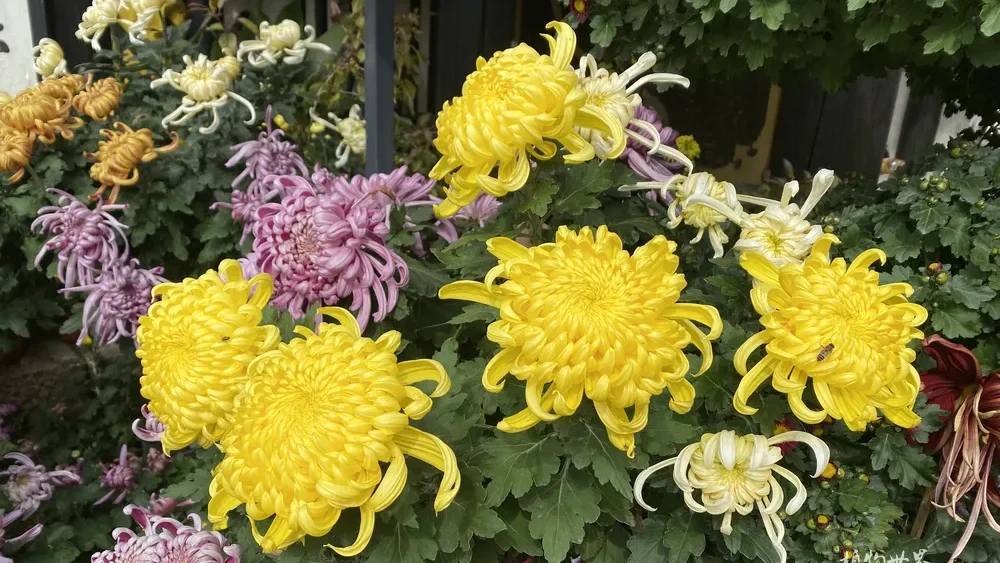
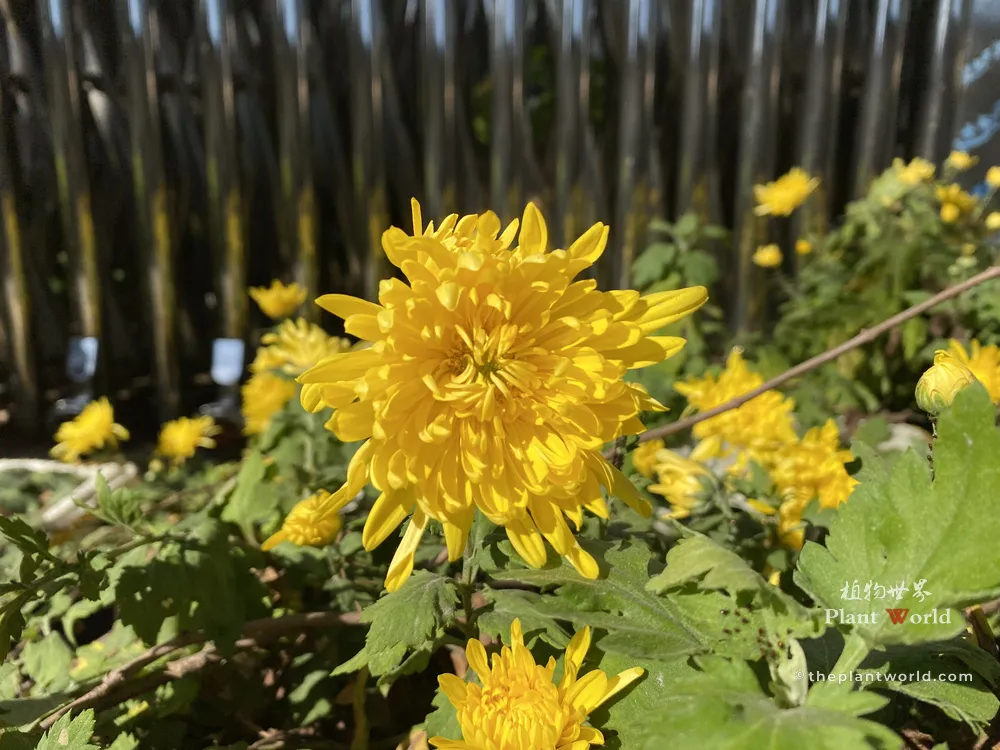
The chrysanthemum is a perennial herbaceous plant growing 60 to 150 centimeters tall. Its stems are erect and much-branched. Leaves are alternate, ovate to lanceolate, with coarsely toothed or deeply lobed margins. The inflorescence is a head (capitulum) borne terminally or in leaf axils, composed of ray florets and disk florets — what we see as “petals” are actually ray florets, while the “center” is made of disk florets, a hallmark of the Asteraceae. Flower colors are extraordinarily rich: yellow, white, red, purple, green, inky black, and even bicolored and patterned varieties. It flowers mainly from October to November and is a classic short-day plant.
It is worth noting that the “×” in the scientific name indicates that the chrysanthemum is a hybrid-origin cultivated complex with no single wild progenitor. Modern genomic research shows that cultivated chrysanthemums were bred primarily from wild Chrysanthemum species such as C. indicum, C. zawadskii, and C. rhombifolium through over 2,500 years of artificial hybridization in China. The genus Chrysanthemum has about 30 species worldwide, 17 of which are native to China — China is truly the homeland of the chrysanthemum.
Cultivars and Growing Types
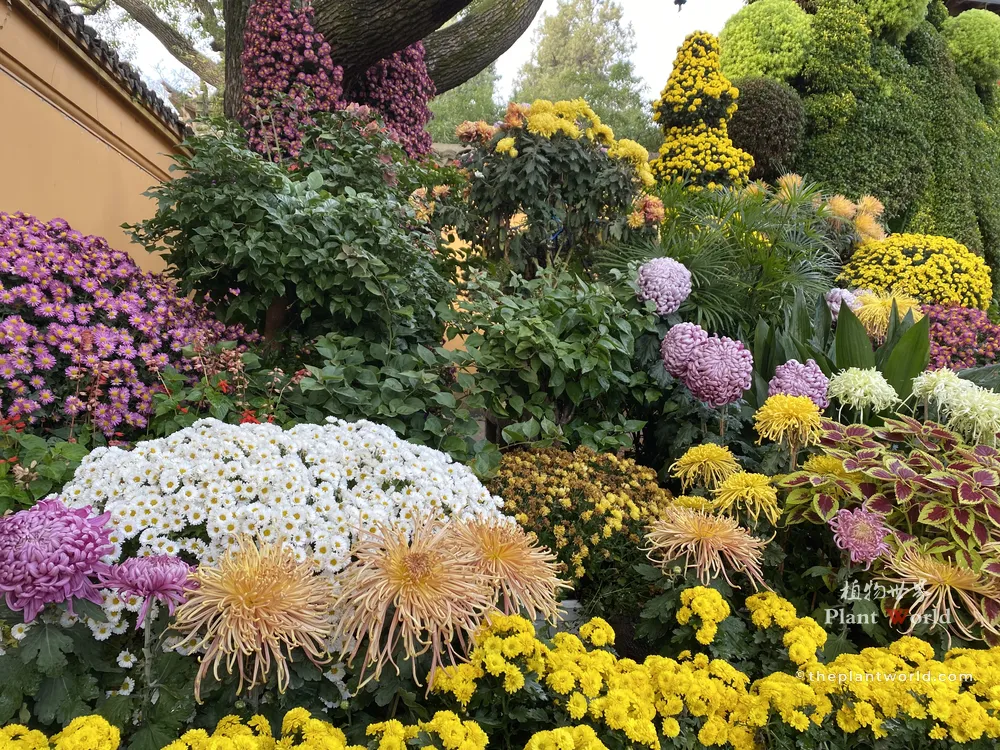
The chrysanthemum is one of the most cultivar-rich flowers in the world, with over 3,000 cultivars in China alone. By growing form, they are classified as:
- Single-stem chrysanthemum (独本菊): One flower per stem, large and vivid, used for cultivar displays and competitions.
- Multi-stem chrysanthemum (多头菊): Several to dozens of flowers per plant, used for flower beds and potted displays.
- Large standard chrysanthemum (大立菊): A single plant bearing hundreds to thousands of flowers, trained into a disk or fan shape — the centerpiece of any chrysanthemum exhibition.
- Cascade chrysanthemum (悬崖菊): Trailing, cascading branches like a waterfall, used for elevated displays.
- Art chrysanthemum (艺菊): Grafted and shaped into artistic forms — towers, dragons, animals, and more.
- Tabletop chrysanthemum (案头菊): Dwarf plants with large flowers, ideal for desks and tabletops.
⚠️ Note: Some sources mistakenly write “大丽菊” (dahlia) instead of “大立菊” (large standard chrysanthemum). This is incorrect — the dahlia (Dahlia spp.) is a separate genus in the Asteraceae and is not a chrysanthemum cultivar type.
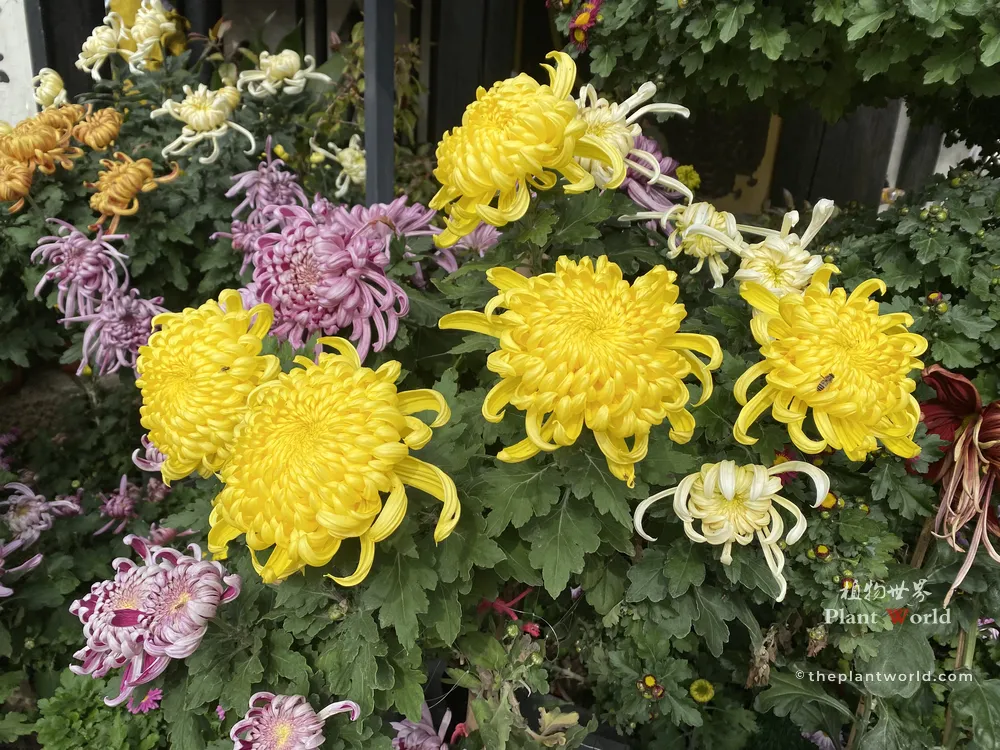
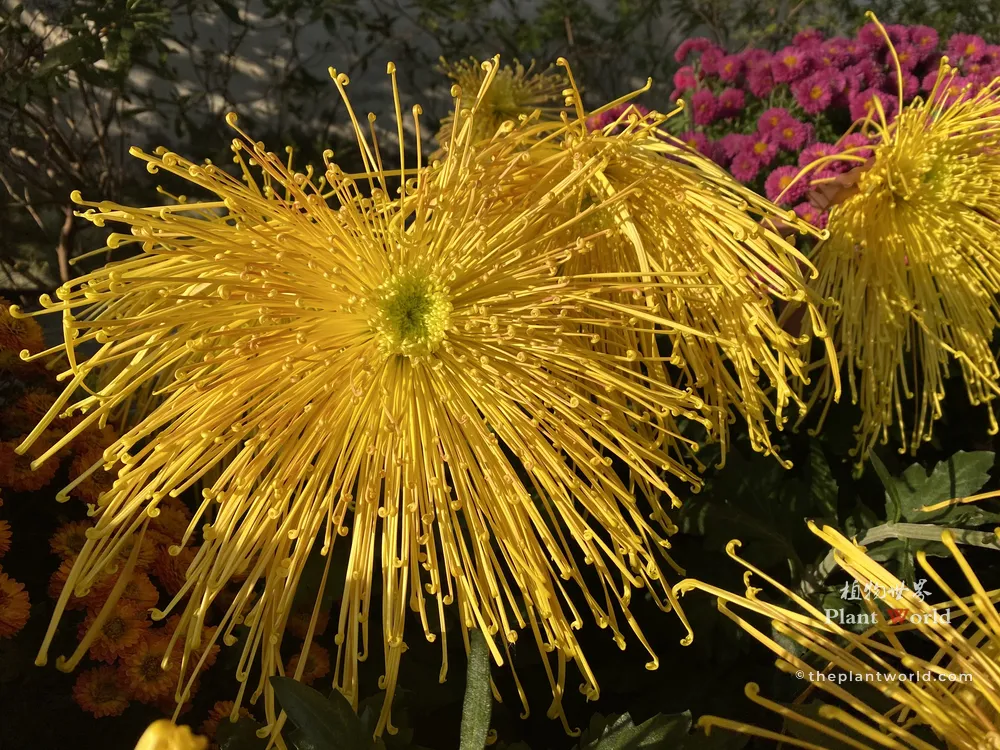
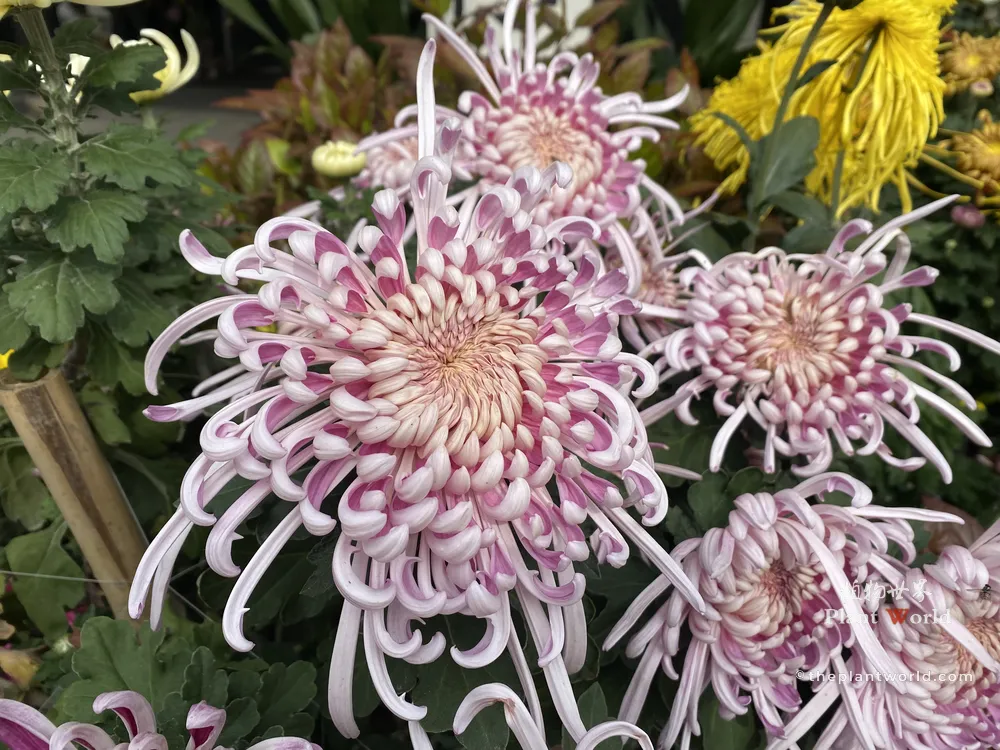
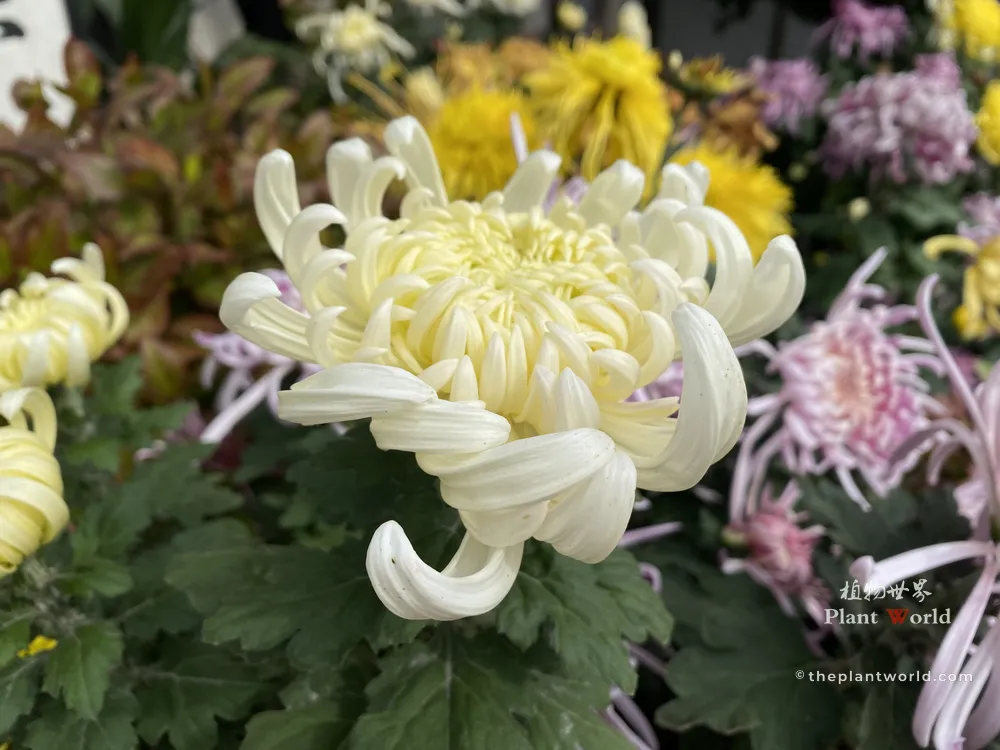
By petal form, they are divided into flat, spoon, tube, osmanthus, and irregular petals; by flower form, into rounded, recurved, feathery, reflexed, irregular, and open-centered types. Endless combinations produce the staggering diversity of chrysanthemum cultivars.
After the Song Dynasty, chrysanthemum cultivation advanced from outdoor planting to potted cultivation, and grafting onto other rootstocks became possible. New flower colors emerged, including green “Green Lotus” (绿芙蓉) and black “Ink Chrysanthemum” (墨菊). Meng Yuanlao, in Dongjing Meng Hua Lu (《东京梦华录》), records that during the Double Ninth Festival in Northern Song Bianjing, several chrysanthemum varieties were already known — “Ten-Thousand-Year Chrysanthemum,” “Peach Blossom Chrysanthemum,” “Wooden Fragrance Chrysanthemum,” and “Golden Bell Chrysanthemum” — showing how advanced chrysanthemum cultivation had become by the Song.
Chrysanthemum Flower Meaning: The Noble, the Long-Lived, and the Hermit
In Chinese culture, the chrysanthemum’s meaning is multilayered — it is the noble gentleman who defies frost, the symbol of good fortune and longevity, and the flower of the hermit who retires from the world.
One of the Four Gentlemen: Defying Frost with Integrity
The chrysanthemum, together with the plum blossom, orchid, and bamboo, is known as one of the Four Gentlemen of Flowers. It blooms after all other flowers have faded, with an elegant form. People love not only its refined charm but also its proud integrity in blooming against frost and standing firm in the west wind.
Zhong Hui, a scholar of the Cao Wei state during the Three Kingdoms period, praised the chrysanthemum for its “Five Virtues” in his Ode to the Chrysanthemum (《菊花赋》):
“Its round flower hangs high, matching the celestial pole; its pure yellow is unmixed, the color of the earth; it is planted early and harvested late, the virtue of the gentleman; it puts forth blossoms through frost, symbolizing strength and uprightness; its lightness of body makes it the food of immortals.”
The round flower corresponds to the heavens, the pure yellow to the earth, early planting and late harvest to the gentleman’s virtue, blooming through frost to upright strength, and lightness of body to the food of immortals — the chrysanthemum was endowed with a complete moral personality, from form to character.
The Song Dynasty poet Lu You praised it: “The chrysanthemum is like an upright person, standing alone through ice and frost. Its name is recorded in pre-Qin books; its merit is listed in the recipes of immortals.” Comparing the chrysanthemum to a person of integrity standing alone in frost and snow captures the very core of its spiritual symbolism.
Good Fortune and Longevity: The Longevity Guest
Another important meaning of the chrysanthemum is longevity. Shennong’s Classic of Materia Medica (《神农本草经》) listed the chrysanthemum as a superior-grade herb, stating that “long-term use of chrysanthemum benefits the blood and qi, lightens the body, resists fatigue, and prolongs life.” Hence the chrysanthemum’s alternative names include “Longevity Guest” (寿客) and “Prolonging Life” (延年) — directly expressing the wish for long life.
The ancients called the chrysanthemum “Sun Essence” (日精) — its golden yellow color symbolizes the essence of the sun, and long-term use was believed to strengthen the body and prolong life. In traditional auspicious patterns, the chrysanthemum paired with the pine symbolizes “pine and chrysanthemum prolong life,” and paired with the quail symbolizes “peaceful longevity” — common motifs for birthday and auspicious decorations.
The Hermit’s Flower: Tao Yuanming and the Chrysanthemum
No discussion of the chrysanthemum’s cultural meaning is complete without Tao Yuanming.
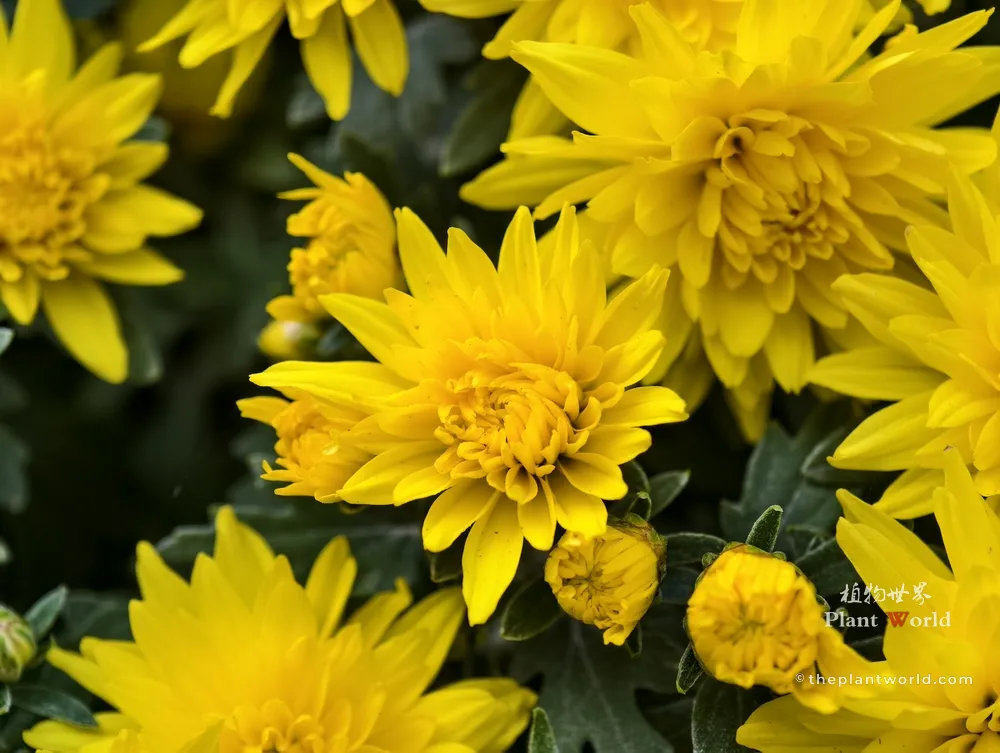
“Picking chrysanthemums by the eastern hedge, I gaze calmly at the southern mountain.” These two lines have become almost synonymous with the chrysanthemum. Tao Yuanming grew, admired, and drank wine with chrysanthemums, firmly linking the flower with the hermit’s spirit of retiring to the countryside, rejecting fame and profit, and preserving purity.
That said, Tao Yuanming’s reasons for growing chrysanthemums may have been less ethereal than later generations imagined — he grew them primarily for wine-making and medicinal use. But his praise of the flower had a profound influence on later literati. After the Song Dynasty, scholars often used the chrysanthemum as a symbol of the hermit and of purity, so much so that it was said, “between the hedges and vegetable plots of a lofty hermit, one cannot go a single day without this flower.” The chrysanthemum thus became the representative flower of hermit culture.
The Double Ninth Festival: Chrysanthemum Wine and Warding Off Evil
The chrysanthemum is inseparably linked to the Double Ninth Festival (the ninth day of the ninth lunar month).
The ancients believed that on the Double Ninth Festival, the rising earth qi and descending heaven qi intersect — and to avoid exposure to inauspicious qi (不正之气), people needed to climb to high places to ward off evil. By the Wei and Jin dynasties, customs had developed of wearing dogwood on the head, climbing heights, and drinking chrysanthemum wine. At the time, even palace women called chrysanthemum wine the “Longevity Wine” and exchanged it as a tonic.
In Lin’an (Hangzhou) during the Southern Song, every Double Ninth was called the “Chrysanthemum Festival” (开菊会). People drank chrysanthemum wine, and the court grew chrysanthemums, wore chrysanthemum branches, hung chrysanthemum lanterns, and drank chrysanthemum wine. Admiring chrysanthemums has long been a beloved Chinese folk tradition — from ancient imperial courts and noble households to common people, and from ancient times to today, chrysanthemum festivals and exhibitions are held every autumn across China.
It is one of the richest subjects in all of Chinese flower symbolism.
History and Literature: Three Thousand Years of Chrysanthemum Memory
China’s chrysanthemum cultivation history stretches back over 3,000 years, and literati have been entwined with the flower since ancient times.
Pre-Qin: From the Book of Rites to the Songs of Chu
As early as the Book of Rites · Monthly Commands (《礼记・月令》), it is recorded: “In the last month of autumn, the chrysanthemum bears yellow flowers“— linking the chrysanthemum’s flowering period to the seasonal calendar. Here”ju” (鞠) is the ancient name for chrysanthemum.
The ancient dictionary Erya (《尔雅》) records: “The chrysanthemum is also called zhiqiang (治蘠).” Other ancient names include “Sun Essence” (日精) and “Prolonging Life” (延年) — the former referring to its golden color symbolizing the sun’s essence, the latter to its medicinal function.
In the Warring States period, Qu Yuan wrote in Songs of Chu · Li Sao (《楚辞・离骚》): “In the morning I drink the fallen dew of the magnolia; in the evening I eat the fallen petals of the autumn chrysanthemum.” This began the tradition of eating chrysanthemums and, by pairing the spring orchid with the autumn chrysanthemum, launched the later tradition of admiring both orchids and chrysanthemums.
Tang and Song: From Tao Yuanming to the Bianjing Chrysanthemum Festival
Tao Yuanming’s “picking chrysanthemums by the eastern hedge” elevated the flower to the pinnacle of hermit culture.
During the Tang Dynasty, the chrysanthemum was introduced to Japan, where it was later adopted as the imperial flower — the Japanese emperor’s crest is the sixteen-petal chrysanthemum, and the imperial family is known as the “Chrysanthemum Throne.” A Chinese flower becoming the supreme symbol of power in another country is rare in world cultural history.
The Song Dynasty was a period of great development in chrysanthemum cultivation. It advanced from outdoor planting to potted cultivation, and grafting onto other rootstocks became possible. New colors emerged, including green “Green Lotus” and black “Ink Chrysanthemum.” Meng Yuanlao’s Dongjing Meng Hua Lu records several varieties already known in Northern Song Bianjing. In Southern Song Lin’an, the “Chrysanthemum Festival” was held, with both court and common people admiring chrysanthemums and drinking chrysanthemum wine.
Song people had a comprehensive summary of the chrysanthemum’s uses: “The shoots can be eaten as vegetables, the flowers used as medicine, the flowers stuffed into sachets for pillows, and the flowers brewed into wine.” A single chrysanthemum, from shoot to flower, from food to medicine, had extraordinarily wide uses.
Ming and Qing to Today: From Chrysanthemum Exhibitions to Chrysanthemum Tea
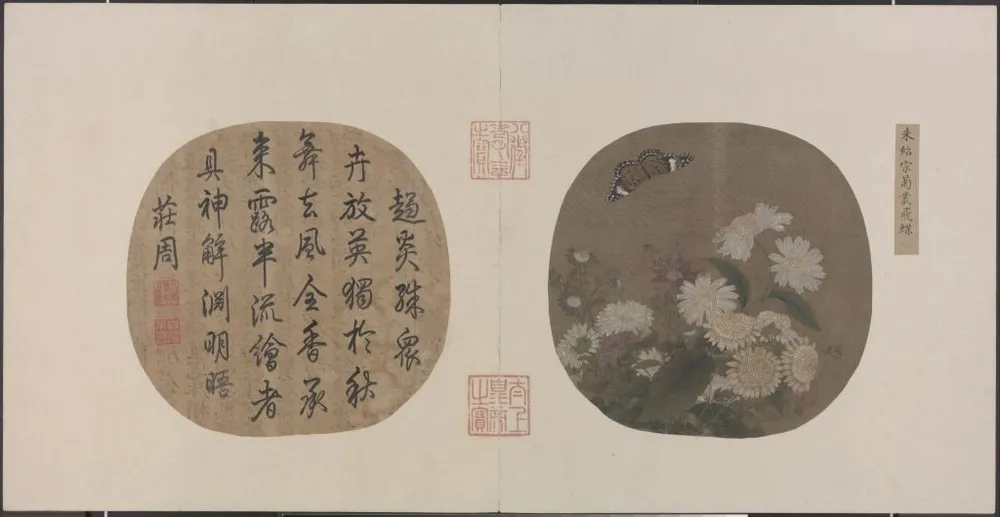
During the Ming and Qing dynasties, chrysanthemum cultivation became more refined, with ever-richer cultivars. Qing Dynasty paintings such as Xu Gu’s Vase of Chrysanthemums (《瓶菊图轴》), Shen Huan’s Chrysanthemum, Rock, and Crabapple (《菊石海棠图轴》), and Zhu Shaozong’s Butterflies Flying Among Chrysanthemums (《菊丛飞蝶图页》) are classic works featuring the chrysanthemum.
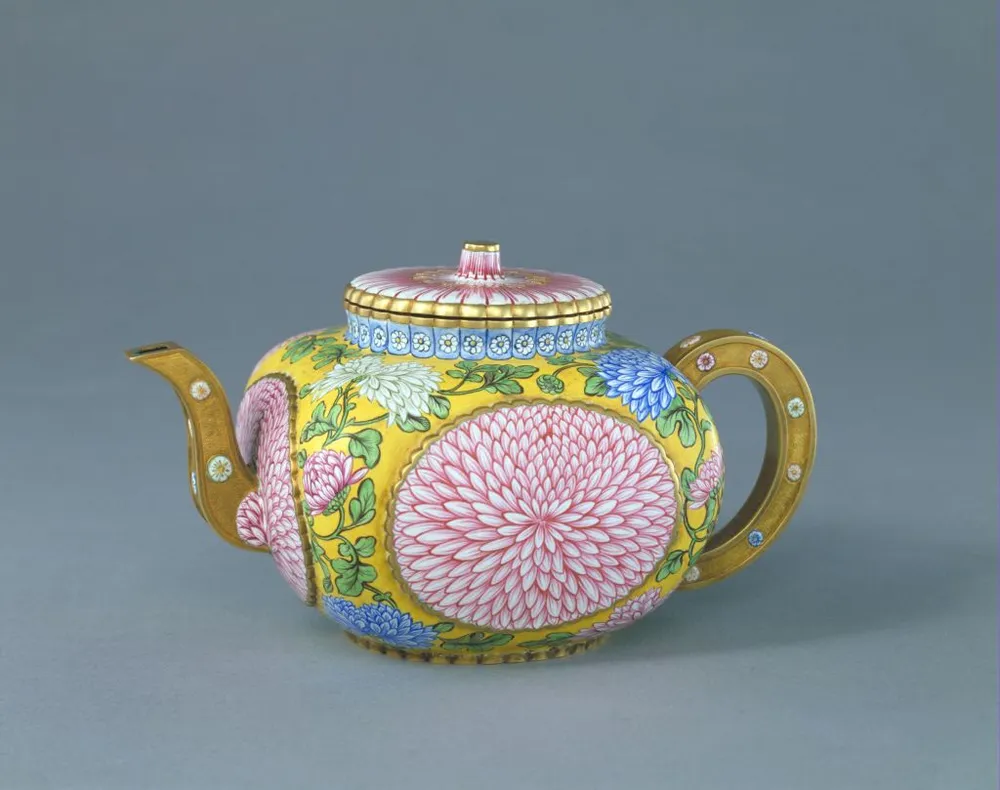
A Republican-era textbook described the chrysanthemum simply and vividly: “When chrysanthemums bloom, their clear fragrance fills the air. Their petals are like silk, like claws. Their colors are yellow, white, reddish-brown, or red. There are many varieties. They tolerate cold; when the harsh frost descends and all flowers fall, the chrysanthemum alone flourishes.”
Today, annual chrysanthemum exhibitions are held across China — from Beihai Park in Beijing to Huishan Ancient Town in Wuxi, from Kaifeng to Hangzhou — the autumn chrysanthemum exhibition remains the most familiar autumn event for Chinese people.
Chrysanthemum Flower Uses: Edible, Medicinal, Ornamental, and for Pillows
The chrysanthemum is a plant where every part serves a purpose. The Song saying — “shoots as vegetables, flowers as medicine, sachets as pillows, brewed as wine” — still holds true today.
Edible: Chrysanthemum Tea, Wine, and Cuisine
- Chrysanthemum tea: The most common way to consume chrysanthemums. Tea-grade chrysanthemums (such as Hang white chrysanthemum, tribute chrysanthemum, and emperor chrysanthemum) have a light, slightly sweet flavor and clear fragrance — one of the most popular autumn teas.
- Chrysanthemum wine: The traditional drink of the Double Ninth Festival. Wine brewed or infused with chrysanthemums was anciently called “Longevity Wine,” believed to be tonic and life-prolonging.
- Chrysanthemum in cuisine: Chrysanthemum petals are fragrant and can be eaten raw or cooked, or shredded into fillings. Chrysanthemum hot pot, chrysanthemum fish fillets, chrysanthemum porridge, and chrysanthemum cake are all common chrysanthemum dishes.
- Chrysanthemum pillow: Dried chrysanthemums stuffed into a cloth pillow — ancients believed it clears the liver, brightens the eyes, and calms the nerves for better sleep.
Medicinal: Dispersing Wind-Heat, Calming the Liver, and Brightening the Eyes
The chrysanthemum is a traditional Chinese medicine, listed in the 2026 edition of China’s Catalogue of Substances That Are Traditionally Both Food and Chinese Medicinal Materials — a flower that is both healthful and delicious.
- Nature and flavor: Sweet, bitter, slightly cold; enters the lung and liver meridians.
- Functions: Disperses wind-heat, calms the liver and brightens the eyes, clears heat and resolves toxins.
- Indications: Wind-heat common cold, headache and dizziness, red and swollen eyes, blurred vision, carbuncles and sores.
- Classical records: Listed as a superior-grade herb in Shennong’s Classic of Materia Medica — “long-term use benefits the blood and qi, lightens the body, resists fatigue, and prolongs life”; the Compendium of Materia Medica records that chrysanthemum “treats wind-heat of the head and eyes, vertigo, skull pain, and all wandering wind on the body, disperses it, and benefits the blood vessels.”
The Four Famous Medicinal Chrysanthemums: Tea-Grade vs. Medicine-Grade
Chinese medicinal chrysanthemums are known as the “Four Famous Chrysanthemums”:
| Cultivar | Origin | Characteristics |
|---|---|---|
| Hangju (杭菊) | Tongxiang, Zhejiang | Large, broad petals, light and sweet — best for tea |
| Boju (亳菊) | Bozhou, Anhui | Loose flowers, strong medicinal aroma — primarily medicinal |
| Chuju (滁菊) | Chuzhou, Anhui | Small, tight flowers, golden centers — primarily medicinal |
| Huaiju (怀菊) | Henan | Smaller flowers, strong medicinal taste — primarily medicinal |
Other well-known varieties include Gongju (贡菊,tribute chrysanthemum) from Huangshan, Anhui; Huangju (皇菊,emperor chrysanthemum) from Yichun, Jiangxi; and Qiju (祁菊) from Hebei.
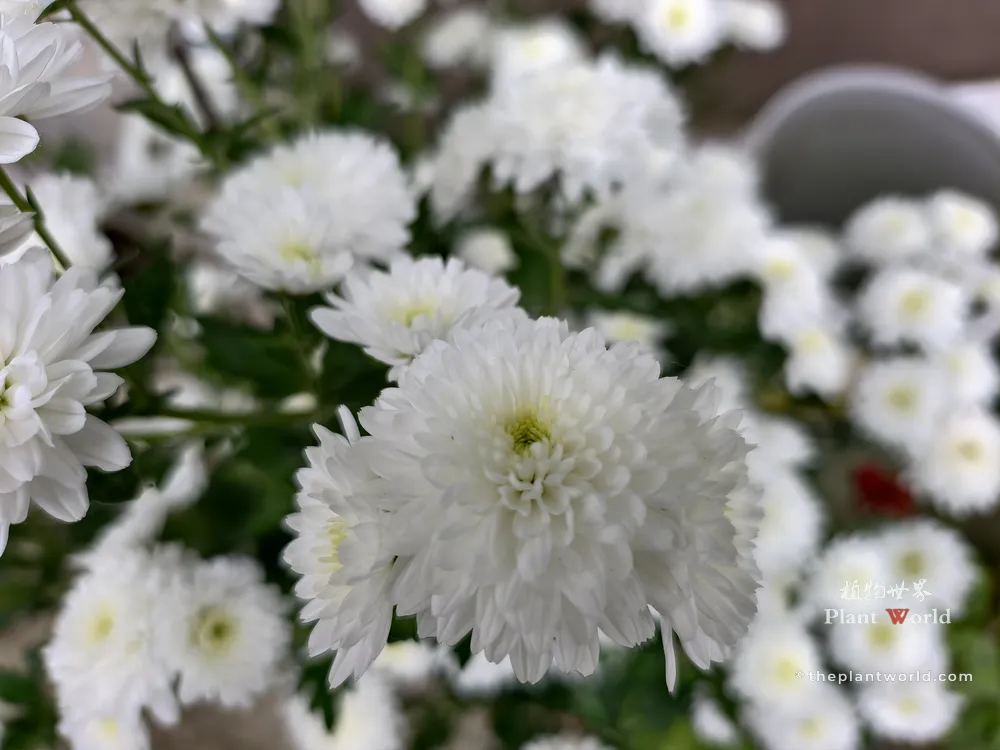
There is a Zhejiang saying: “Yellow chrysanthemum for medicine, white chrysanthemum for tea.” Tea-grade chrysanthemums (such as Hang white chrysanthemum and Gongju) are light and slightly sweet; medicine-grade chrysanthemums (such as Boju and Chuju) have a strong “mugwort” aroma and bitterness. The two differ noticeably in taste and use — an important distinction when purchasing.
Modern Research
Modern scientific research shows that chrysanthemums are rich in bioactive compounds:
- Flavonoids: Quercetin, luteolin, apigenin, kaempferol, and others — reaching 2% to 4% in dried flowers, with strong antioxidant effects.
- Chlorogenic acid: 0.5% to 1.5%, with antioxidant capacity even exceeding vitamin C.
- Phenolic acids, terpenoids, volatile oils, polysaccharides: Together forming the chrysanthemum’s active compound system.
Modern pharmacological studies confirm that chrysanthemums have antioxidant and anti-aging, anti-inflammatory and antipyretic, antibacterial and antiviral, cardiovascular-protective (coronary dilation, blood pressure reduction), and eye-protective (improving ocular microcirculation, relieving eye fatigue) effects.
⚠️ Ethnobotanical disclaimer: The above is for historical and cultural reference only and does not constitute medical advice. Those with spleen-stomach deficiency-cold (chronic diarrhea, poor appetite) should avoid long-term, heavy consumption of chrysanthemum tea. Consult a qualified healthcare professional before use.
It is a valued member of the Chinese herbaceous plants tradition.
Ornamental: Chrysanthemum Exhibitions and Art Chrysanthemums
The chrysanthemum is the most important ornamental flower of autumn. Ranging from the large, vivid flowers of single‑stem chrysanthemum to the profuse blooms of large standard chrysanthemum, from the waterfall‑like trailing branches of cascade chrysanthemum to the sculpted artistry of art chrysanthemum — the chrysanthemum, with its rich cultivars and extraordinary plasticity, is the undisputed star of autumn gardens.
Toxicity and Pet Safety
While the chrysanthemum is a safe food and medicine for humans, it has clear toxicity for pets.
The American ASPCA (American Society for the Prevention of Cruelty to Animals) explicitly lists Chrysanthemum spp. as toxic to dogs, cats, and horses.
- Toxic principles: Sesquiterpenes, lactones, pyrethrins, and other potential irritants.
- Clinical signs: Vomiting, diarrhea, hypersalivation, incoordination, dermatitis.
- Cats are especially sensitive: Cats have a far lower capacity to metabolize pyrethrins than dogs (limited glucuronidation), and even small amounts can cause severe neurological symptoms (tremors, seizures, coma, even death). The Hong Kong Agriculture, Fisheries and Conservation Department lists the chrysanthemum as a “first-degree highly toxic” plant for cats.
⚠️ Pet safety note: Households with cats should avoid placing chrysanthemums within feline reach. If you suspect your pet has ingested chrysanthemum, contact a veterinarian or the ASPCA Animal Poison Control Center immediately.
Cultivation and Care Guide
The chrysanthemum is robust and low-maintenance — an ideal autumn flower for gardens and balconies.
Light and Temperature
- Light: Loves full sun, requiring at least 6 hours of direct sunlight daily. Insufficient light causes leggy growth and sparse flowering. The chrysanthemum is a classic short-day plant — it only initiates flower buds when day length drops below 12 hours, which is why it blooms in autumn.
- Temperature: Loves cool conditions and tolerates cold. Optimal growing temperature is 15–25°C, optimal flowering temperature 10–20°C. Underground rootstocks can tolerate lows around -10°C, surviving winter outdoors in most of northern China.
Watering and Soil
- Watering: Loves moisture but hates waterlogging. Keep soil moist during the growing season, following the “water when the surface dries” principle. Water once daily in summer heat; ensure good drainage during rainy seasons. Moderate water control during flowering can extend bloom time.
- Soil: Not fussy about soil, but thrives in fertile, loose, well-drained sandy loam. Prefers slightly acidic to neutral pH.
Fertilizing and Pruning
- Fertilizing: Apply nitrogen fertilizer after spring budbreak to promote leaf and branch growth; from late summer to early autumn (bud formation), increase phosphorus-potassium fertilizer (such as potassium dihydrogen phosphate) to promote larger, more vivid flowers. Apply dilute liquid fertilizer weekly before flowering.
- Pruning: Chrysanthemums sprout vigorously and require regular pinching to promote branching and control height. Single-stem chrysanthemums require continuous removal of side buds to ensure the terminal flower develops; multi-stem chrysanthemums require multiple pinchings. Cut back above-ground parts after flowering, leaving rootstocks to overwinter.
Propagation
Chrysanthemums are primarily propagated by cuttings, but also by division, grafting, and seed. Cuttings are taken from tender shoots in April–May with a high survival rate. Grafting, often onto Artemisia annua or Artemisia scoparia rootstocks, is used for cultivating large standard and art chrysanthemums.
Final Thoughts
The chrysanthemum is a flower that perfectly unites character, utility, and beauty.
It is the seasonal flower of the Book of Rites — “in the last month of autumn, the chrysanthemum bears yellow flowers”; it is Qu Yuan’s “evening meal of fallen autumn chrysanthemum petals”; it is Tao Yuanming’s hermit spirit of “picking chrysanthemums by the eastern hedge”; it is the “Five Virtues” gentleman of Zhong Hui’s Ode to the Chrysanthemum; it is the longevity wine in the Double Ninth Festival cup; it is the quiet tea among the Four Famous Chrysanthemums; and it is the profusion of forms at the autumn chrysanthemum exhibition.
Chrysanthemum flower meaning in China is the gentleman’s integrity in defying frost, the good wish for fortune and longevity, the hermit spirit of retiring from the world, and the festive memory of climbing heights at the Double Ninth. Chrysanthemum flower uses span chrysanthemum tea to chrysanthemum wine, from medicine to chrysanthemum pillows, from ornamental display to art chrysanthemums — a single flower woven through every dimension of Chinese life: food, medicine, admiration, and home.
“It is not that I alone favor the chrysanthemum among flowers — after this flower blooms, there will be no more.” When the chrysanthemum blooms against the frost, autumn’s flowering season draws to a close — though narcissus and wintersweet will continue the fragrance of winter, the chrysanthemum, with its resilience and warmth, draws a fragrant and perfect close to China’s autumn. It remains a timeless chapter in Chinese plant culture.
References
Plants of the World Online (POWO). Chrysanthemum × morifolium (Ramat.) Hemsl. Royal Botanic Gardens, Kew. — Primary taxonomic database for modern botanical classification.
Shennong’s Classic of Materia Medica (《神农本草经》) & Book of Rites (《礼记》) — Historical medicinal and seasonal records of chrysanthemum in ancient China.
Qu Yuan, Songs of Chu · Li Sao (《楚辞·离骚》) — Early literary foundation for eating chrysanthemums (“evening meal of fallen autumn chrysanthemum petals”).
ASPCA Animal Poison Control. “Mum (Chrysanthemum spp.)” — Authoritative reference on chrysanthemum toxicity in pets (cats, dogs, and horses).
PMC (2023). “Analyses of a chromosome-scale genome assembly reveal the origin and evolution of cultivated chrysanthemum.” — Modern genomic research confirming the hybrid origin of C. × morifolium.
More from The Plant World:
- Chinese Wingnut: The Romantic “Ingot Tree” and Its Cultural Charm
- Plum Blossom Meaning: Symbolism & Cultural Significance
- The Hidden Meanings Behind Red Plum Blossoms
- Chinese Wisteria: History, Symbolism, and Identification
- Peach Blossoms in China: History, Culture, and Symbolism
- Chinese Crepe Myrtle: Guide to Origins & Symbolism
- Ginkgo Leaf Meaning: 5 Secrets of This Ancient Fossil
- Chinese Loquat Tree: Guide to Benefits & History
- Rose of Sharon Tree: Guide to Meaning & Care
- Hosta Plant Benefits: 5 Surprising Uses & Planting Guide
- Strawberry Begonia Care: How to Grow Saxifraga Stolonifera
Discover more from The Plant World
Subscribe to get the latest posts sent to your email.