
Introduction
Every summer and autumn, across fields, parks, and roadsides in China, waves of delicate pink, purple, and white flowers sway in the breeze — their thin stems holding aloft blooms so light they seem to float. This is the cosmos flower (Cosmos bipinnatus), known in Chinese as Qiuying (秋英) or, more commonly, Bosi ju (波斯菊,”Persian chrysanthemum”).
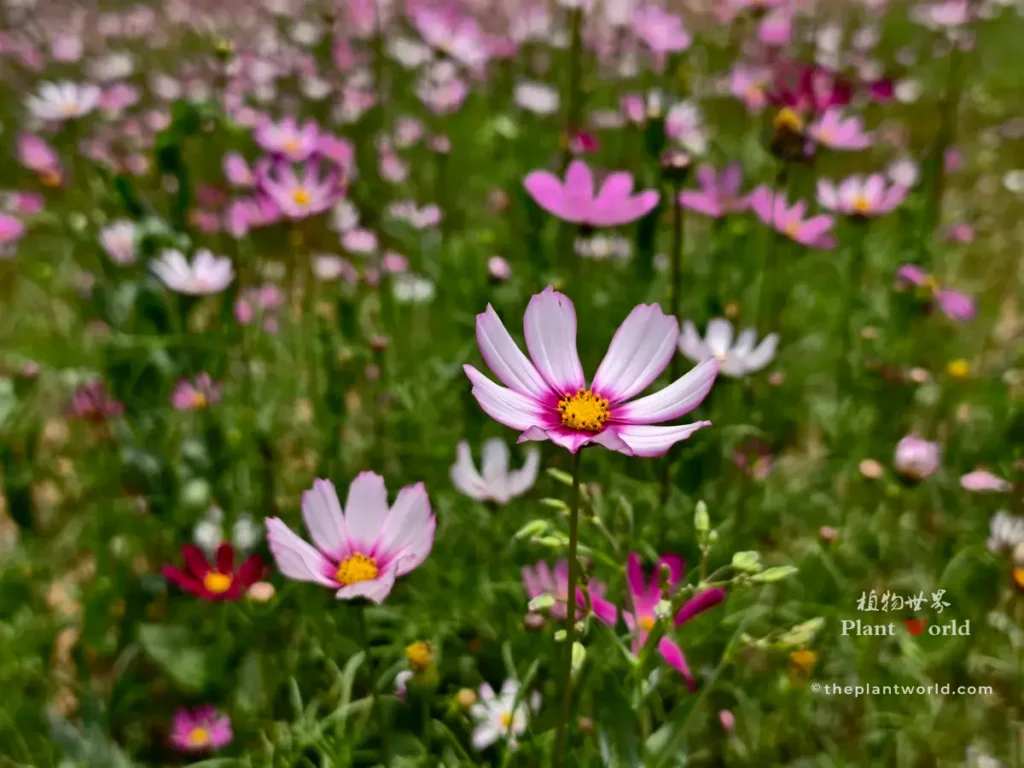
Native to the highlands of Mexico, this unassuming annual has traveled across oceans and taken root deeply in China — becoming not only one of the most common ornamental plants among Chinese Garden Plants, but also acquiring culturally rich Chinese names such as “Lord Zhang’s flower” and the “Gesang flower.“— the “flower of happiness” in Tibetan culture; and its very Chinese name, Qiuying, evokes the elegance of autumn chrysanthemums.
If you have ever wondered about the cosmos flower meaning in Chinese culture, this guide explores its fascinating journey from Mexico to China, its rich symbolic associations, and the surprising history behind its most beloved Chinese names.
- Introduction
- What Is the Cosmos Flower?
- How Cosmos Came to China: The Story of "Lord Zhang's Flower"
- The Gesang Flower Mystery: Is Cosmos the "Flower of Happiness"?
- Cosmos Flower Meaning in Chinese Culture
- A Note on Ecology
- Growing Cosmos: The "Low-Maintenance" Flower
- Final Thoughts
- References
- More from The Plant World:
What Is the Cosmos Flower?
The cosmos flower (Cosmos bipinnatus) is an annual or short-lived perennial herb in the daisy family (Asteraceae), genus Cosmos. The genus name Cosmos comes from the Greek word kosmos, meaning “order, harmony, beauty, and the universe” — Spanish missionaries in Mexico were so struck by the orderly arrangement of its petals that they named it after the cosmos itself.
Key characteristics:
- Height: 60–120 cm, sometimes reaching 1.5–2 m
- Leaves: Finely dissected, feathery, thread-like — resembling green feathers
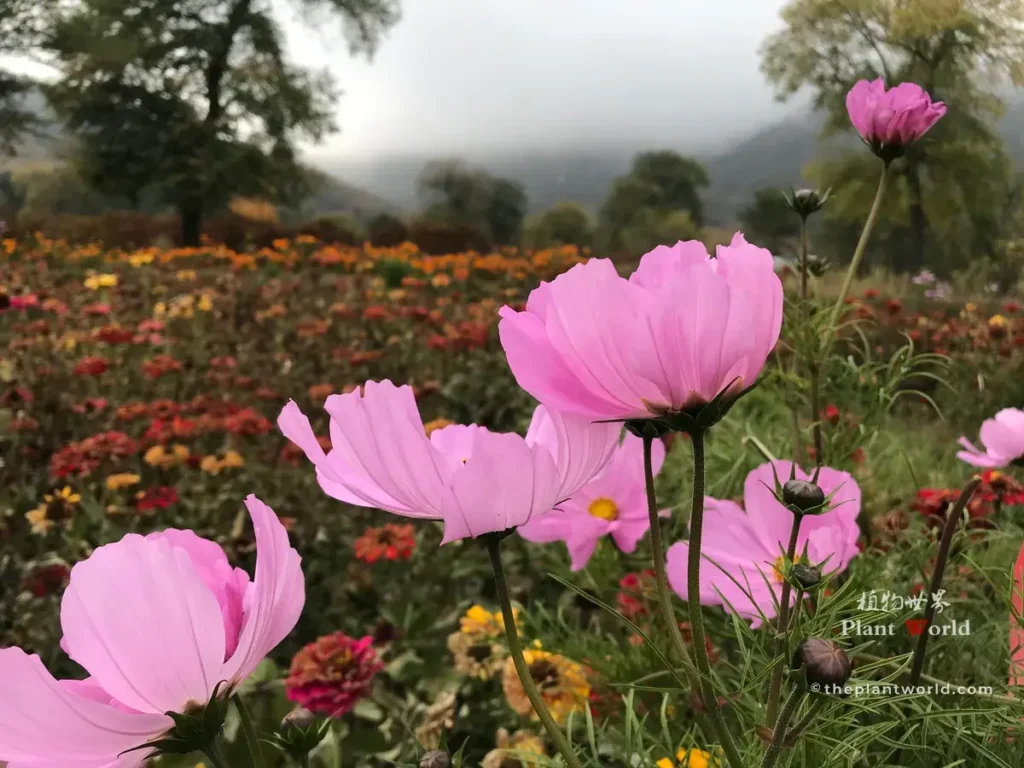
- Flowers: Daisy-like heads, usually single with 8 petals (ray florets), in white, pink, rose, red, and magenta, with a bright yellow center
- Bloom time: July through November, peaking in autumn
- Origin: Mexican highlands
- Introduction to China: Late Qing to early Republican era (late 19th to early 20th century)
The cosmos looks delicate — thin stems, papery petals, airy foliage — but it is remarkably tough. It tolerates poor soil, drought, and harsh conditions. In fact, overly rich soil causes it to grow leggy and bloom poorly. This contrast between fragile appearance and resilient nature is central to its symbolic meaning.
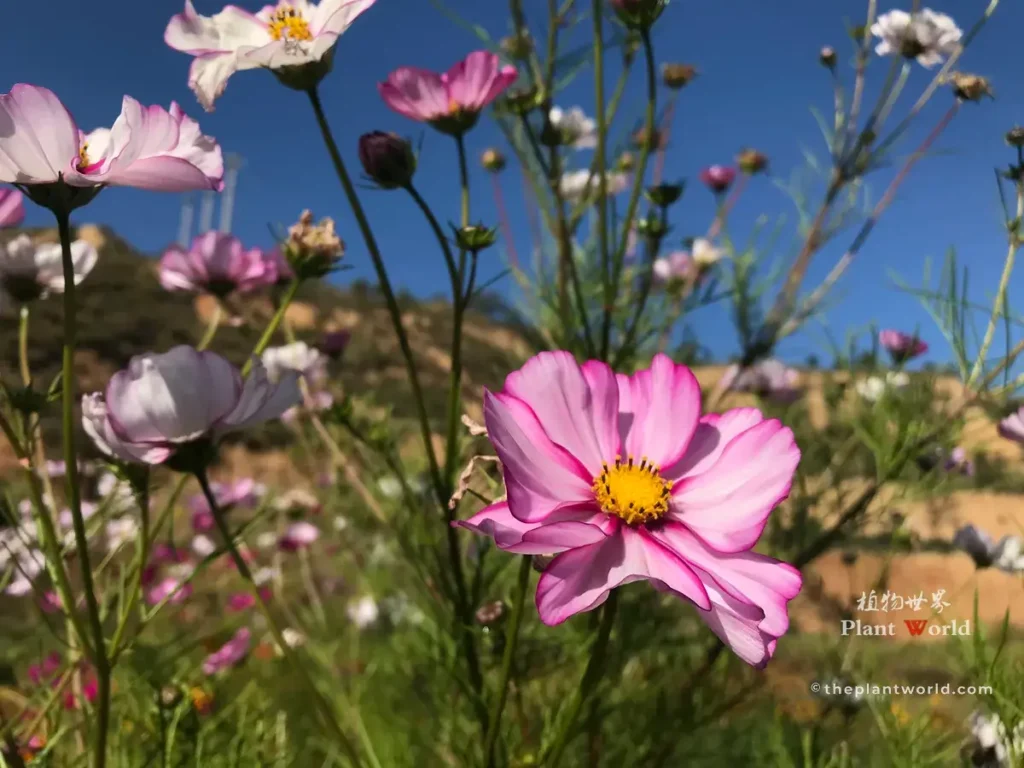
How Cosmos Came to China: The Story of “Lord Zhang’s Flower”
The cosmos was introduced to Europe in the late 18th century by Spanish missionaries, then spread to Japan during the Meiji era, and finally reached China in the late 19th and early 20th centuries. But its most remarkable chapter in Chinese history began in 1906, on the high plateau of Tibet.
In that year, a Cantonese official named Zhang Yintang (张荫棠,1866–1937) was dispatched to Tibet as the Assistant Amban (驻藏帮办大臣) to “investigate Tibetan affairs.” Zhang was known for his love of flowers. According to legend, he brought packets of flower seeds with him to Lhasa and distributed them to monks, nobles, and local families to plant in their courtyards.
The Tibetan plateau is harsh — cold, thin-soiled, and unforgiving. Most of the seeds Zhang brought failed to survive. But the cosmos, with its extraordinary resilience, took root immediately. Its eight-petaled blooms in red, pink, and white spread quickly through Lhasa’s streets and courtyards.
The local people did not know the flower’s name. They only knew it had been brought by “Lord Zhang” (张大人,Zhang Daren). So they called it Zhang Daren hua (张大人花) — “Lord Zhang’s flower.”
What makes this story especially poignant is that at the time, few Tibetans spoke Chinese. Yet nearly everyone could say the three words “Zhang Daren.” Even elderly Tibetans who spoke no other Chinese could pronounce the name of the flower. Today, “Lord Zhang’s flower” is the most common sight in Lhasa — in temple courtyards, on windowsills, along streets, and across meadows. In 2026, an epic drama titled Resident in Tibet: Lord Zhang was staged in Guangdong, bringing this century-old story of Han-Tibetan cultural exchange to a new audience.
The Gesang Flower Mystery: Is Cosmos the “Flower of Happiness”?
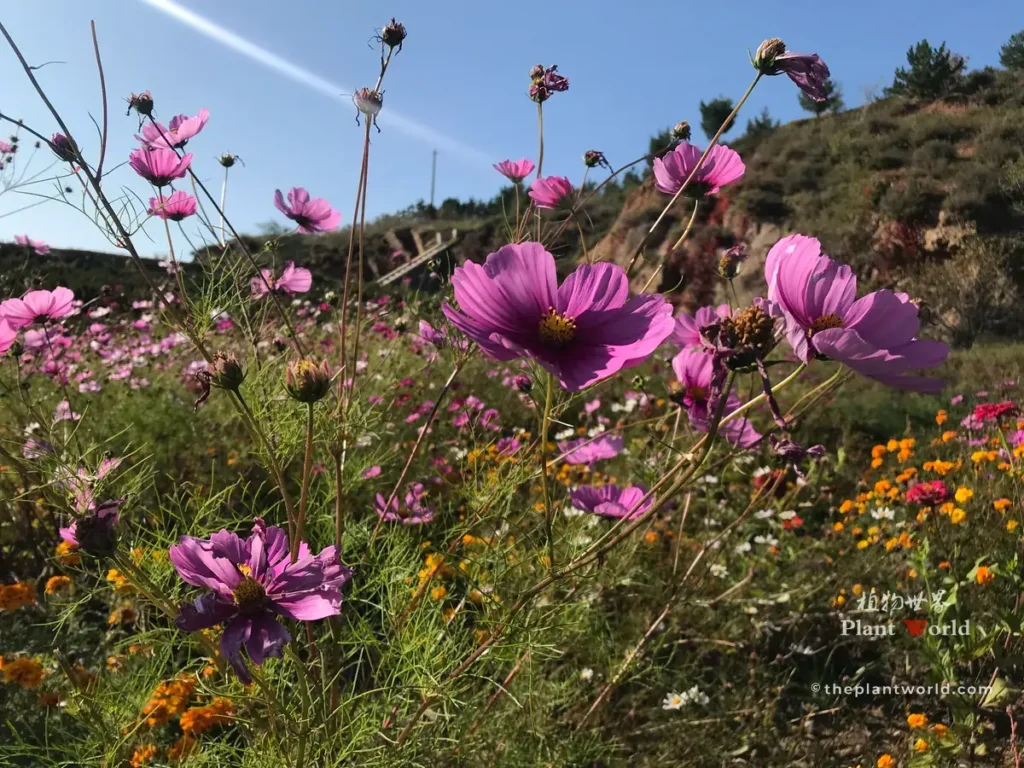
In Tibetan regions, the cosmos is widely known as the Gesang flower (格桑花,Gesang hua). In Tibetan, Gesang (格桑梅朵,Gesang Meidu) means “good times” or “happiness” — so the Gesang flower is literally the “flower of happiness” or “auspicious flower.”
But here is where it gets complicated. The term “Gesang flower” is not a botanical name — it is a cultural category, a Tibetan word for any beautiful, auspicious wildflower. There is no single, universally agreed-upon species.
Scientific research by the Northwest Institute of Eco-Environment and Resources (Chinese Academy of Sciences), led by researcher Su Peixi, concluded that the traditional Gesang flower of Tibetan culture is most likely the shrubby cinquefoil (Dasiphora fruticosa, formerly Potentilla fruticosa), known in Chinese as Jinlumei (金露梅). This is a native Tibetan plateau shrub with small yellow flowers, growing at altitudes up to 5,200 meters, with medicinal properties — far more consistent with the ancient legends of the Gesang flower.
From a botanical-historical perspective, the cosmos cannot be the “original” Gesang flower: it is native to Mexico and only arrived in China in the late 19th century. However, because the cosmos adapted so well to the plateau, bloomed so profusely, and was so visually striking, it gradually became the flower that most Tibetans — and most Chinese people today — picture when they hear “Gesang flower.” Search for “Gesang flower” online, and the vast majority of images shown are cosmos flowers.
So the nuanced answer is: The cosmos is the most widely recognized “Gesang flower” in contemporary popular culture, though academic research suggests the traditional Gesang flower of Tibetan folklore is more likely the shrubby cinquefoil. The cosmos has, in a sense, inherited the title through its beauty and resilience.
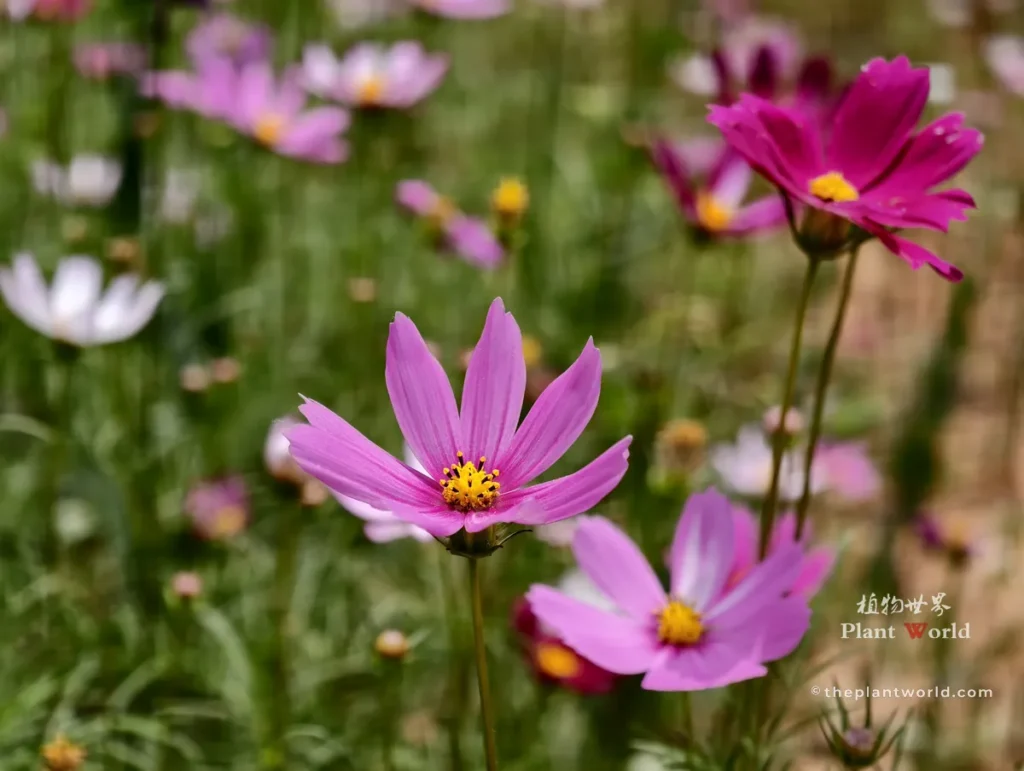
Cosmos Flower Meaning in Chinese Culture
The cosmos flower meaning in Chinese culture draws from several layers — its autumn blooming, its fragile-yet-tough nature, its Tibetan associations, and its delicate appearance.
1. Elegance and Independence (清雅与独立)
Because the cosmos blooms in autumn, alongside the chrysanthemum — China’s most symbolically charged autumn flower — it has inherited some of the chrysanthemum’s cultural aura. The Chinese name Qiuying (秋英) literally means “autumn flower” or “autumn beauty,” placing it in the same seasonal category as the chrysanthemum (菊花,ju hua).
In Chinese aesthetics, autumn flowers represent elegance, detachment, and independence — the virtue of blooming when others have faded, of not competing with the spring blossoms. The cosmos does not vie for attention with peonies or roses; it opens quietly in the cooling air, its colors clear and uncluttered. This makes it a symbol of the person who stays true to themselves regardless of season or circumstance.
2. Resilience and Vitality (坚韧与生命力)
The cosmos is a classic example of “looks fragile, is actually tough.” It thrives in poor, sandy soil where other flowers struggle. It tolerates drought and neglect. It self-sows readily and returns year after year. From the Mexican highlands to the Tibetan plateau, from city flower beds to country roadsides, the cosmos puts down roots and blooms.
This makes it a powerful symbol of resilience, adaptability, and the ability to flourish anywhere. In Chinese culture, this quality is deeply admired — the ideal of the person who, like the cosmos, needs no special pampering but can make beauty wherever they are planted.
3. Happiness and Good Fortune (幸福与吉祥)
Through its association with the Gesang flower in Tibetan culture, the cosmos has become a symbol of happiness, good fortune, and auspiciousness across China. The phrase “finding the Gesang flower” is a Tibetan metaphor for finding happiness. While the botanical identity may be debated, the cultural meaning is clear: the cosmos, as the most visible Gesang flower, carries the wish for a good life and happy times.
This association has made cosmos plantings enormously popular in Chinese tourism — “Gesang flower seas” (格桑花海) are common attractions in places like Litang, Sichuan, drawing visitors who come to walk through fields of pink and purple blooms and absorb the symbolism of happiness.
4. Maidenly Purity and Hope (少女的纯真与希望)
The cosmos’s light, airy form — thin stems, translucent petals, feathery leaves — has made it a natural symbol of youthful purity, innocence, and hope. Its pink and white blooms, trembling in the wind, are often compared to young girls: delicate, bright, and full of promise. In Chinese floriography, the cosmos represents the clean, uncomplicated affection of youth and the hopefulness of looking toward the future.
A Note on Ecology
Because the cosmos is so adaptable and self-sows so readily, it has been listed in China as a “species under observation” for potential invasive impact (invasion level 5). It has naturalized in parts of Yunnan, Sichuan, and Tibet. While it is not considered a severe invasive threat, gardeners are advised to plant it in controlled areas and avoid sowing it in nature reserves or ecologically sensitive zones.
Growing Cosmos: The “Low-Maintenance” Flower
If the cosmos flower meaning in Chinese culture appeals to you, you will be glad to know it is one of the easiest flowers to grow:
- Light: Full sun, good air circulation
- Soil: Any well-drained soil — actually prefers poor to average soil; too much fertilizer reduces blooming
- Water: Moderate; drought-tolerant once established; avoid waterlogging
- Sowing: Sow in late spring or early summer; germinates in 5–7 days at 15–25°C; blooms 60–80 days after sowing
- Care: Truly low-maintenance — just water moderately and avoid overfeeding
Final Thoughts
The cosmos flower (Cosmos bipinnatus) is a remarkable example of how a plant can acquire meanings far beyond its place of origin. From the Greek kosmos — the order and beauty of the universe — to the Chinese Qiuying — the elegant autumn bloom; from “Lord Zhang’s flower” in Lhasa to the “Gesang flower” of happiness across the Tibetan plateau; from resilience in poor soil to the purity of a maiden’s heart — this delicate Mexican native has woven itself deeply into the rich tapestry of Chinese Flower Symbolism.
Its story reminds us that meaning is not always native to a place. Sometimes a flower travels, takes root, and becomes more beloved in its adopted home than in its land of origin. The cosmos did not ask to become the “flower of happiness” or to be named after a Qing Dynasty official — but it bloomed where it was planted, and in blooming, it earned its place.
Next time you pass a field of cosmos swaying in the autumn wind, remember: behind those light, papery petals lies a story of cross-ocean journeys, Han-Tibetan friendship, and the universal human desire to find happiness in a simple flower.
References
Royal Botanic Gardens, Kew: Cosmos bipinnatus Cav. — Plants of the World Online
Plant Science Journal: Botanical Research on Shrubby Cinquefoil and the Gesang Flower (2020)
People’s Daily Online: Historical Record: Zhang Yintang and the Origin of “Lord Zhang’s Flower”
China Tibet Online: Cultural Distinction: “Lord Zhang’s Flower” vs. “Gesang Flower”
Science China: Identifying the True Gesang Flower of the Qinghai-Tibet Plateau
More from The Plant World:
- Chinese Wingnut: The Romantic “Ingot Tree” and Its Cultural Charm
- Plum Blossom Meaning: Symbolism & Cultural Significance
- The Hidden Meanings Behind Red Plum Blossoms
- Chinese Wisteria: History, Symbolism, and Identification
- Peach Blossoms in China: History, Culture, and Symbolism
- Chinese Crepe Myrtle: Guide to Origins & Symbolism
- Ginkgo Leaf Meaning: 5 Secrets of This Ancient Fossil
- Chinese Loquat Tree: Guide to Benefits & History
- Rose of Sharon Tree: Guide to Meaning & Care
- Hosta Plant Benefits: 5 Surprising Uses & Planting Guide
- Strawberry Begonia Care: How to Grow Saxifraga Stolonifera
Discover more from The Plant World
Subscribe to get the latest posts sent to your email.