
Introduction
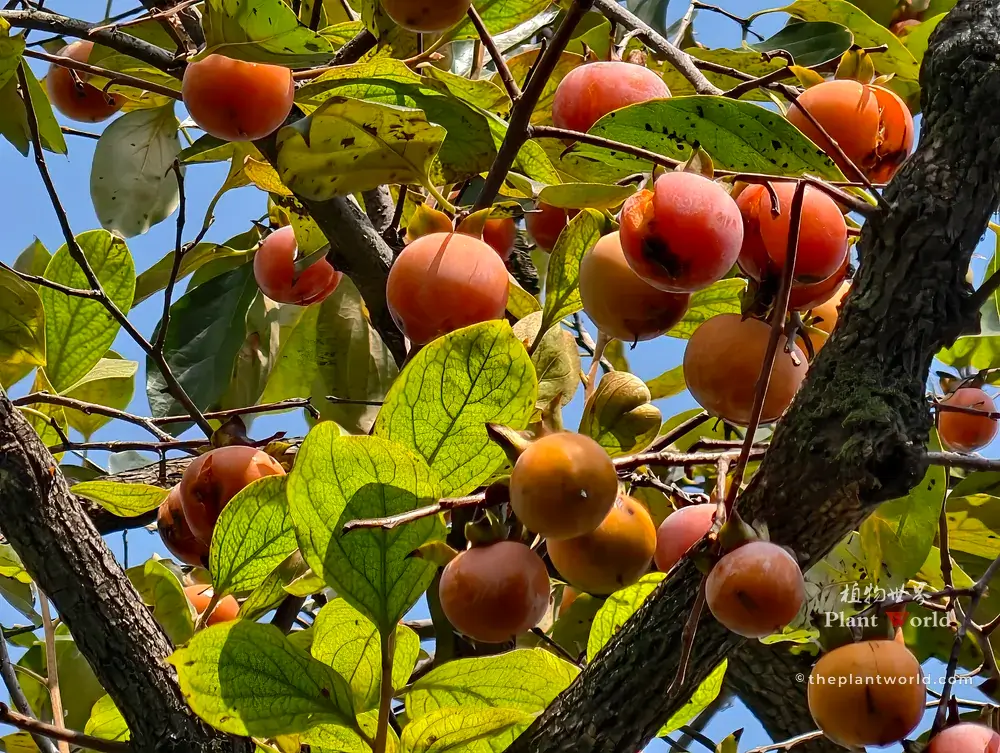
Walk through a Chinese village in late autumn, and you will see them: bright orange lanterns hanging from bare branches, glowing against the grey November sky. They are persimmons — Diospyros kaki — and for thousands of years, they have been one of China’s most beloved fruits.
The botanical name gives a clue to their prestige. Diospyros comes from the Greek dios (divine) and pyros (grain or fruit) — literally, “the fruit of the gods.” Native to the Yangtze River valley of China, the persimmon has been cultivated for over two millennia, spreading to Korea, Japan, and eventually across the world.
In China, the persimmon is far more than a fruit. It is a symbol of good fortune, a subject of classical painting, a staple of autumn festivals, and a medicine recorded in the oldest herbal texts. Its name sounds like the word for “affair” or “matter” in Chinese, making it a living pun for “may all things go well.” Let us explore this remarkable fruit.
- Introduction
- Plant Profile
- Cultural Symbolism: "May All Things Go As You Wish"
- Folk Traditions: Frost's Descent and the Art of Drying
- Varieties: Astringent vs. Non-Astringent
- Health Benefits & Traditional Medicine
- Culinary Uses
- Persimmon Beyond China: A Global Fruit
- In the Garden
- Conclusion
- More from The Plant World:
Plant Profile
| Feature | Details |
|---|---|
| Scientific Name | Diospyros kaki Thunb. |
| Family & Genus | Ebenaceae (ebony family), genus Diospyros. The genus includes over 700 species, many valued for their dark, hard timber (ebony). |
| Origin | Native to the Yangtze River valley of China; cultivated for over 2,000 years. Introduced to Korea and Japan in ancient times, and to Europe and North America in the 19th century. |
| Plant Type | Deciduous tree, 5–9 m tall in cultivation (up to 20 m in the wild), with a rounded canopy and often drooping branches. |
| Leaves | Alternate, simple, elliptic-ovate, 6–18 cm long, glossy dark green above. In autumn they turn brilliant yellow, orange, and red before falling. |
| Flowers | Small, yellowish-white, borne in spring. Trees are typically dioecious (male and female flowers on separate trees), though many cultivars produce fruit without pollination (parthenocarpy). |
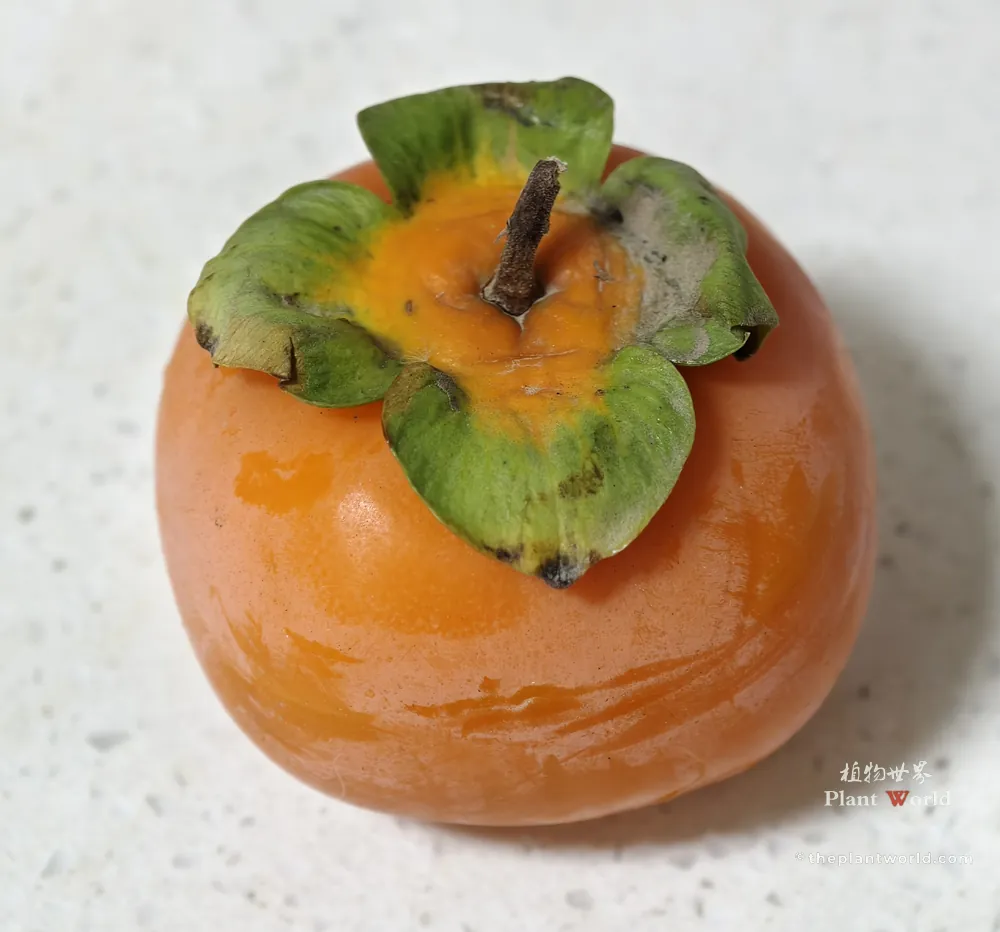
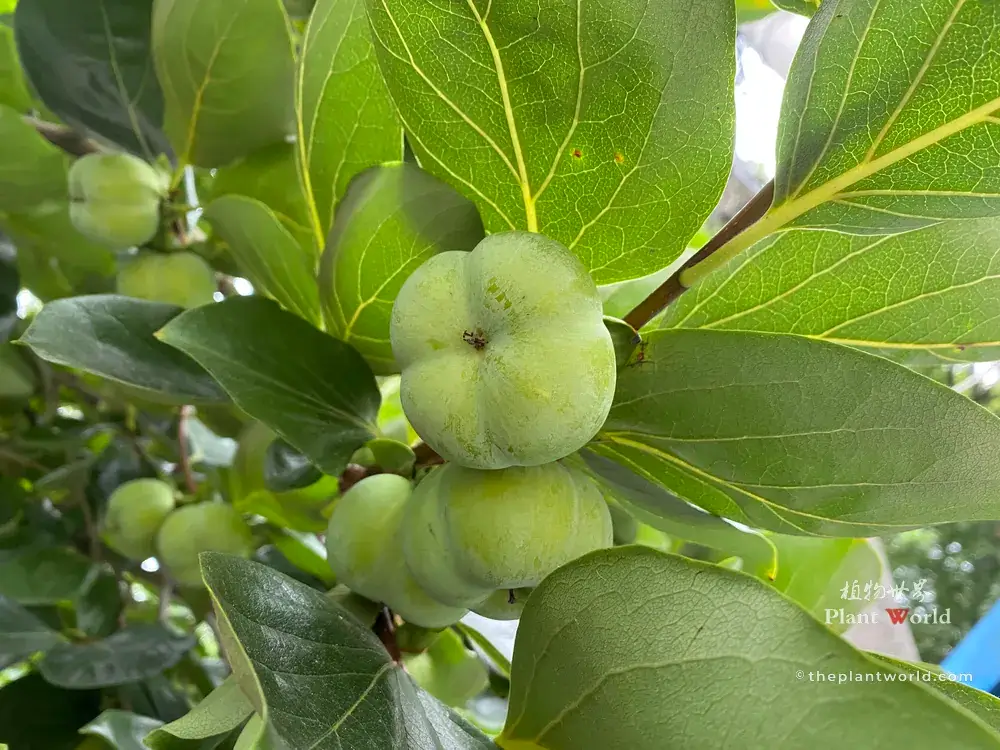
| Fruit | A large berry, varying in shape from flat and tomato-like to heart-shaped or acorn-shaped. Skin ranges from yellow-orange to deep red-orange. Flesh is sweet, soft, and jelly-like when fully ripe. |
| Key Trait | Unripe fruit contains high levels of soluble tannins, causing a powerful astringent (puckering) sensation. These tannins break down as the fruit ripens — or can be removed artificially. |
Note: Two related species are sometimes confused with D. kaki. The American persimmon (Diospyros virginiana) is native to the eastern United States and produces smaller, more astringent fruit. The date plum (Diospyros lotus), native to West Asia and the Himalayas, produces small, dark, sweet fruit and is often used as rootstock for grafting D. kaki.
Cultural Symbolism: “May All Things Go As You Wish”
In Chinese culture, the persimmon is one of the most auspicious fruits — and the reason is a play on words.
The Chinese word for persimmon, shi (柿), is a homophone for shi (事), meaning “affair,” “matter,” or “thing.” Two persimmons therefore suggest shi shi — “all things” or “every matter.” Paired with a ruyi scepter (a traditional ceremonial object whose name means “as you wish”), the combination reads shi shi ru yi (事事如意): “may all things go as you wish.”
The visual pun goes deeper. The persimmon calyx — the four-lobed green cap at the top of the fruit — has four heart-shaped lobes that resemble the cloud-head motifs of a ruyi scepter. Sound and shape together reinforce the blessing.
This symbolism appears everywhere in Chinese art and material culture:
- New Year paintings (Nianhua): Persimmons are a common motif in Sui Chao Tu (First Morning paintings), displayed at Lunar New Year to invite good fortune for the coming year. A typical composition pairs persimmons with cypress branches and tangerines — bai shi ji (百事吉), meaning “a hundred affairs, all auspicious.” The Ming dynasty painter and writer Xu Wei recorded that people in Jiangnan hung cypress, persimmon, and tangerine in their halls with exactly this meaning.
- Textiles and ceramics: The persimmon calyx pattern (shi di wen) was a popular auspicious design on brocades, porcelain, and lacquerware.
- Imperial gardens: Persimmon trees were planted in the Forbidden City and other royal gardens. As early as the Book of Rites (Li Ji), compiled in the Zhou dynasty (c. 1050–256 BCE), persimmons were listed among the fruits offered at imperial sacrifices.
- Gift-giving: A basket of persimmons is still a popular gift during the Mid-Autumn Festival and Lunar New Year, carrying the wish that the recipient’s affairs will all go smoothly.
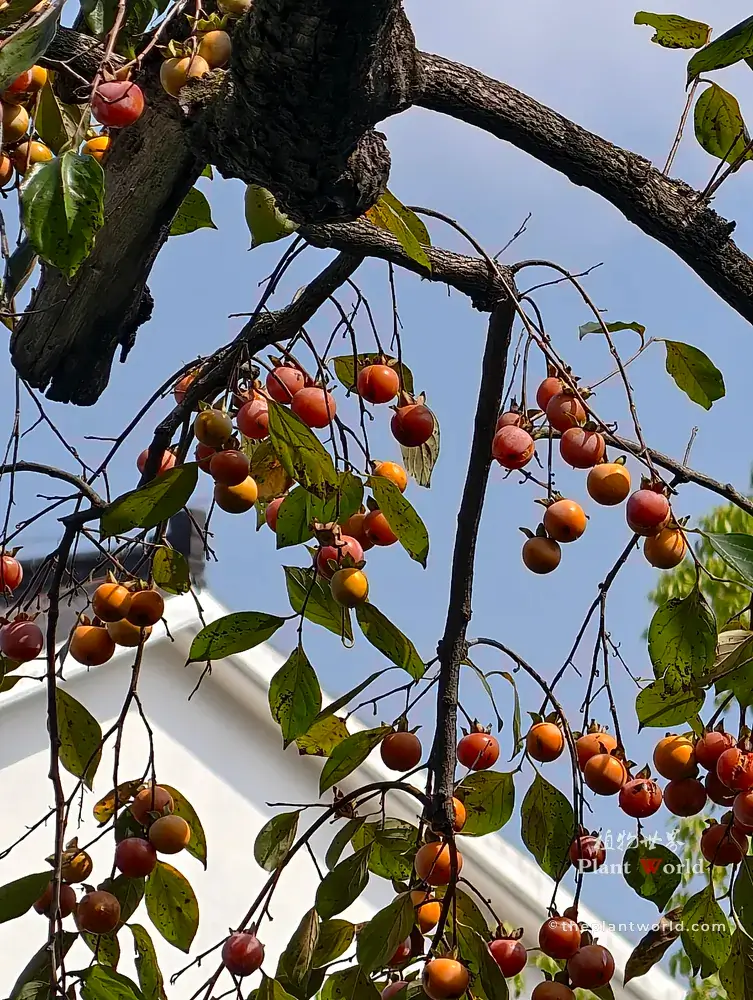
The persimmon’s autumn ripening also gives it a philosophical dimension. While other fruits fade with the coming of cold, the persimmon hangs on the bare branch, glowing brighter as the leaves fall — a symbol of resilience, of sweetness that comes only after the frost.
Folk Traditions: Frost’s Descent and the Art of Drying
In the Chinese agricultural calendar, the solar term Shuang Jiang (Frost’s Descent), falling around October 23, marks the traditional persimmon harvest. A folk saying captures the rhythm: “White Dew harvests walnuts; Frost’s Descent picks persimmons.”
Eating persimmons at Frost’s Descent is believed to ward off colds and strengthen the body for winter. In rural northern China, it is said that eating a persimmon on this day prevents chapped lips — a folk belief rooted in the fruit’s moisturizing, vitamin-rich flesh.
But the most enduring folk tradition is the making of dried persimmons (shi bing). The technique, developed in China over a thousand years ago and later adopted in Japan (where it is called hoshigaki) and Korea (gotgam), is a labor of patience:
- Fresh, firm persimmons are peeled, leaving the calyx intact.
- They are hung by their stems in a cool, dry, well-ventilated place — often under the eaves of a farmhouse.
- Over several weeks, they are gently massaged by hand every few days to distribute sugars and soften the flesh.
- As they dry, a natural white powder of glucose and fructose crystallizes on the surface — called shi shuang (persimmon frost), considered the finest part and used in traditional medicine.
- The finished dried persimmon is chewy, intensely sweet, and keeps for months without refrigeration.
Famous regional varieties include the hanging-dried persimmons of Fuping in Shaanxi province, known for their plump, dumpling-like shape and thick, powdery frost. In Guangxi province, flat-pressed dried persimmons are a local specialty.
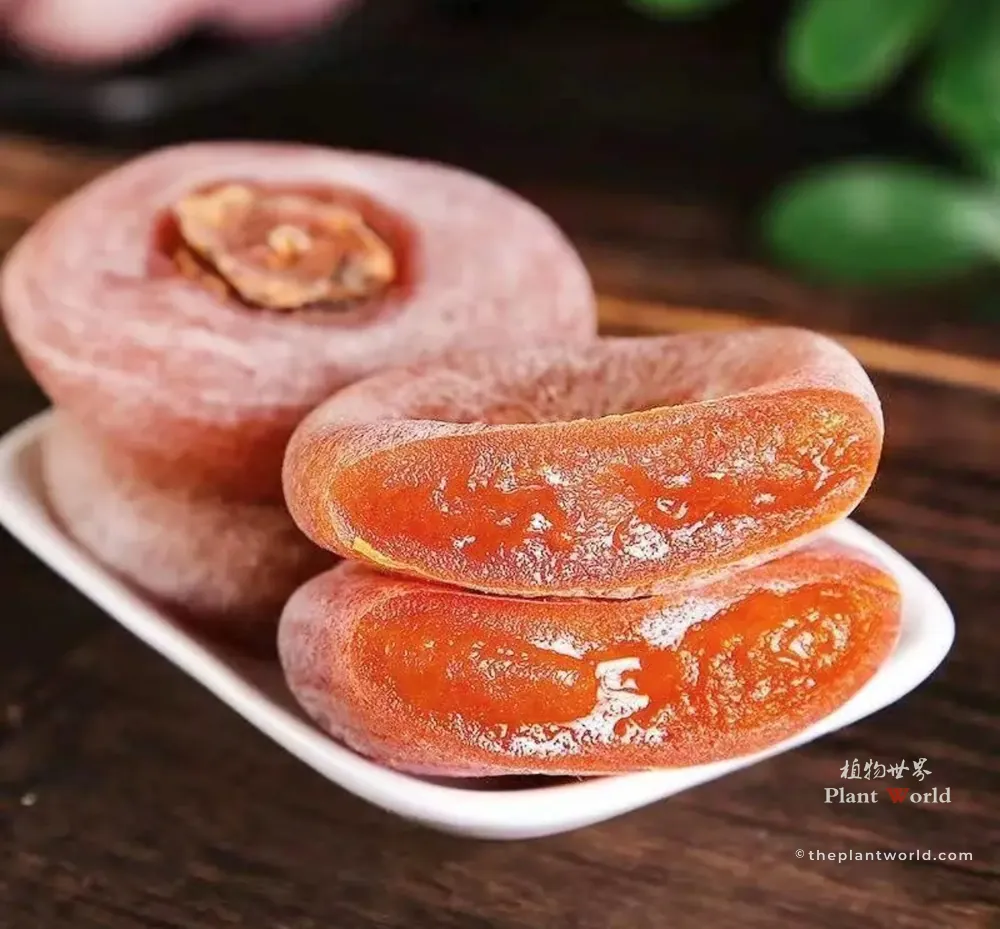
A note on the “persimmon frost”: The white powder on dried persimmons is not mold — it is naturally crystallized sugar. In traditional Chinese medicine, it is collected and used to soothe sore throats and mouth ulcers.
Varieties: Astringent vs. Non-Astringent
Persimmons fall into two fundamental categories based on how they lose their astringency. For Western readers, this is the single most important thing to know — eating an unripe astringent persimmon is an unforgettable (and unpleasant) experience.
| Category | How it behaves | Representative cultivars | Best eaten |
|---|---|---|---|
| Astringent (PCA) | Contains high soluble tannins until fully soft-ripe. Inedible when firm. Must ripen until jelly-soft, or be artificially de-astringented. | ‘Hachiya’ (heart-shaped, the most common astringent variety in the West; originally from China); ‘Mopan’ (磨盘柿,flat with a characteristic waist-like constriction, a classic Chinese variety); ‘Tanenashi’ (seedless, heavy-bearing); ‘Oxheart’ (牛心柿,conical) | Fully soft, almost liquid — scoop with a spoon. Also ideal for drying. |
| Non-astringent (PCNA) | Tannins disappear naturally while the fruit is still firm. Sweet and crisp even when hard, like an apple. | ‘Fuyu’ (富有,flat, tomato-shaped, the most widely planted non-astringent variety worldwide); ‘Jiro’ (次郎,slightly flattened, very sweet); ‘Maekawa Jiro’ | Firm and crisp, like a crisp apple or pear. Can be sliced into salads or eaten out of hand. |
Key point for Western shoppers: If you see a heart-shaped, pointed persimmon (likely ‘Hachiya’), do not bite into it while firm — it will pucker your mouth horribly. Wait until it feels as soft as a water balloon. If you see a flat, tomato-shaped persimmon (likely ‘Fuyu’), you can eat it while still crisp.
China holds the world’s richest persimmon germplasm resources, with more than one thousand recorded cultivars. Most traditional local varieties are astringent persimmons, well suited for the ancient practice of making dried persimmons and eating soft, ripe fruit. While native non-astringent (sweet) persimmons exist in the Dabie Mountains of China, the widely commercialized sweet persimmon cultivars dominating global orchards were bred in Japan.
Health Benefits & Traditional Medicine
The persimmon’s vivid orange color signals its nutritional wealth.
Modern nutrition highlights several benefits:
- Vitamin A: One medium persimmon provides about 15% of the daily value of vitamin A, primarily from beta-cryptoxanthin and beta-carotene — carotenoids that support eye health, immune function, and skin integrity.
- Vitamin C: A single fruit supplies roughly 20% of daily vitamin C needs, supporting collagen production and immune defense.
- Dietary fiber: Persimmons are rich in soluble fiber, which supports digestive health and helps stabilize blood sugar. Dried persimmons concentrate this fiber further.
- Antioxidants: Beyond carotenoids (beta-carotene, lycopene, beta-cryptoxanthin), persimmons contain flavonoids including fisetin and myricetin, as well as tannins — all of which combat oxidative stress.
- Minerals: Manganese, potassium, and copper are present in useful amounts.
Traditional Chinese medicine has used the persimmon for centuries. Li Shizhen, in his 16th-century Compendium of Materia Medica (Ben Cao Gang Mu), wrote:
“Persimmon is the fruit of the spleen, lung, and blood. Its flavor is sweet and its qi is level; its nature is astringent and able to gather. Therefore it strengthens the spleen, binds the intestines, treats cough, and stops bleeding.”
In TCM practice:
- Ripe persimmon is used to moisten the lungs, resolve phlegm, and soothe autumn dryness cough.
- Persimmon calyx (shi di) is a specific remedy for hiccups and nausea — one of the few fruit parts regularly used as a medicinal ingredient.
- Dried persimmon is considered more warming and nourishing than fresh, and is used to tonify qi and blood.
- Persimmon frost (shi shuang) is applied to sore throats and mouth ulcers.
Safety note: Unripe astringent persimmons contain high levels of soluble tannins that can bind with protein in the stomach to form hard masses called bezoars (specifically diospyrobezoars). This is rare but can occur with heavy consumption of unripe fruit, especially on an empty stomach. The folk warning against eating persimmons with crab or other high-protein foods has a basis in this tannin-protein interaction, though the risk is low with ripe fruit. As with any food, moderation is wise.
Culinary Uses
The persimmon’s culinary identity changes dramatically depending on variety and ripeness.
Fresh:
- Non-astringent varieties (‘Fuyu’, ‘Jiro’) are eaten crisp, like an apple — sliced into salads, paired with cheese and charcuterie, or simply eaten out of hand.
- Fully ripe astringent varieties (‘Hachiya’) are scooped with a spoon, their custard-like flesh eaten as a dessert. They can also be pureed into smoothies, puddings, or baked goods.
Dried:
- Dried persimmons are eaten as a snack, steeped in tea, or used in desserts. In Japan, hoshigaki is considered a luxury confection. In Korea, dried persimmons are served with sujeonggwa (cinnamon punch).
Preserved and fermented:
- Persimmon vinegar (shi cu) is a traditional Chinese condiment, prized for its mild, fruity acidity.
- Persimmon wine and brandy are produced in several regions, including China’s Shanxi province and parts of Europe.
- In Korea, persimmon is fermented into sikhye-style punches and used in kimchi.
Cooked:
- Persimmon puree makes moist, fragrant quick breads, muffins, and cakes — a natural substitute for pumpkin or sweet potato puree.
- In northern China, frozen persimmons (dong shi) are a winter treat: left outdoors to freeze, then thawed and eaten like a sorbet.
Persimmon Beyond China: A Global Fruit
The persimmon’s journey from a Chinese native to a global fruit is a story of slow diffusion and, finally, enthusiastic adoption.
East Asia: From its origin in the Yangtze valley, the persimmon spread to Korea and Japan well over a thousand years ago. In Japan, it became deeply embedded in culture — the word for persimmon, kaki, is now used worldwide. Japanese growers developed the non-astringent varieties that dominate modern commercial production. In Korea, the persimmon (gam) is a symbol of transformation and patience, and dried persimmons are a staple of winter cuisine.
Europe: European explorers first encountered Asian persimmons in the 1600s, and the fruit was formally introduced to European botanic gardens in the late 1700s. It remained largely a curiosity until the 20th century, when Mediterranean climates — Italy, Spain, southern France, and Turkey — proved ideal for cultivation. Today, Spain and Italy are significant European producers.
North America: The United States has its own native persimmon (Diospyros virginiana), a smaller, more astringent fruit long used by Indigenous peoples. But the Asian persimmon arrived in 1856, when Commodore Matthew Perry brought seeds back from Japan after his historic expedition. From the 1870s through the 1920s, the U.S. Department of Agriculture imported and tested hundreds of varieties. Japanese immigrants in California recognized the state’s Mediterranean climate as perfect for persimmons, and by the early 20th century, California had become the center of American persimmon growing. It remains so today.
The Middle East: Persimmons were introduced to Palestine in 1912 and later to Israel, where the Sharon fruit — a trademarked, seedless, non-astringent persimmon — became an export success.
In every culture it has touched, the persimmon has been valued for the same qualities: its luminous color, its concentrated sweetness, and its ability to be stored and enjoyed through the lean winter months.
In the Garden
For home gardeners in temperate climates, the persimmon is a rewarding and relatively low-maintenance tree.
- Climate: Best suited to USDA zones 7–10. It tolerates summer heat and winter cold down to roughly −15°C (5°F), though late spring frosts can damage blossoms.
- Site: Full sun, with well-drained soil. Persimmons tolerate a range of soil types, including clay, but resent waterlogged roots.
- Size: Most grafted cultivars reach 5–7 m tall and wide, making them suitable for suburban yards. Dwarf varieties are available for smaller spaces.
- Ornamental value: Beyond the fruit, persimmon trees offer brilliant autumn foliage in shades of gold and scarlet, and the fruit often hangs on the tree well after leaf drop, creating a striking winter display.
- Pollination: Many cultivars are parthenocarpic (set seedless fruit without pollination), but pollination can improve fruit set and size in some varieties. Planting a male tree or a dual-grafted tree is an option.
- Pests and diseases: Persimmons are relatively trouble-free, though birds and squirrels are fond of the fruit. Netting or timely harvesting can reduce losses.
A persimmon tree is an investment — it may take 3–5 years to bear fruit — but it is a long-lived one, with productive lives of 50 years or more.
Conclusion
The persimmon is a fruit of patience. It hangs on the branch long after other fruits have gone, sweetening only after the frost, rewarding those who wait. It is a fruit of wordplay — its very name a wish that all things may go well. And it is a fruit of transformation: from astringent and inedible to soft and honeyed, from fresh autumn fruit to a dried confection that lasts through winter.
From the imperial sacrifices of ancient China to the farmers’ markets of modern California, from classical New Year paintings to contemporary charcuterie boards, the persimmon has carried its bright orange glow across cultures and centuries. Its botanical name says it best: Diospyros — the fruit of the gods.
Next autumn, when you see those orange lanterns glowing in a bare tree, take a moment. Pick one. Wait for it to soften. And taste the sweetness that comes only after the cold.
If you love Chinese plants the way I do and would like a few of them growing in your own garden, I write planting plans: six chosen for your region and your kind of garden — where each one goes, how to plant it, and why that one. Here is what a plan includes →
More from The Plant World:
- Chinese Wingnut: The Romantic “Ingot Tree” and Its Cultural Charm
- Plum Blossom Meaning: Symbolism & Cultural Significance
- The Hidden Meanings Behind Red Plum Blossoms
- Chinese Wisteria: History, Symbolism, and Identification
- Peach Blossoms in China: History, Culture, and Symbolism
- Chinese Crepe Myrtle: Guide to Origins & Symbolism
- Ginkgo Leaf Meaning: 5 Secrets of This Ancient Fossil
- Chinese Loquat Tree: Guide to Benefits & History
- Rose of Sharon Tree: Guide to Meaning & Care
- Hosta Plant Benefits: 5 Surprising Uses & Planting Guide
- Strawberry Begonia Care: How to Grow Saxifraga Stolonifera
Discover more from The Plant World
Subscribe to get the latest posts sent to your email.