
Introduction
When the Buddha preached profound Dharma, heavenly blossoms fell from the sky, and golden lotus flowers emerged directly from the earth.
This ancient Buddhist legend describes a miraculous, auspicious scene. While the tale belongs to spiritual folklore, the “golden lotus rising from the soil” is a tangible, living plant: Musella lasiocarpa, widely known to Western gardeners as the Golden Lotus Banana or Chinese Yellow Banana.
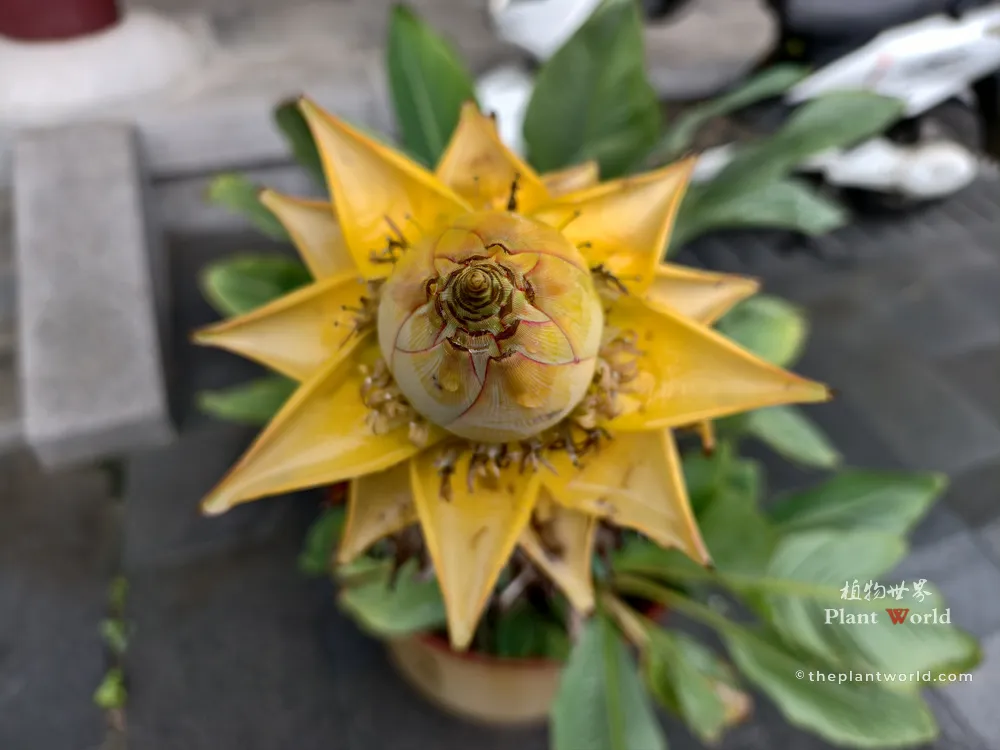
I have admired well‑established potted Golden Lotus Banana specimens at Ganlu Temple in Wuxi, eastern China. Its striking golden inflorescences rise straight up out of the potting medium, creating a solemn, tranquil atmosphere perfectly suited to temple courtyards. Though it resembles a lotus, it belongs to the banana family. This rare perennial herb carries thousands of years of Chinese cultural heritage. It adorns Buddhist altars, shines in courtyard landscapes, serves as a folk herbal element, and even becomes a seasonal vegetable on the dining table.
- Introduction
- Plant Profile: Musella lasiocarpa
- Cultivation & Care Guide for Golden Lotus Banana
- Design Ideas for Meditation & Oriental Gardens
- Historical Records in Chinese Ancient Texts
- Cultural Symbolism: The Sacred Flower of Southern Buddhism
- Edible & Traditional Herbal Uses
- Final Conclusion
- References
- More from The Plant World:
Plant Profile: Musella lasiocarpa
- Scientific Name: Musella lasiocarpa (Franch.) C.Y.Wu ex H.W.Li
- Common Names: Golden Lotus Banana, Ground Lotus Banana, Thousand-Petal Lotus
- Family: Musaceae (Banana Family)
It is the only species within the genus Musella, making it a precious endemic plant native exclusively to Southwest China. Wild populations primarily grow across the mountainous regions of Yunnan and Sichuan provinces, at elevations between 1,450–2,500 meters. Small wild‑occurring populations can also be found in northern Vietnam, while its core native range lies in Southwest China. Wild populations were once threatened by habitat loss. Today this species is widely cultivated in botanical gardens and private yards across the globe, though wild stands remain vulnerable.
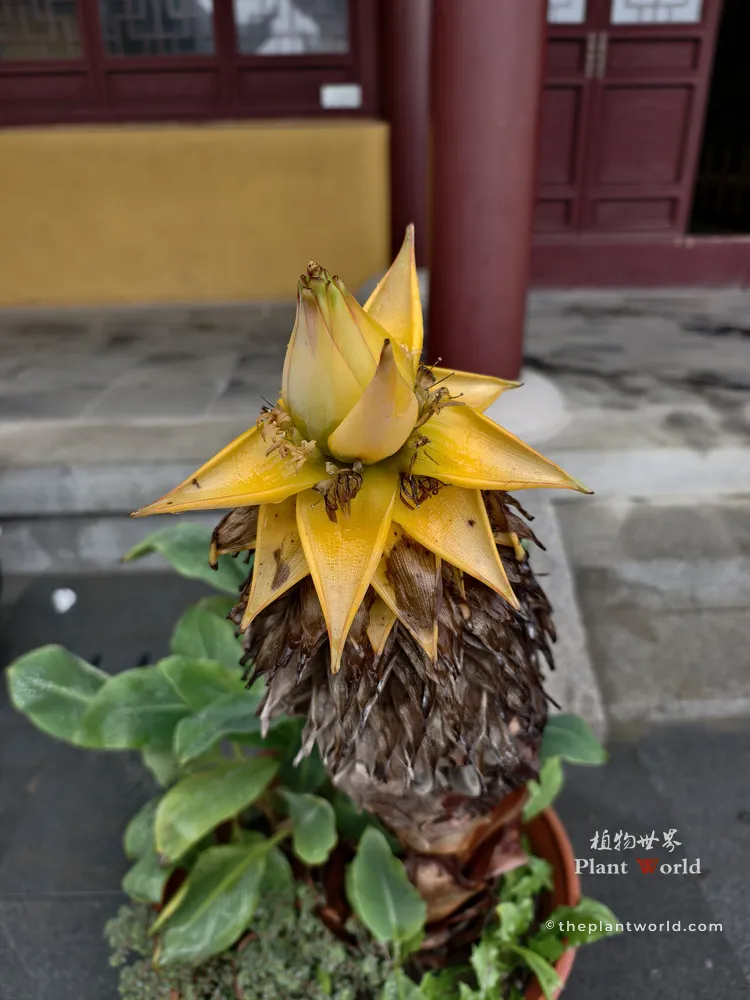
The plant features long oval leaves, roughly 50 cm long and 20 cm wide, coated in a pale white powder. The foliage shape bears a superficial similarity to Canna lilies. Like other banana relatives, its leaf sheaths overlap tightly to form a short, sturdy pseudostem. Most mature clumps stay under 1 metre in height, making it far more compact than the Musa basjoo hardy banana.
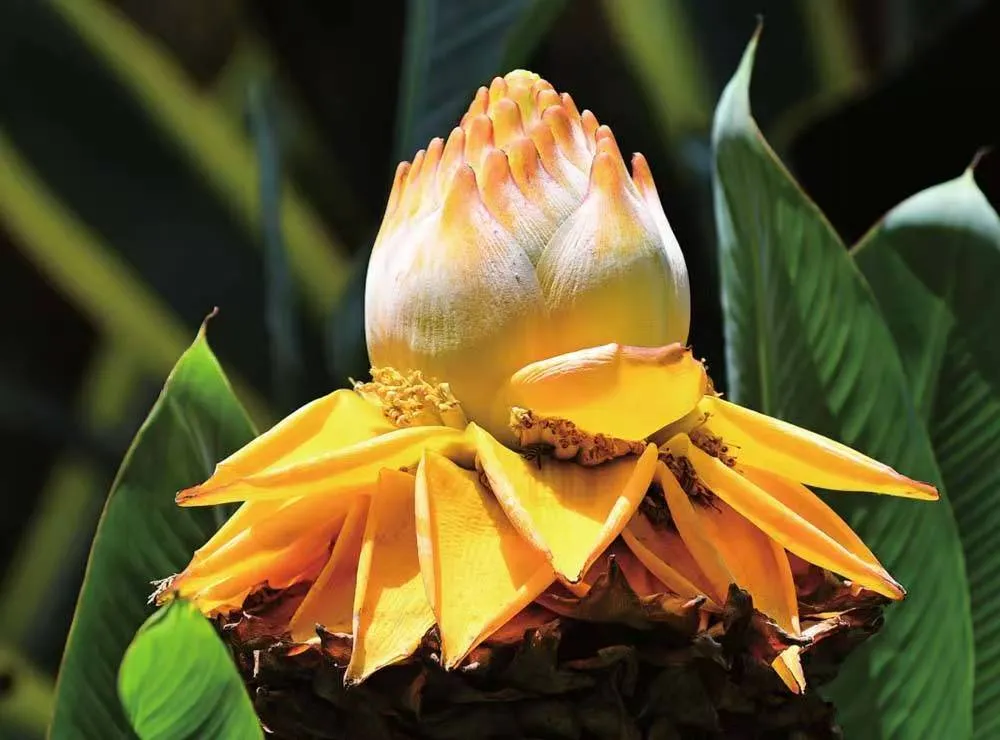
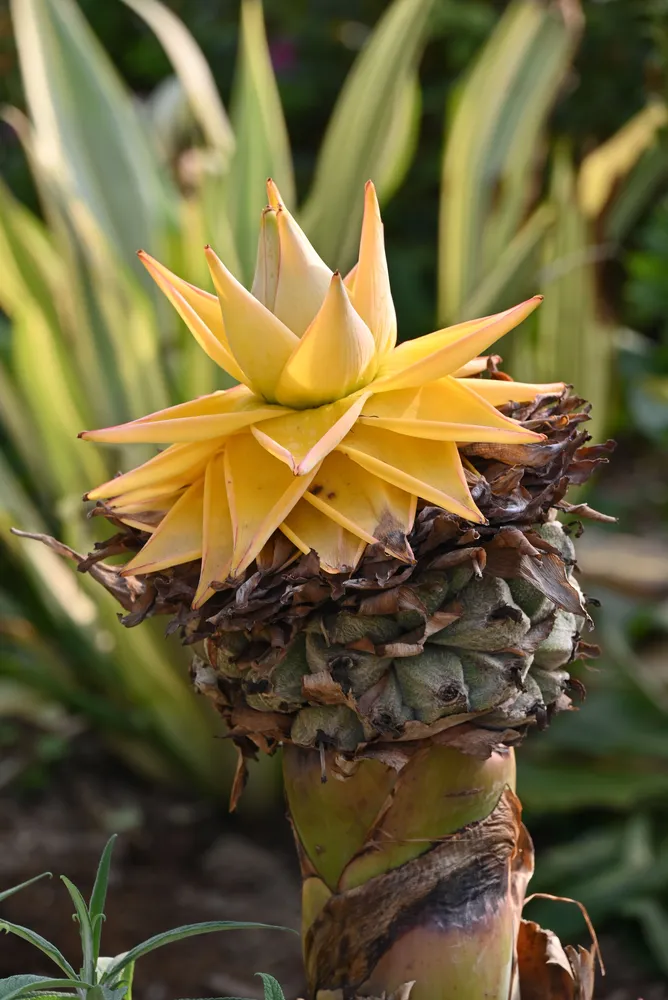
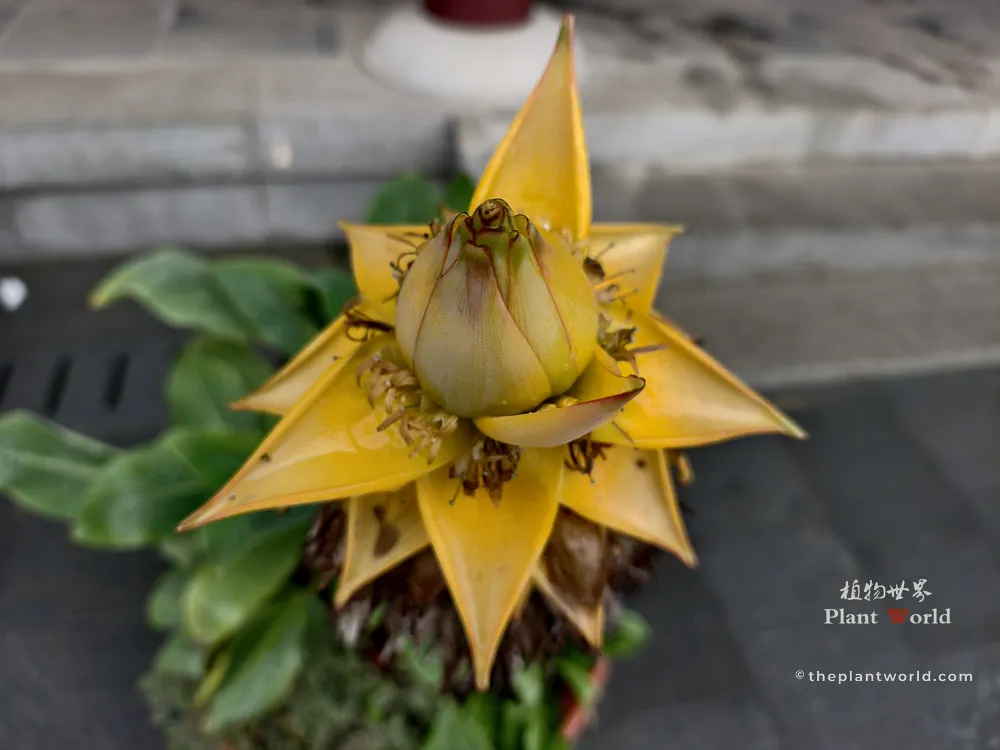
The eye‑catching golden layered structures that people mistake for flower petals are actually modified bracts. Small, genuine blossoms nestle between the bract bases, arranged in two neat rows: female flowers on the lower section capable of forming fruit, and pollen‑bearing male flowers growing above.
After successful pollination, triangular oval berries develop, covered in dark stiff hairs and containing multiple flat brown seeds. The showy bract‑inflorescence display can last more than 240 days — an exceptionally long blooming period for temperate and subtropical gardens. In Chinese symbolism, it represents good fortune, prosperity, peace, and happiness.
Cultivation & Care Guide for Golden Lotus Banana
Hardiness
- USDA Hardiness Zones: 8–11.
- It tolerates light frost well. Mulch thickly at the root zone with straw or bark to help the underground rhizomes survive brief cold snaps in Zone 8. In colder northern regions, it is best grown in large containers to overwinter indoors or in a heated greenhouse.
Light & Position
- Requirements: Prefers full morning sun with dappled afternoon shade. Intense, unbroken midday summer sun can occasionally scorch the soft waxy foliage.
- Landscaping Inspiration: Plant it near stonework, courtyard entrances, or beside water features. Much like how the architectural hosta plant defines shaded borders, the Golden Lotus Banana creates dramatic, structural focal points in oriental, tropical, and meditation gardens, making it a distinctive Chinese Garden Plants.
Soil & Water
- Requires loose, fertile, sharply draining loamy soil with plenty of organic matter. Keep the substrate evenly moist during the active spring and summer growing seasons, but never allow waterlogging, which easily rots the rhizome. Reduce watering significantly during winter dormancy.
Propagation & Maintenance
- Musella lasiocarpa spreads via underground rhizome offsets. Divide established clumps in early spring before new foliage emerges. Remove dead bracts and old leaves regularly to keep the plant tidy and support healthy new growth.
Design Ideas for Meditation & Oriental Gardens
Traditional Chinese garden design highly values plants that evoke a sense of timelessness and peace. To fully showcase the spiritual beauty of the Golden Lotus Banana:
- The Temple Look: Plant it against a dark, solid background or stone wall. The bright golden bracts will stand out vividly, creating an area for quiet contemplation.
- The Exotic Border: Pair it with fine-textured plants. The massive, bold leaves of the Golden Lotus Banana create a stunning texture contrast when planted alongside fine bamboo or the delicate, crinkled blossoms of the Chinese Crepe Myrtle.
- Courtyard Entrances: Place a pair of potted specimens on either side of a doorway or gate as an auspicious symbol to welcome guests with good fortune.
Historical Records in Chinese Ancient Texts
Human documentation of Musella lasiocarpa stretches back to the Ming Dynasty (1368–1644), proving its long history alongside other ancient Chinese flora like the hollyhock flower.
Diannan Materia Medica (Diannan Bencao), Ming Dynasty
This Ming dynasty herbal work records the plant’s bitter, astringent, and cold nature, documenting its early traditional folk use in southern regions for regulating circulation and vitality.
Xuepu Zashu by Wang Shimao, Ming Dynasty
“There is another plant named Golden Lotus Treasure. Its small pointed leaves resemble canna lilies. It may take three to eight years to bloom. During the Ming era, famous specimens flowered simultaneously in Nanjing temples, drawing crowds of visitors. Blooms carry yellow-red layers larger than lotus petals, giving rise to its common name.”
Jinghualu by Chen Haozi, Qing Dynasty
“Musella lasiocarpa bears leaves similar to taro, growing flat on the ground. Its blooms unfold like a lotus with a small yellow centre. It emits a delicate, pleasant fragrance, yet it is famously difficult to bring into flower.”
Zhiwu Mingshi Tukao by Wu Qirui, Qing Dynasty
“Golden Lotus Banana originates from the mountain regions of Yunnan. It resembles a banana tree but with shorter leaves. A lotus-like bloom rises from its centre; one bract unfurls each day. New buds continuously extend while old bracts remain stacked, layered like carved Buddhist thrones.”
Cultural Symbolism: The Sacred Flower of Southern Buddhism
Musella lasiocarpa holds a unique spiritual standing within Theravada Buddhist culture in Southwest China and Southeast Asia. It is counted among the celebrated Five Trees & Six Flowers, the traditional plant collection strictly cultivated within Buddhist temple grounds.
- The Five Trees: Sacred Fig (Ficus religiosa), Banyan (Ficus benghalensis), Talipot Palm (Corypha umbraculifera), Areca Palm (Areca catechu), Sugar Palm (Borassus flabellifer).
- The Six Flowers: Lotus, Crinum Lily, Ginger Lily, Plumeria, Osmanthus, and Musella lasiocarpa (Golden Lotus Banana).
Among the ethnic Dai communities of Yunnan, the plant symbolises kindness, justice, and the triumph of good over evil in local folklore. The striking sight of golden blooms emerging straight from the earth resonates deeply with Buddhist concepts of purity, awakening, and auspicious revelation.
Edible & Traditional Herbal Uses
Herbal Properties & Folk Lore
Modern phytochemical analysis shows that Musella lasiocarpa contains volatile oils, sterols, fatty acids, and glycosides, which exhibit antioxidant properties.
⚠️ Important Disclaimer: All herbal descriptions included in this article serve cultural and botanical reference purposes only. This content is not medical advice. Do not harvest wild plants for self-medication. Always consult a qualified healthcare professional or certified practitioner before internal use.
In regional Yunnan literature, two traditional folk recipes are well-documented:
- Golden Lotus Banana Herbal Tea: Dried flower buds were historically steeped in boiling water as a regional folk remedy to clear internal heat and promote wellness.
- Golden Lotus Banana Soup: The tender inner sections of fresh flower buds were cooked into simple savory broths with minced meat, used in folk practice as a traditional dietary tonic.
Culinary Applications
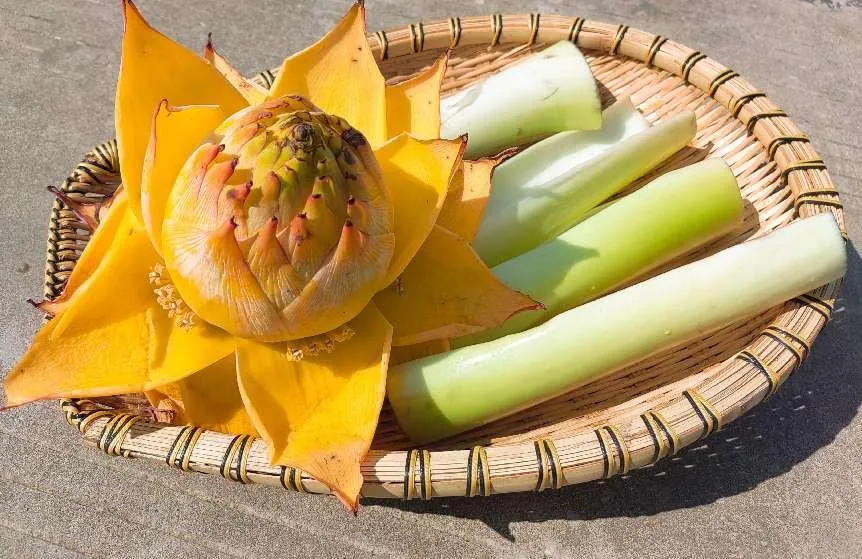
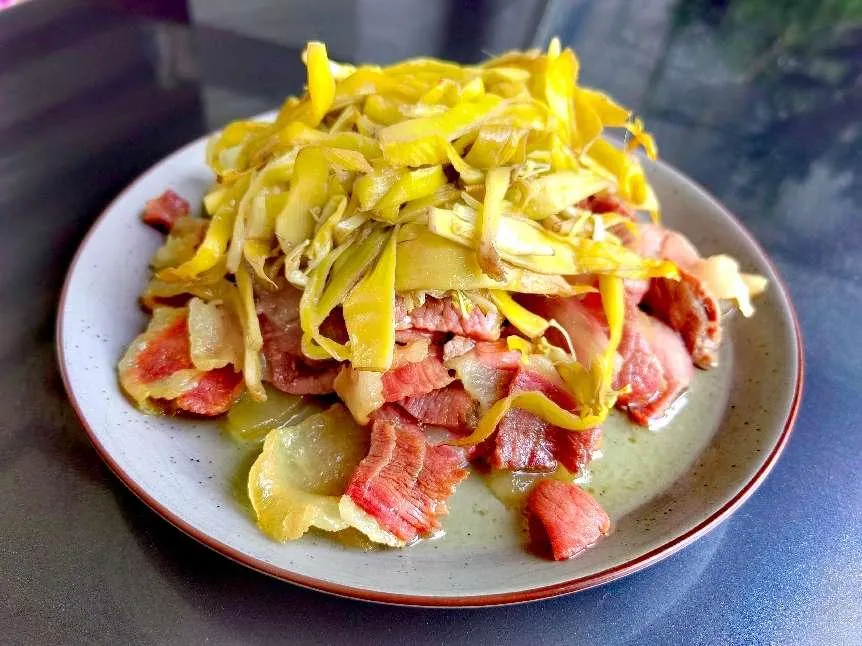
Multiple parts of the plant are eaten across ethnic minority communities in Southwest China. The tender core of the pseudostem can be stir-fried with meat or slow-cooked in stews, valued for its exceptionally high fiber content. Fresh flower buds may be blanched and stir-fried, added to soups, pickled, or made into sweet preserves. Local folklore also refers to it as a “slimming flower” due to its highly fibrous nature.
Final Conclusion
Musella lasiocarpa, the Golden Lotus Banana, is far more than an exotic tropical ornamental plant. As a rare endemic Chinese species, it beautifully blends dramatic garden aesthetics, profound Buddhist heritage, centuries of written records, and practical folk culinary uses.
Whether featured in a quiet meditation garden, an oriental courtyard, or a collector’s greenhouse, it delivers a unique visual impact paired with rich historical storytelling. If you are seeking a true conversation-piece plant with a remarkably long bloom time and timeless eastern symbolism, the Golden Lotus Banana deserves a prominent place in your landscape.
References
- Flora of China (English Edition): Musella lasiocarpa Species Account & Taxonomy — Joint botanical database by the Missouri Botanical Garden and Harvard University Herbaria.
- Plants of the World Online (POWO): Musella lasiocarpa (Franch.) C.Y.Wu ex H.W.Li Profile — Handled by the Royal Botanic Gardens, Kew.
- Royal Horticultural Society (RHS): Musella lasiocarpa (Golden Lotus Banana) Plant Care — The United Kingdom’s leading gardening authority.
- Plant Plus of China (PPBC): Scientific Specimen and Photographic Archive for Musella — National scientific infrastructure for Chinese native flora.
- Diannan Materia Medica (Ming Dynasty) & Zhi Wu Ming Shi Tu Kao (Qing Dynasty) — Classical Chinese Botanical Literature.
More from The Plant World:
- Chinese Wingnut: The Romantic “Ingot Tree” and Its Cultural Charm
- Plum Blossom Meaning: Symbolism & Cultural Significance
- The Hidden Meanings Behind Red Plum Blossoms
- Chinese Wisteria: History, Symbolism, and Identification
- Peach Blossoms in China: History, Culture, and Symbolism
- Chinese Crepe Myrtle: Guide to Origins & Symbolism
- Ginkgo Leaf Meaning: 5 Secrets of This Ancient Fossil
- Chinese Loquat Tree: Guide to Benefits & History
- Rose of Sharon Tree: Guide to Meaning & Care
- Hosta Plant Benefits: 5 Surprising Uses & Planting Guide
- Strawberry Begonia Care: How to Grow Saxifraga Stolonifera
Discover more from The Plant World
Subscribe to get the latest posts sent to your email.