
Introduction
Walk along the edges of a lake, pond, or riverbank almost anywhere in the Northern Hemisphere, and you will likely find sweet flag (Acorus calamus) growing in dense clumps, its sword-shaped leaves standing upright and vivid green. It often shares the water’s edge with reeds, cattails, and pennywort.
This unassuming aquatic plant is one of humanity’s oldest documented medicinal and aromatic herbs — mentioned in the Egyptian Ebers Papyrus around 1550 BCE, in the Bible’s Book of Exodus, and in classical Greek and Roman texts. It spread across continents, taking root in the herbal traditions of India, the Middle East, Europe, and North America.
In China, it holds a remarkable dual identity. During the Dragon Boat Festival, it is hung on doorways as a protective herb to ward off evil and disease. Yet step into a scholar’s study, and you will find a smaller, more delicate relative cultivated as a prized desk plant — celebrated as “the most elegant grass under heaven.”
What makes this plant so enduring across so many cultures? And why does it appear both in folk medicine and in classical poetry? Let us explore.
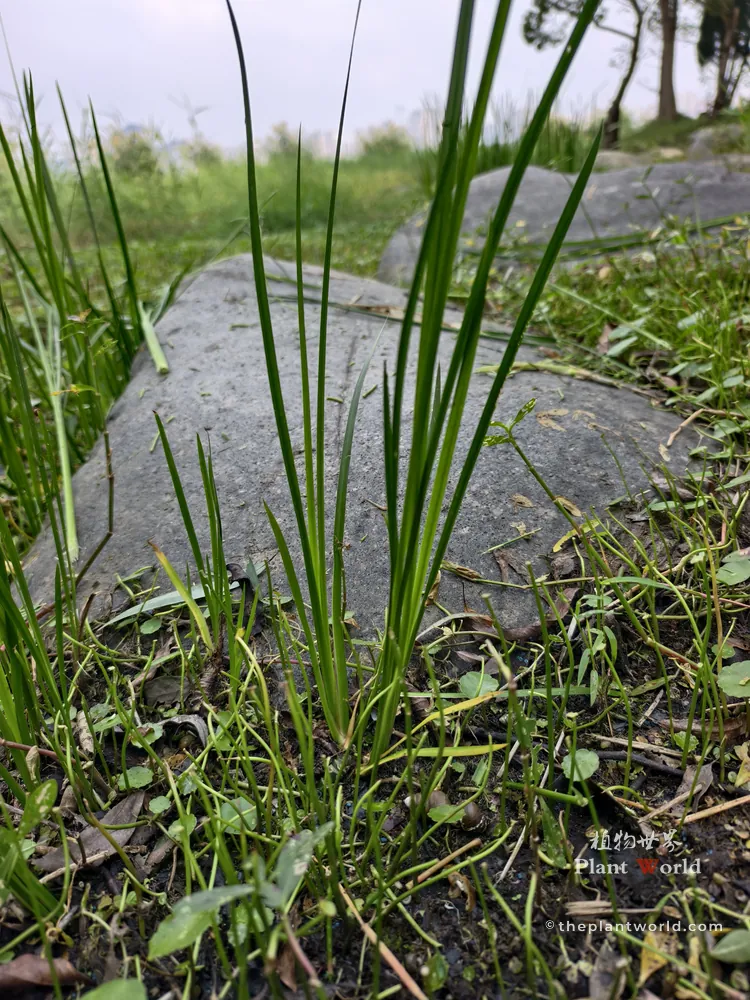
Plant Profile
| Feature | Details |
|---|---|
| Family & Genus | Acoraceae (Sweet Flag family), genus Acorus. Formerly placed in Araceae (the arum family). Flora of China recognizes two native species: Acorus calamus and Acorus gramineus. |
| Distribution | Widespread across the Northern Hemisphere — Europe, Asia, and North America. A. calamus grows in marshes, rice paddies, and shallow streams; A. gramineus clings to rocks and crevices in mountain ravines. |
| Leaves | Sword-shaped, leathery, upright, glossy green. A. calamus has broader, longer leaves (90–150 cm) with a prominent midrib; A. gramineus has narrow, short leaves (20–50 cm) without a midrib. |
| Flowers & Fruit | Both produce a spadix (fleshy spike) hidden among the leaves, with tiny yellow-green flowers. A. calamus bears red oblong berries; A. gramineus bears yellow-green to whitish berries. |
| Key Trait | The entire plant contains volatile aromatic oils. Do not eat raw. A. calamus contains β-asarone. In the United States, the FDA has prohibited calamus and its derivatives from use in food since 1968 (21 CFR 189.110). The EU similarly restricts β-asarone as a flavoring. |
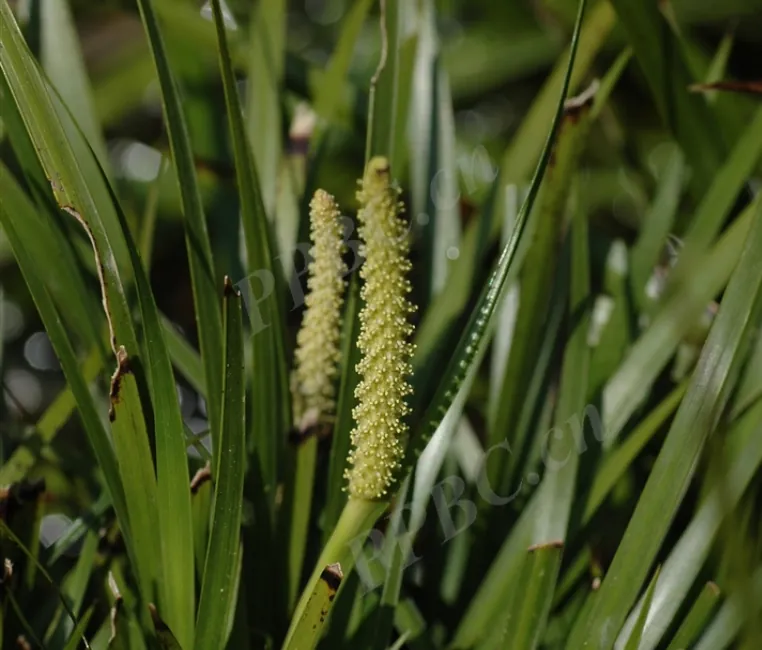
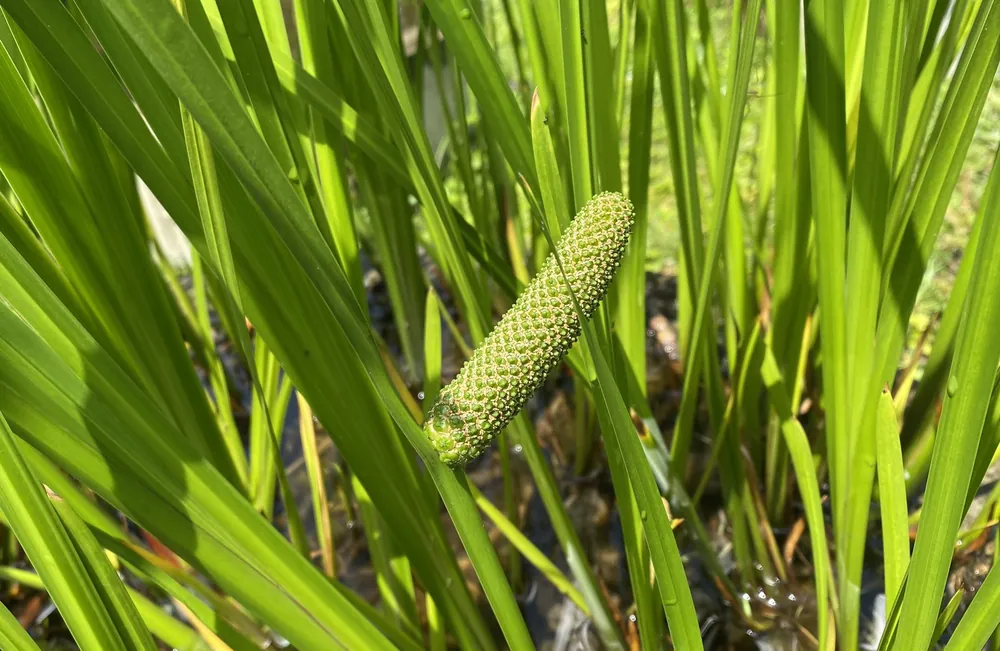
Note: The plant on your doorframe and the plant on a scholar’s desk are close relatives but different species. The doorframe plant is Acorus calamus — commonly called water calamus, sweet flag, or “water sword grass.” The desk plant is Acorus gramineus — commonly called dwarf calamus, stone calamus, or “nine-node calamus” in older texts.
Folk Tradition: The Dragon Boat Sword
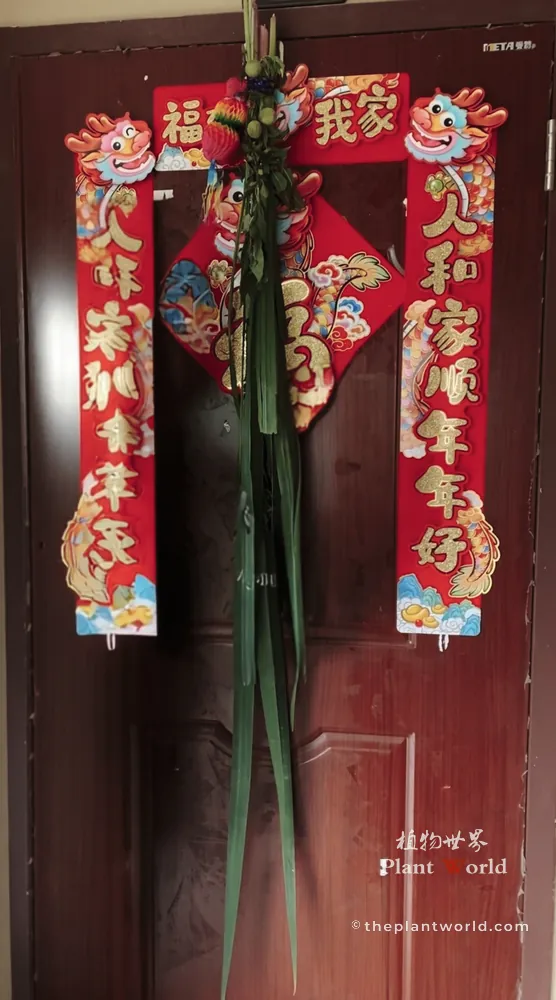
The Dragon Boat Festival (Duanwu), falling on the fifth day of the fifth lunar month, marks the height of summer heat and humidity. The ancients called the fifth month the “poison month” — a time when insects, bacteria, and disease thrived.
The custom was to hang mugwort (Artemisia argyi) and calamus above the door. As the Qing dynasty writer Fucha Dunchong recorded in Yansui Sui Shiji (Annual Records of Yanjing):
“On the day of Duanwu, calamus and mugwort are placed by the door to ward off misfortune — a surviving custom of the ‘mugwort tiger’ and ‘calamus sword.'”
The logic was practical as well as symbolic. Calamus releases volatile aromatic compounds that repel insects and freshen the air — a natural disinfectant before such a concept existed. Bundles of fresh calamus were hung on doorframes, windowsills, and in kitchens and bathrooms.
After the festival, the dried calamus was not discarded. It was saved and boiled in bathwater, believed to clear dampness and toxins from the skin.
The Scholar’s Plant: Dwarf Calamus as Desk Ornament
While Acorus calamus guarded the doorway, its smaller cousin Acorus gramineus (dwarf calamus) entered the scholar’s study.
The Song dynasty (960–1279) saw a flourishing of literati stone appreciation — the taste for viewing stones, rock gardens, and miniature landscapes. Dwarf calamus, which grows naturally on rocks in mountain streams, fit perfectly. A pot of stones with calamus growing among them became the classic desk accessory of the Song study.
Dwarf calamus is ranked among the “Four Elegant Plants” (along with orchid, narcissus, and chrysanthemum) and was called “the most elegant grass under heaven.”
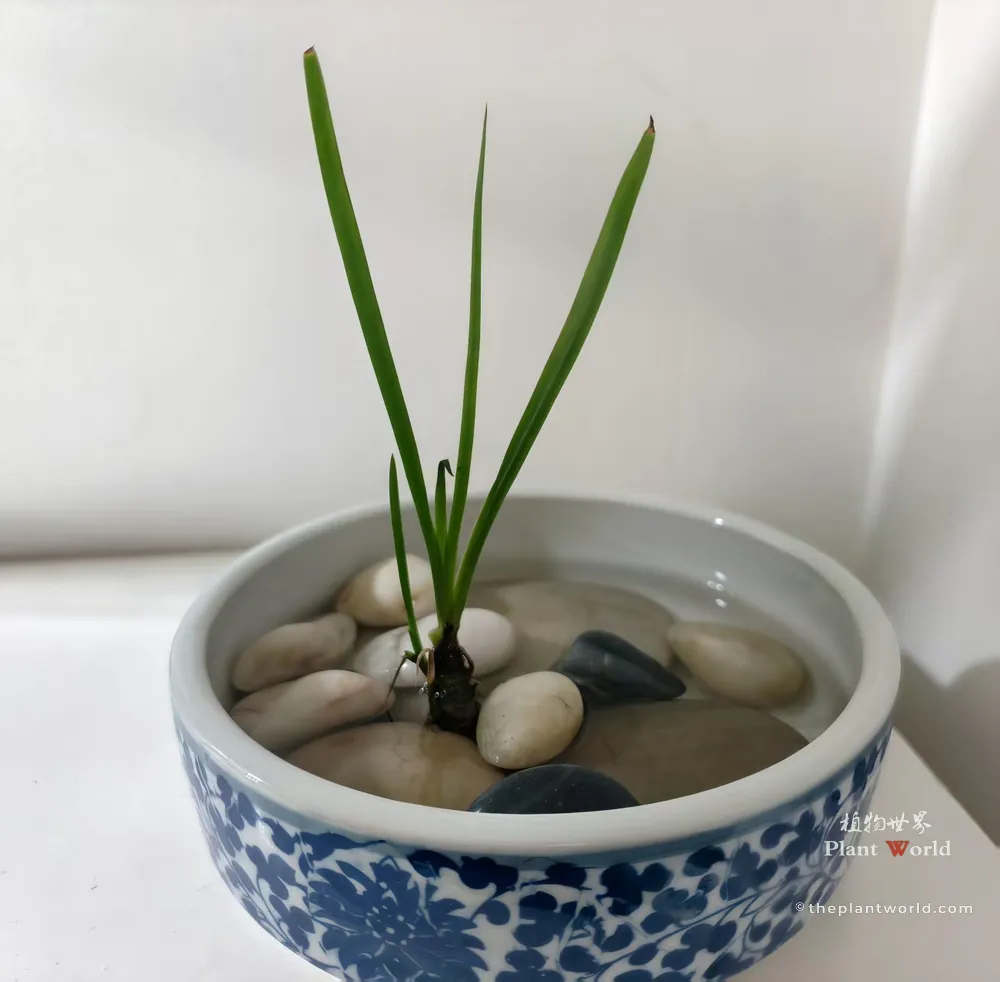
The great Song poet Su Shi (Su Dongpo) loved stone-grown calamus and wrote in his In Praise of Stone Calamus:
“It endures cold and hardship, dwells in simplicity, keeps company with clear springs and white stones, and needs no soil to grow.”
He collected pebbles from the seashore and grew calamus in clear water on his desk, admiring its lean, resilient form.
The poet Lu You was equally devoted. He wrote:
“Yandang calamus and Kunshan stone — old Chen brought them to comfort my solitude. Dense roots, nine nodes, slender and lean; a single fist of stone worth a thousand pieces of gold.”
And in a lighter vein:
“I change the calamus water with cold spring water, and brew olive tea over a living flame.”
For these scholars, tending calamus — changing its water, trimming its leaves — was a meditative ritual, a moment of calm in a busy life.
Dwarf calamus rarely flowers. It may take three years or more of careful cultivation before a tiny spike appears, hidden deep among the leaves. The Qing dynasty painter Jin Nong captured this rarity:
“Do not be surprised that calamus flowers so rarely — it will not bloom for anyone but a kindred spirit.”
Su Shi’s younger brother Su Zhe once found his own calamus in bloom and wrote a poem to commemorate the rare event — a story that became a celebrated anecdote among literati.
In the Ming dynasty, Wang Xiangjing summarized the plant’s appeal in his Qunfang Pu (Encyclopedia of Flowers):
“Stone calamus needs no sunlight, no soil, no concern for seasons. The longer it grows, the denser it becomes; the poorer its conditions, the finer its leaves. It suits the emotions and nourishes the nature. Place one near your study, and you feel a refined, carefree joy.”
Scholars also kept a pot of calamus by their lamp while reading at night — the plant was believed to absorb smoke and dust from the oil lamp, protecting the eyes and clearing the air.
A note on calamus wine: During the Dragon Boat Festival, there was an old custom of drinking calamus wine, alongside realgar wine and mugwort wine. The Song poet Ouyang Xiu wrote: “It is the season of bathing in orchid water; we share fine calamus wine from clear cups.” However, calamus is toxic, and calamus wine is a medicinal liquor. Never pick and brew it yourself. Any internal use of calamus must be under the guidance of a qualified practitioner.
Herbal Medicine: Three Plants Called “Calamus” — Not All the Same
In Chinese herbal medicine, the name changpu (“calamus”) refers to three different plants from two different families. They are not interchangeable. For readers unfamiliar with Chinese common names, the Latin names are the reliable guide:
表格
| Comparison | Acorus calamus L. | Acorus gramineus Sol. | Anemone altaica Fisch. |
|---|---|---|---|
| Family | Acoraceae (sweet flag family) | Acoraceae (sweet flag family) | Ranunculaceae (buttercup family) |
| Chinese names | 菖蒲 / 水菖蒲 (water calamus); medicinal name: 藏菖蒲 (Tibetan calamus) | 金钱蒲 / 石菖蒲 (stone calamus); folk: 随手香 (“fragrant-on-hand”) | 九节菖蒲 (nine-node calamus, trade name); also 京菖蒲 |
| Taxonomic note | The true “sweet flag” of Western herbals | Medicinal base sometimes listed as A. tatarinowii Schott, now merged into A. gramineus | Not a calamus at all — a buttercup relative sold under the “calamus” trade name |
| Habitat & form | Aquatic. Sword-shaped leaves with prominent midrib, 90–150 cm long. Tall, robust plant. | Lithophytic (grows on rocks). Linear leaves without midrib, 20–50 cm long. Small, delicate plant. | Terrestrial herb, 11–23 cm tall. One basal leaf, ternately compound. White flower in spring. |
| Rhizome | Thick, fleshy, 0.8–2 cm diameter, spongy cross-section. Strong, distinctive aroma. Pungent, bitter taste. | Flattened cylindrical, 0.3–1 cm diameter, fibrous cross-section. Fragrant aroma. Bitter, slightly pungent. | Spindle-shaped, 1–4 cm long, brown-yellow surface. Whitish, starchy cross-section. Slight aroma, slightly sour taste. |
| Medicinal status | Listed in Chinese Pharmacopoeia as “Tibetan calamus” (Tibetan folk medicine). Warms the stomach, reduces inflammation and pain. Contains β-asarone — internal use requires caution. | The genuine “stone calamus” in Chinese Pharmacopoeia. Opens orifices, resolves phlegm, awakens the spirit, improves digestion. | Not in main pharmacopoeia text; listed in provincial standards. Opens orifices, resolves phlegm, calms the spirit. Same name, different plant — cannot substitute for A. gramineus. |
Taxonomy note: Based on Flora of China, the genus Acorus is now its own family, Acoraceae (though Chinese pharmacopoeia and textbooks still use the older classification, Araceae). Flora of China recognizes only two native Acorus species: A. calamus and A. gramineus. What was formerly called “stone calamus” (A. tatarinowii) is now merged into A. gramineus botanically, though the medicinal name “stone calamus” remains in use.
Key point for Western readers: Acorus calamus is the same plant known in Western herbals as sweet flag, calamus root, or myrtle flag. Acorus gramineus is the dwarf or grassy-leaved sweet flag, sometimes called Japanese sweet flag or dwarf rush. Anemone altaica is not an Acorus at all — it belongs to the buttercup family and is only called “calamus” in the Chinese medicinal trade.
Cultural Legends: A Plant of Stars and Omens
In ancient Chinese thought, calamus was never merely a plant — it was an herb of immortality and auspicious omen.
The apocryphal classical text Chunqiu Yun Dou Shu (The Spring and Autumn Axis of the Dipper) states:
“The Jade Balance star scattered and became calamus.”
The ancients believed calamus was a fragment of a celestial star fallen to earth — which explained its otherworldly purity. Another text, Dian Shu, recorded:
“In the time of Emperor Yao, heavenly essence fell in the courtyard as leek; stirred by the yin breath of a hundred valleys, it became calamus.”
For this reason, calamus was anciently called “Yao’s leek” — a plant touched by the divine.
Its most famous attribute is the rarity of its flowering. The saying goes: “Calamus flowers are hard to meet.” While ordinary plants bloom every year, calamus was said to withhold its flowers until a person of great fortune or destiny was present.
The official history Liang Shu (Book of Liang) records a famous omen: the future Empress Zhang suddenly saw calamus blooming in the courtyard with radiant, otherworldly flowers — flowers that no one else could see. She had heard that “whoever sees calamus flowers will attain great nobility.” She picked and ate them, and soon afterward gave birth to the future emperor. The Tang poet Li He referenced this story:
“The royal aura comes from the Xiao family — it was originally the calamus flower.”
Calamus was also an herb of immortality. The Biographies of Immortals (Shenxian Zhuan) and Baopuzi both record that the finest calamus — “one inch, nine nodes” — when taken over a long period, could calm the spirit, extend life, and make the body light. Legend says that when Emperor Wu of the Han met an immortal on Mount Song, the immortal was gathering nine-node calamus from the rocks, explaining that eating it could lead to longevity.
Calamus Beyond China: A Global Herb
Sweet flag is not uniquely Chinese. It is one of the most widely used aromatic and medicinal plants in human history, with a presence stretching from ancient Egypt to Native North America.
The Ancient Near East and the Bible
Calamus appears in some of humanity’s oldest written records. The Egyptian Ebers Papyrus (c. 1550 BCE), one of the oldest surviving medical texts, lists calamus among medicinal plants. Ancient Egyptians used it in Kyphi, a complex ritual incense, and included it in preparations for mummification.
In the Hebrew Bible, the Book of Exodus (30:23) instructs Moses to make a holy anointing oil using kaneh bosem — often translated as “sweet calamus” or “sweet cane” — along with myrrh, cinnamon, and cassia. The Song of Solomon also evokes its fragrance. While the exact botanical identity of kaneh bosem remains debated among scholars, Acorus calamus is a leading candidate.
Greece and Rome
The ancient Greeks called the plant akoron or acoron, from a word meaning “sweetness.” It was considered a symbol of friendship in both Greek and Roman culture. Priests burned calamus root to purify temples, and physicians including Hippocrates and Dioscorides prescribed it for digestive complaints, liver ailments, and inflammation. Dioscorides, in his De Materia Medica (c. 70 CE), described the rhizome as warming and astringent, useful for stomach and liver disorders.
Medieval and Early Modern Europe
Calamus spread across Europe during the Middle Ages, likely carried by Crusaders and spice traders who valued its aromatic rhizome. The botanist Clusius first cultivated it in Vienna in 1574, from a root obtained in Asia Minor, and distributed it to colleagues in Belgium, Germany, and France. It was introduced to England around 1596.
Its most distinctive European use was as a strewing herb. Because of its pleasant, persistent fragrance, sweet flag leaves were scattered across the floors of churches and private houses — especially during festivals — to mask unpleasant odors in an era before modern sanitation. This practice continued surprisingly late: Norwich Cathedral in England was still strewn with sweet flag during festivals well into the 19th century. The use of fresh strewing herbs was considered such a luxury that Cardinal Wolsey was charged with extravagance for using them abundantly in his household.
Calamus also found its way into sachets and potpourri for scenting linens and clothing, and its powdered root was used in incense blends and perfumery. European herbalists valued it as a stomachic and nervine — to stimulate appetite, relieve indigestion and flatulence, and ease nervous tension. It was chewed to soothe sore throats and toothaches.
Native North America
In North America, sweet flag — often called “rat root” — was used by an extraordinary number of Indigenous nations, including the Cree, Ojibwe, Potawatomi, Iroquois, Mohawk, and many others across the Great Lakes and Eastern Woodlands regions. Several tribes considered it a sacred plant.
Uses were diverse and practical:
- The dried rhizome was scraped or grated and given to children for stomach pain and flatulence; adults chewed the root and swallowed the juice for all manner of stomach complaints.
- It was brewed as a tea or decoction for colds, coughs, bronchitis, and sore throats — valued for clearing congestion.
- Small pieces of dried rhizome were chewed as a stimulant and tonic, similar to how ginger or ginseng is used in other traditions — to combat fatigue and strengthen the body.
- It was used in smudging ceremonies and other rituals for purification and protection.
The parallel with Chinese tradition is striking: on opposite sides of the world, people independently discovered the same aromatic rhizome and used it for digestive health, respiratory relief, and spiritual protection.
Modern Safety and Regulation
Despite its long history, modern science has raised important safety concerns. The essential oil of Acorus calamus contains β-asarone, which studies have shown to be carcinogenic in rodents at high doses. As a result:
- The U.S. FDA has prohibited calamus, calamus oil, and calamus extracts from use in human food since 1968 (21 CFR 189.110).
- The European Union prohibits the use of β-asarone as a flavoring substance.
- The International Fragrance Association (IFRA) sets conservative maximum levels for asarone in fragrances.
These regulations apply specifically to food and flavoring. Calamus continues to be used in traditional medicine systems — including Ayurveda (where it is called vacha) and Traditional Chinese Medicine — under the guidance of qualified practitioners.
In the Garden: Calamus as an Ornamental Plant
Beyond medicine and ritual, Acorus has found a secure place in Western horticulture — not for its flowers (which are tiny and inconspicuous), but for its architectural foliage and its remarkable tolerance for wet soil. Three garden uses dominate.
1. Water Gardens and Pond Margins
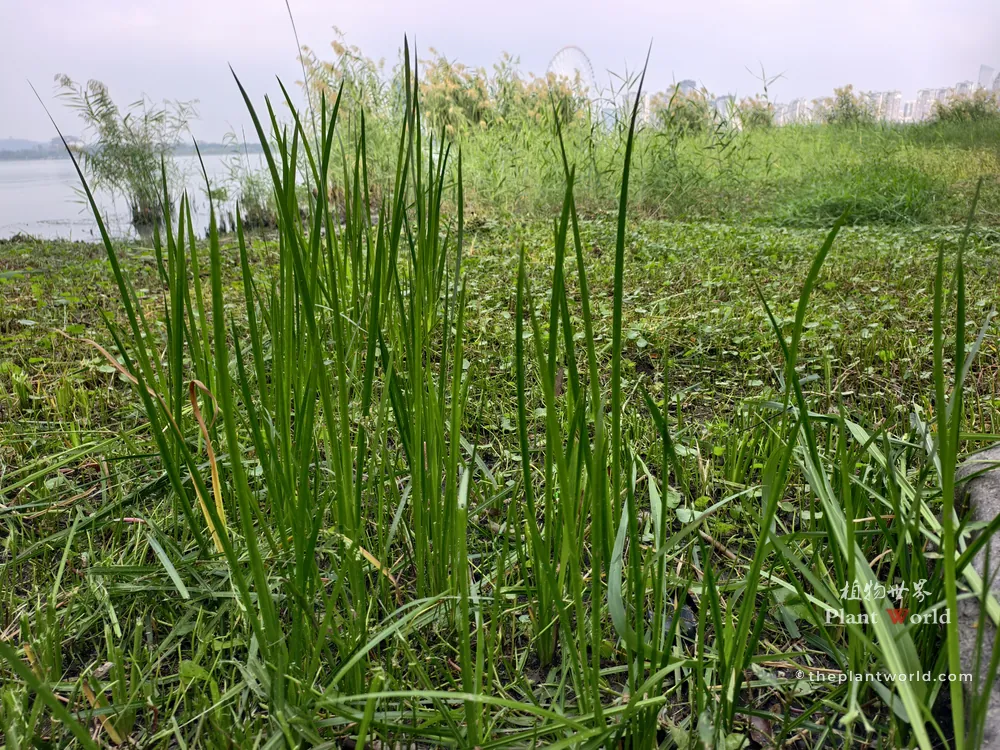
The classic Western use of sweet flag is at the edge of a pond, stream, or water garden. Acorus calamus is a marginal plant — it thrives in shallow water and saturated soil, with its rhizomes anchored in mud and its leaves rising above the surface.
Its stiff, sword-shaped leaves, held vertically in neat fans, provide a strong architectural form that contrasts beautifully with the softer, rounder foliage of water lilies, lotus, and pickerelweed. Planted along a pond edge, it creates a natural-looking transition between water and bank, while its dense root system helps stabilize the soil and prevent erosion. In larger water features, it can be grown in submerged baskets to control spread.
2. Rain Gardens and Wetland Restoration
As ecological gardening has grown in popularity, so has the use of sweet flag in rain gardens — shallow depressions designed to capture and filter stormwater runoff. These gardens are intentionally wet, and many conventional landscape plants struggle there. Acorus calamus excels: its extensive rhizome network tolerates periodic flooding, filters pollutants, and holds soil in place.
It is also increasingly used in wetland restoration and bioswale plantings, where it helps absorb excess nutrients and provides cover for amphibians and aquatic invertebrates. For homeowners concerned about runoff or poorly draining low spots in the yard, sweet flag is a low-maintenance, functional choice.
3. Ornamental Cultivars: Variegated and Golden Foliage
While Western gardeners may not share the Chinese literati’s appreciation for calamus as a symbol of resilience and purity, they are enthusiastic about its foliage varieties. Two cultivars are especially popular:
- Acorus calamus ‘Variegatus’ — Variegated Sweet Flag. Leaves are boldly striped with creamy white and green, creating a bright, eye-catching accent at the water’s edge. It is one of the most sought-after marginal plants for formal and cottage-style water gardens alike.
- Acorus gramineus ‘Ogon’ — Golden Sweet Flag (the name Ogon comes from the Japanese word for “gold”). A dwarf cultivar with bright, luminous golden-yellow foliage, it is widely grown as an ornamental grass substitute. It stays compact (15–30 cm tall), making it ideal for the front of a border, a shaded woodland path, a rock garden crevice, or a container combination. Its golden color pairs especially well with dark-leaved heucheras, ferns, and hostas.
Both cultivars are as tolerant of wet conditions as the species, and A. gramineus ‘Ogon’ is also surprisingly drought-tolerant once established — making it versatile beyond the water’s edge.
Garden tip: Acorus calamus can spread vigorously by rhizome in ideal conditions. In small ponds or contained rain gardens, grow it in a submerged pot or root barrier to prevent it from overtaking less vigorous neighbors. Acorus gramineus cultivars are much slower spreading and suitable for ordinary border planting.
Conclusion
Two plants, one name. One is tall, robust, and pungent — guarding the doorway and purifying the air. The other is slender, delicate, and quietly fragrant — sitting on the scholar’s desk, changing water with the seasons.
And beyond China, the same plant has walked through Egyptian temples, biblical anointing oils, Greek and Roman apothecaries, medieval cathedral floors, and Native American medicine bundles. In modern gardens, it lines pond edges, filters rainwater, and brightens shaded borders with golden and variegated leaves. A single aromatic rhizome, known by many names, used for many purposes — yet always recognized for the same qualities: its fragrance, its warmth, and its quiet power to soothe and protect.
A sword-shaped leaf holds aspiration; a cluster of fine leaves guards the heart. The ancient meaning lives on, quietly, in the ordinary moments — and in the wetlands of every continent.
If you found this guide helpful, explore more about Chinese Garden Plants and the rich symbolism of Chinese Flower Symbolism.
If you love Chinese plants the way I do and would like a few of them growing in your own garden, I write planting plans: six chosen for your region and your kind of garden — where each one goes, how to plant it, and why that one. Here is what a plan includes →
More from The Plant World:
- Chinese Wingnut: The Romantic “Ingot Tree” and Its Cultural Charm
- Plum Blossom Meaning: Symbolism & Cultural Significance
- The Hidden Meanings Behind Red Plum Blossoms
- Chinese Wisteria: History, Symbolism, and Identification
- Peach Blossoms in China: History, Culture, and Symbolism
- Chinese Crepe Myrtle: Guide to Origins & Symbolism
- Ginkgo Leaf Meaning: 5 Secrets of This Ancient Fossil
- Chinese Loquat Tree: Guide to Benefits & History
- Rose of Sharon Tree: Guide to Meaning & Care
- Hosta Plant Benefits: 5 Surprising Uses & Planting Guide
- Strawberry Begonia Care: How to Grow Saxifraga Stolonifera
Discover more from The Plant World
Subscribe to get the latest posts sent to your email.