
Introduction
The orchid is one of China’s traditional famous flowers, blooming in secluded valleys, standing apart from the world — often compared to the refined seclusion of a lofty hermit.
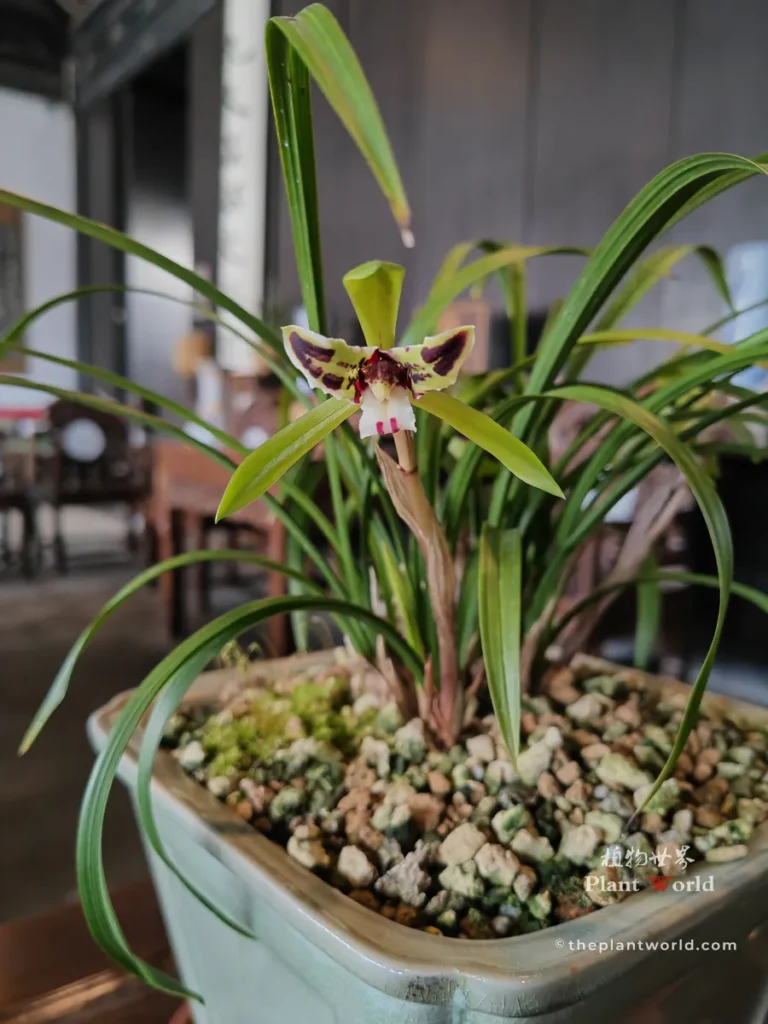
“The fragrant orchid grows in the deep forest, and does not fail to perfume the air because no one is there.” Over two thousand years ago, Confucius compared the orchid to a gentleman — even in an uninhabited valley, it still releases its fragrance; just as a gentleman cultivates virtue and integrity, and does not change his principles because of poverty. From that moment, the orchid ceased to be merely a plant and became a symbol of purity, elegance, and unyielding integrity in the Chinese spiritual world.
The orchid of Chinese tradition — the Chinese orchid or guo lan (国兰) — is a terrestrial orchid of the genus Cymbidium in the family Orchidaceae. Unlike the large, showy tropical epiphytic orchids (such as phalaenopsis and dendrobium), the Chinese orchid is prized for its subtle flower colors, clear fragrance, and graceful foliage. Together with the plum blossom, bamboo, and chrysanthemum, it is known as one of the Four Gentlemen of Flowers, and ranks first among China’s Ten Traditional Famous Flowers. To understand the Cymbidium orchid and its Chinese meaning, you have to start with its taxonomy, petal-form theory, cultural symbolism, and care.
- Introduction
- Plant Profile
- A Note on the Plant Identity of "Lan" in Pre-Qin Literature
- The Five Major Types of Chinese Orchids
- Petal-Form Theory: A Uniquely Chinese Orchid Aesthetic
- Cymbidium Orchid Chinese Meaning: The Pure, the Elegant, and the Gentleman
- History and Literature: Three Thousand Years of Orchid Fragrance
- Uses: Ornamental, Medicinal, Tea, and Edible
- Toxicity and Pet Safety
- Cultivation and Care Guide
- Final Thoughts
- References
- More from The Plant World:
Plant Profile
- Scientific Name: Cymbidium spp. (Chinese orchids are a group of terrestrial Cymbidium species, primarily including C. goeringii (spring orchid), C. faberi (faber orchid), C. ensifolium (sword-leaf orchid), C. sinense (Chinese orchid / New Year orchid), and C. kanran (winter orchid))
- Common Names: Cymbidium Orchid, Chinese Orchid, Boat Orchid
- Chinese Name: 兰花 (lán huā); also 国兰 (guo lan, “national orchid”), 兰草,幽兰 (“secluded orchid”), 芝兰,兰华
- Family: Orchidaceae → Genus Cymbidium
- Native Range: China (Yangtze River basin and southward), distributed across tropical and subtropical Asia
- Growth Form: Perennial evergreen terrestrial herb with pseudobulbs; leaves linear or lorate, leathery, evergreen
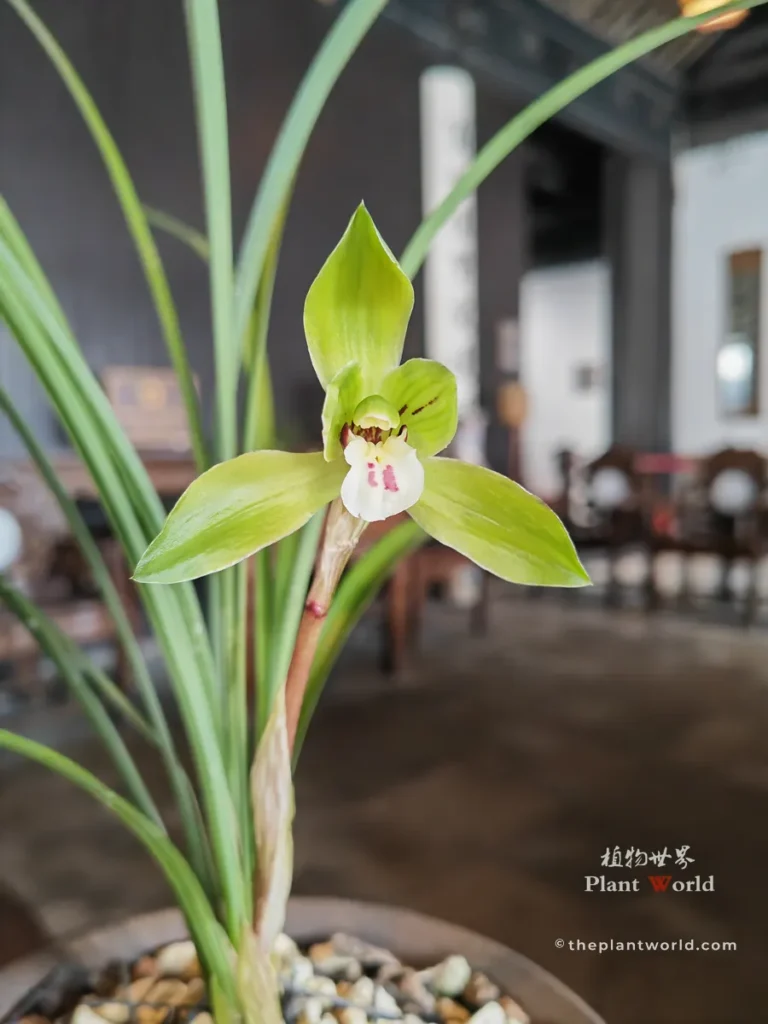
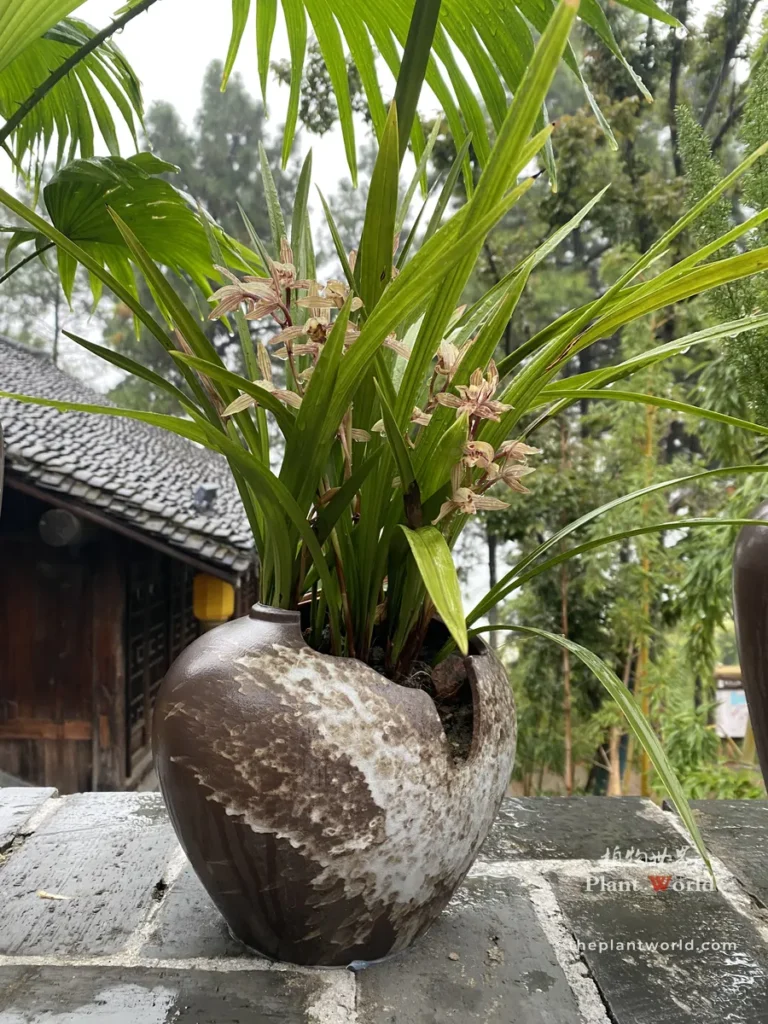
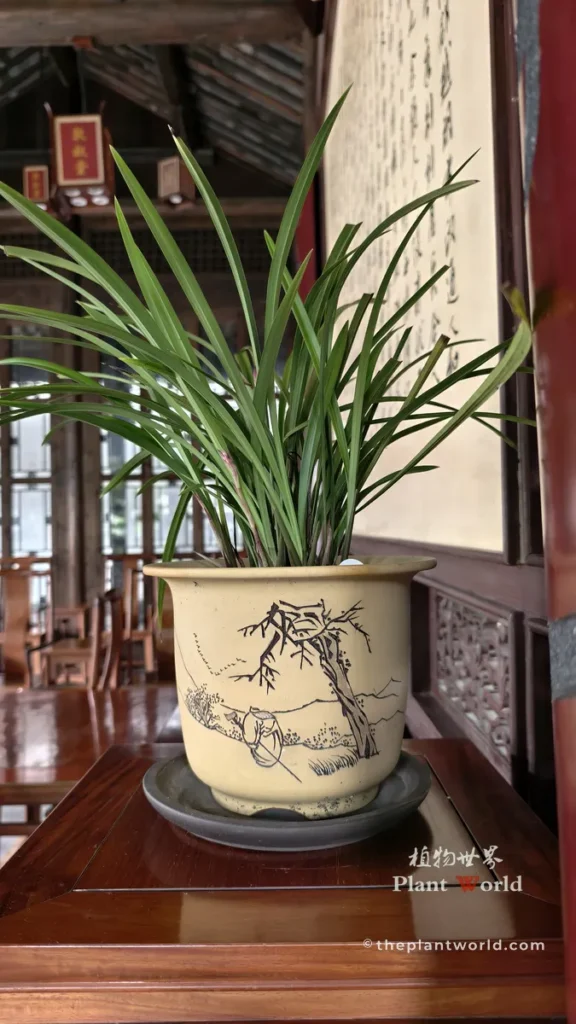
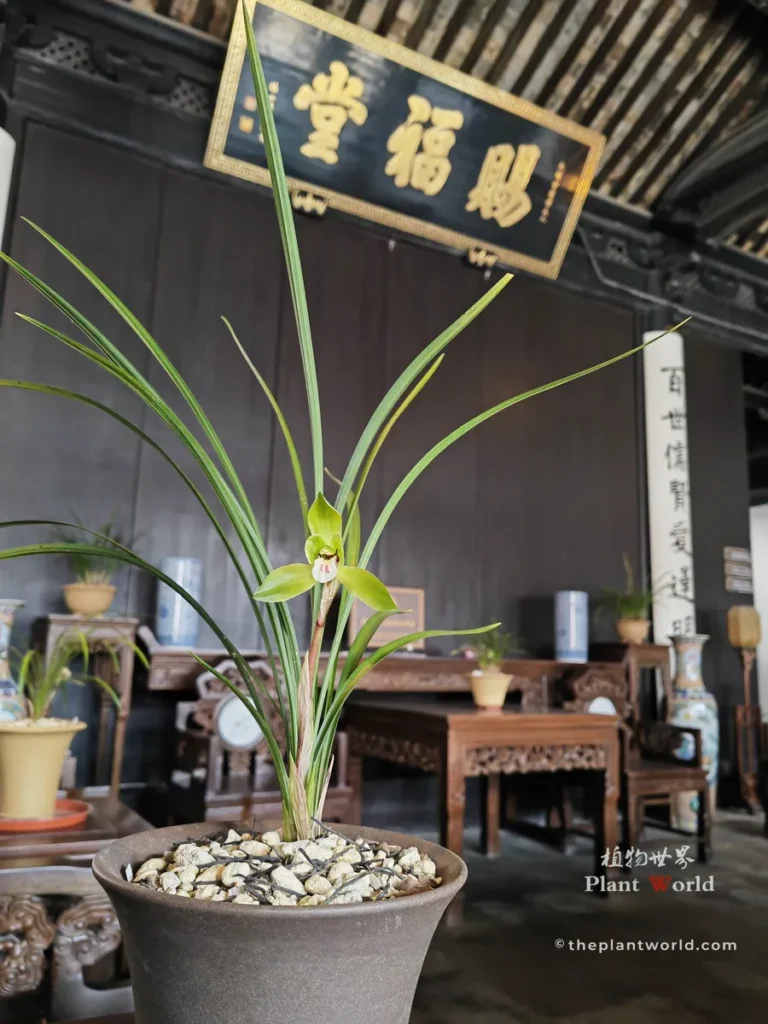
The Chinese orchid is a perennial evergreen herb with small pseudobulbs enclosed within the leaf bases. Its leaves are linear or lorate, leathery, acuminate at the apex, often with finely serrated margins, and stay evergreen year-round — both firm and supple. Even when not in bloom, orchid foliage is like a living work of art. The flower scape is erect, emerging from the base of the pseudobulb, bearing solitary flowers or a raceme. The flower structure is distinctive: the outer whorl of three sepals (one dorsal and two lateral), the inner whorl of two petals (the “holding petals”), and one specialized labellum (the “lip”) — a hallmark of the Orchidaceae.
Chinese orchid flower colors are subtle, mostly tender green or yellow-green, with white, pale red, and purple-red varieties as well. The most prized are the plain-center (素心) varieties, with lips free of any colored spots or streaks. Its fragrance is clear and not cloying — “one pot in the room, and fragrance fills every corner.” This fragrance was called the “national fragrance” (国香) by the ancients, and is the orchid’s most enchanting quality.
It is worth noting that the traditional Chinese orchid differs from the tropical epiphytic orchids commonly seen in the West (such as Phalaenopsis and Dendrobium). The Chinese orchid is a terrestrial orchid, its roots growing in the loose topsoil, with small, elegant flowers and a rich, lingering fragrance; tropical epiphytic orchids attach to tree trunks or rocks with aerial roots, bearing large, colorful flowers with varied fragrances — often bold or sweet, though some lack scent entirely. The Chinese orchid is distinct for its subtle, lingering “secluded fragrance” (幽香), clear and not cloying. This article focuses on the terrestrial Chinese orchids of the genus Cymbidium.
A Note on the Plant Identity of “Lan” in Pre-Qin Literature
Before entering the cultural symbolism, an important scholarly clarification is needed.
The plant identity of “lan” (兰) mentioned in pre-Qin to Tang Dynasty literature is a matter of academic debate. Most scholars conclude that the “lan” of this period primarily refers to peilan (佩兰,Eupatorium fortunei) or zelan (泽兰,Eupatorium japonicum) — aromatic herbs in the Asteraceae family, used for incense, bathing, exorcism, and medicine — rather than the ornamental Cymbidium orchid of today. Li Shizhen already addressed this distinction in the Compendium of Materia Medica (《本草纲目》), separating the “lan-cao” (兰草,”lan herb”) of ancient texts from the “lan-hua” (兰花,”orchid flower”) cultivated in the Ming Dynasty.
Nevertheless, the cultural symbolism of “lan” as pure, elegant, and unyielding is continuous. After the Tang and Song dynasties, the Cymbidium orchid gradually replaced Eupatorium as the scholar’s desk companion, inheriting and deepening the gentlemanly symbolism of “lan” since pre-Qin times. Thus, the Chinese orchid culture discussed in this article encompasses both the cultural origins of “lan” in pre-Qin literature and the ornamental Cymbidium orchid from the Tang and Song onward.
The Five Major Types of Chinese Orchids
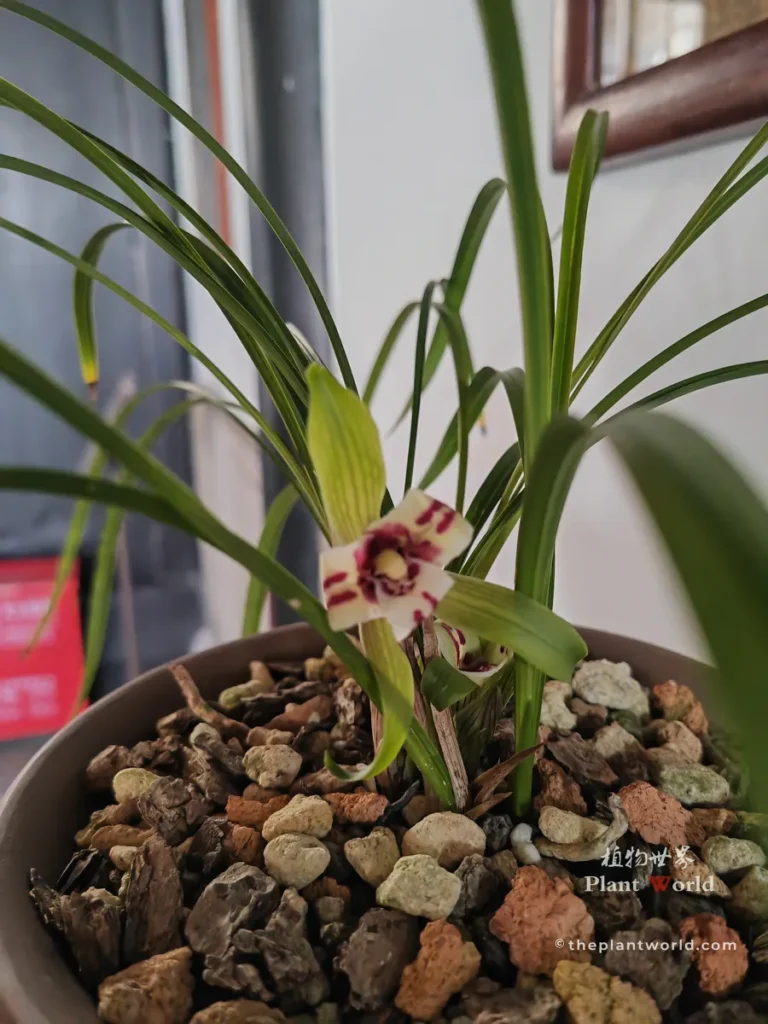
Traditional Chinese orchids are primarily divided into five major types, with additional regional groups such as the lotus-petal orchid and spring sword.
Spring Orchid (Cymbidium goeringii)
Also known as grass orchid or mountain orchid. Leaves 4–6, relatively soft, arching and drooping. Flowers solitary, occasionally paired, 4–5 cm across, mostly yellow-green or tender green, fragrant. Blooms February–March (early spring), the earliest-flowering type. The spring orchid has the richest cultivar diversity and the most developed petal-form theory. Classic cultivars such as “Song Mei” (宋梅), “Ji Yuan” (集圆), “Long Zi” (龙字), and “Wang Zi” (汪字) are known as the “Four Heavenly Kings” of spring orchids.
Faber Orchid (Cymbidium faberi)
Also known as nine-seed orchid, nine-node orchid, or summer orchid. Leaves 5–8, strongly erect, firm, with coarse serrated margins. Flower scape erect, bearing 5–12 or more flowers, ~6 cm across, yellow-green or emerald green, fragrant. Blooms March–May. Prized for its many flowers and upright foliage. Classic cultivars include “Da Yi Pin” (大一品), “Cheng Mei” (程梅), and “Guan Ding” (关顶) — the “Old Eight” of faber orchids.
Sword-Leaf Orchid (Cymbidium ensifolium)
Also known as four-season orchid or autumn orchid. Leaves 2–6, relatively soft, glossy. Flower scape erect, bearing 3–9 flowers, 4–6 cm across, yellow-green or pale yellow, richly fragrant. Blooms June–October, can flower multiple times — hence “four-season orchid.” Robust and easy to grow, ideal for beginners. Classic cultivars include “Jun He” (君荷), “Yi Pin Mei” (一品梅), and “Huang Guang Deng” (黄光登).
Chinese Orchid / New Year Orchid (Cymbidium sinense)
Also known as bao-sui orchid (报岁兰,”heralding the New Year”). Leaves 3–5, relatively broad, deep green, glossy. Flower scape erect, rising above the foliage, bearing 10–20 or more flowers, ~4.5 cm across, mostly dark purple-brown or purple-brown, with yellow-green and white varieties, fragrant. Blooms October to the following March, often flowering around Chinese New Year — hence “heralding the New Year.” Most widely cultivated in Guangdong and Taiwan.
Winter Orchid (Cymbidium kanran)
Leaves 3–7, relatively narrow, strongly erect. Flower scape erect, bearing 5–12 flowers, 6–8 cm across, with narrow, claw-like sepals and petals; colors rich, including yellow-green, purple-red, and white, fragrant. Blooms August–December. Prized for its slender flower form and rich color palette, increasingly popular in recent years.
Additional regional groups include the lotus-petal orchid (C. tortisepalum, primarily Yunnan and Sichuan) and the spring sword (C. goeringii var. longibracteatum, primarily Sichuan), each with distinctive characteristics.
Petal-Form Theory: A Uniquely Chinese Orchid Aesthetic
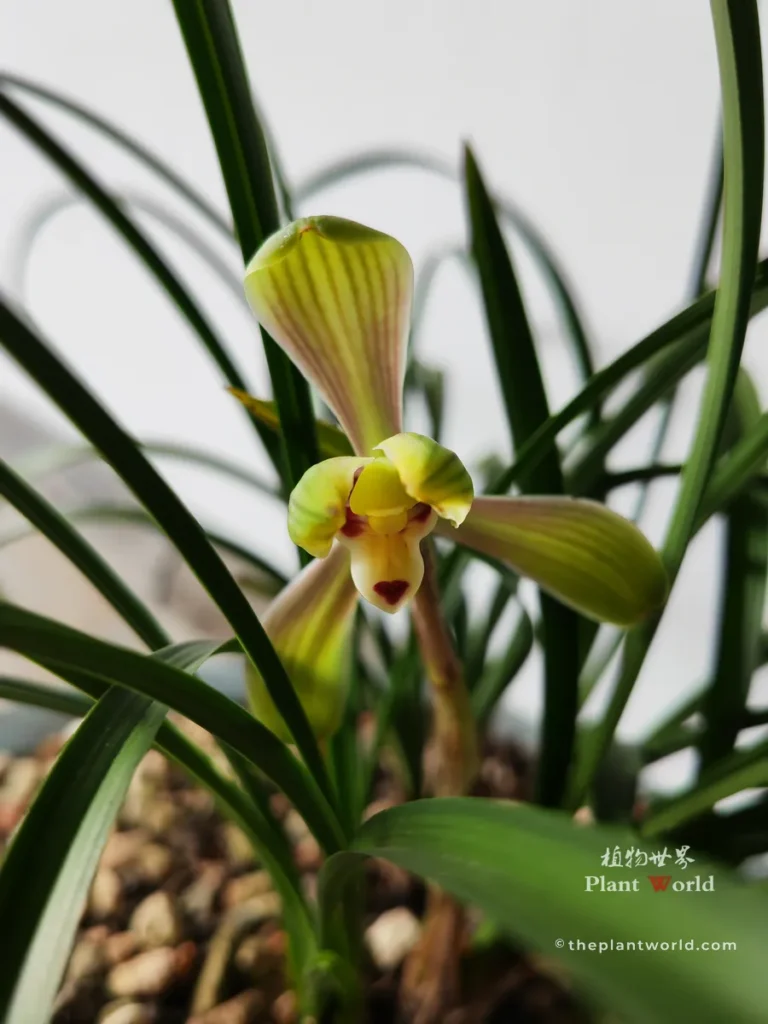
No flower in the world has developed a system as distinctive and refined as the Chinese orchid’s petal-form theory (瓣型学说) — classifying, appreciating, and judging orchid cultivars by the morphology of their petals and sepals.
The petal-form theory was pioneered by Bao Weisheng (鲍薇省) in the Qing Dynasty in his Miscellaneous Notes on Orchid Cultivation (《艺兰杂记》), who divided spring orchids into five categories: plum-petal, narcissus-petal, lotus-petal, plain-center, and butterfly-petal. Refined by generations of orchid masters, it became the core system of Chinese orchid appreciation.
Plum-Petal (梅瓣)
Sepals short and rounded, with blunt tips; the holding petals (inner two petals) form a “pocket” (tips curled inward); the lip short and rounded. The flower form is dignified, resembling a plum blossom — hence the name. Plum-petal is the most revered form. The spring orchid “Song Mei” is the quintessential example.
Lotus-Petal (荷瓣)
The outer three sepals broad and thick, resembling lotus petals, with a length-to-width ratio of about 2:1; holding petals short and rounded; the lip round and full. The lotus-petal form is grand and 雍容 (elegant and poised), and true standard lotus-petal forms are extremely rare. The spring orchid “Da Fu Gui” (大富贵) is a famous lotus-petal cultivar.
Narcissus-Petal (水仙瓣)
Sepals slightly pointed, longer than plum-petal; holding petals form a pocket; the lip drooping or slightly curled. The form is refined, between plum-petal and bamboo-leaf-petal. Subdivided into plum-form narcissus and lotus-form narcissus. The spring orchid “Long Zi” (龙字) is a representative narcissus-petal cultivar.
Plain-Center (素心)
The lip (labellum) is pure, free of any red or purple spots; flower colors are subtle. Plain-center occurs within all petal forms and is not an independent category, but because of its purity and elegance, it has always been regarded as one of the most precious types — there is a saying, “among plain-center forms, none is inferior.”
Butterfly-Petal (蝶瓣)
The petals or sepals undergo labellum mutation, developing red spots and streaks, resembling a butterfly with spread wings. Subdivided into outer butterfly (sepal labellum mutation) and inner butterfly (holding-petal labellum mutation). The flower form is exotic — a treasure among mutations.
Beyond these standard forms, wild orchids and common cultivars are mostly bamboo-leaf-petal (竹叶瓣,with narrow sepals like bamboo leaves). Though not a standard form, they possess their own natural beauty.
The petal-form theory is a uniquely Chinese aesthetic creation — it fuses the meticulous observation of flower form with the pursuit of gentlemanly character, forming a distinctive culture of “judging quality by petal form, expressing character through flowers.”
Cymbidium Orchid Chinese Meaning: The Pure, the Elegant, and the Gentleman
In Chinese culture, the orchid’s meaning is multilayered — it is the pure and elegant gentleman, the unyielding person of integrity, the secluded hermit of the mountains, and the token of sincere friendship.
One of the Four Gentlemen: The Symbol of Purity and Elegance
The orchid, together with the plum blossom, bamboo, and chrysanthemum, is known as one of the Four Gentlemen of Flowers. The plum blossom braves the snow, bamboo is humble, the chrysanthemum defies the frost — and the orchid, growing in secluded valleys and perfuming the air though no one is there, symbolizes the gentlemanly character of purity, elegance, tranquility, and refusal to flatter the world.
The orchid never curries favor with anyone. Born in wild valleys, washed clean of dust, with graceful form and subtle fragrance, it is pure and understated. The Chinese have always regarded the orchid as a symbol of purity and elegance, using it to compare themselves and to express character. “The orchid leaves are graceful and green, the orchid flowers release their fragrance” — the orchid’s form and fragrance are themselves the portrait of a gentleman.
Confucius: The Fragrant Orchid Grows in the Deep Forest
Confucius was the founder of orchid culture. The Confucius Family Sayings (《孔子家语》) records:
“The fragrant orchid grows in the deep forest, and does not fail to perfume the air because no one is there. The gentleman cultivates virtue and establishes character, and does not change his principles because of poverty.”
The fragrant orchid grows in the deep forest and does not withhold its fragrance because no one appreciates it; the gentleman cultivates virtue and does not alter his integrity because of hardship. This passage perfectly fuses the orchid’s natural attributes with the gentleman’s pursuit of character, laying the cultural foundation for the orchid as a symbol of the gentleman.
⚠️ Note: The plant identity of “fragrant orchid” (芝兰) here is debated among scholars; most believe it refers to the Asteraceae Eupatorium (peilan/zelan), but its gentlemanly symbolism was inherited by the later Cymbidium orchid.
Confucius also composed the qin melody Yi Lan Cao (《猗兰操》, “Hymn to the Solitary Orchid”). Legend says that on his return from Wei to Lu, he saw an orchid growing alone in a secluded valley and sighed: “The orchid should be the fragrance of kings; yet here it grows alone, among ordinary grasses.” He stopped his carriage, played the qin, and sang — lamenting that he had not met the right time, using the orchid to express his resolve. From then on, “the fragrance of kings” (王者香) became the highest praise for the orchid’s fragrance.
Qu Yuan: The Fragrant Beauty and Unyielding Integrity
During the Warring States period, Qu Yuan mentioned the orchid ten times in Li Sao (《离骚》), creating the literary image of the “fragrant beauty” (香草美人). He wrote:
“I wear river iris and remote angelica, / I string autumn orchids to wear as ornaments.”
“I have already planted nine fields of orchids, / And a hundred acres of hui (fragrant grass).”
Qu Yuan used the orchid, together with other fragrant herbs, as a symbol of purity, elegance, and loyalty — wearing them on his body, planting them in his gardens. The orchid was not merely a plant but a vessel for his political ideals and personal integrity. Qu Yuan drowned himself in the Miluo River to affirm his principles, and the orchid in his writings thus acquired a tragic dimension of unyielding integrity, refusing to compromise even unto death.
⚠️ Note: The plant identity of “autumn orchid” (秋兰) here is debated among scholars; most believe it refers to the Asteraceae Eupatorium (peilan/zelan), worn as a fragrant herb to ward off impurity; but the orchid’s symbol of purity was thereby established and inherited by the later Cymbidium orchid.
Giving Orchids as Tokens: Friendship and Love
The orchid is not only a symbol of the gentleman but also a token of emotion. The Book of Songs · Zheng Feng (《诗经・郑风》) records: “The young men and women, holding lan grass in their hands” — in spring, young men and women carried orchid grass, exchanging it as a token of good wishes. The Zuo Zhuan (《左传》) tells the story of “Yan Ji dreaming of an orchid” — a concubine of Duke Wen of Zheng dreamed that an ancestor gave her an orchid, saying “the orchid has the national fragrance”; she later gave birth to Prince Lan (Duke Mu of Zheng). From then on, “dreaming of an orchid” became an auspicious sign for childbirth, and “national fragrance” became synonymous with the orchid.
The ancients said, “Holding an orchid, one feels no aversion; giving an orchid, one conveys affection.” The orchid’s subtle fragrance is precisely the metaphor for the secluded hermit, holding fast to purity and integrity; it also compares to the gentleman’s tranquil and humble mind, seeking neither fame nor recognition.
It is one of the richest subjects in all of Chinese flower symbolism.
History and Literature: Three Thousand Years of Orchid Fragrance
The cultivation and appreciation of the Chinese orchid spans over two thousand years, from pre-Qin to Ming-Qing, the orchid’s presence weaving through the entire history of Chinese culture.
Pre-Qin: From the Book of Songs to the Songs of Chu
The Book of Songs already records the orchid. In Zheng Feng · Qin Wei (《郑风・溱洧》): “The Qin and Wei rivers flow abundantly; the young men and women hold lan grass in their hands.” Here “lan” (蕑) is generally identified as orchid grass — at that time, people carried orchid grass in spring, going on outings and exchanging tokens.
The Zuo Zhuan story of “Yan Ji dreaming of an orchid” is the earliest source of “the orchid has the national fragrance.”
Confucius sang of orchids, King Goujian of Yue planted orchids, Qu Yuan chanted of orchids — during the Spring and Autumn and Warring States periods, the orchid had already penetrated politics, ritual, and literature. King Goujian is said to have planted orchids on Lanzhu Mountain (兰渚山) in Shaoxing, Zhejiang — which became one of the sacred sites of Chinese orchid cultivation.
Wei-Jin: Wang Xizhi and the Orchid Pavilion
In the ninth year of the Yonghe era of the Eastern Jin (353 CE), Wang Xizhi and forty-one scholars, including Xie An and Sun Chuo, gathered at the Orchid Pavilion (兰亭) in Shanyin, Kuaiji, for the Spring Purification Ceremony (修禊), drinking wine and composing poems. Wang Xizhi wrote the Preface to the Orchid Pavilion Collection (《兰亭集序》), hailed as the “best running-script calligraphy under heaven.” The Orchid Pavilion was named for the orchid, and the orchid gained additional elegance through the Orchid Pavilion — a single scholarly gathering bound the orchid inseparably to the art of Chinese calligraphy.
Tang-Song: From Chanting Orchids to Cultivating Them
In the Tang Dynasty, poems chanting orchids multiplied. Han Yu wrote a contemporary version of Yi Lan Cao, concluding with “the gentleman’s sorrow, the gentleman’s keeping” — pushing Confucius’s use of the orchid to express resolve into deeper philosophical reflection.
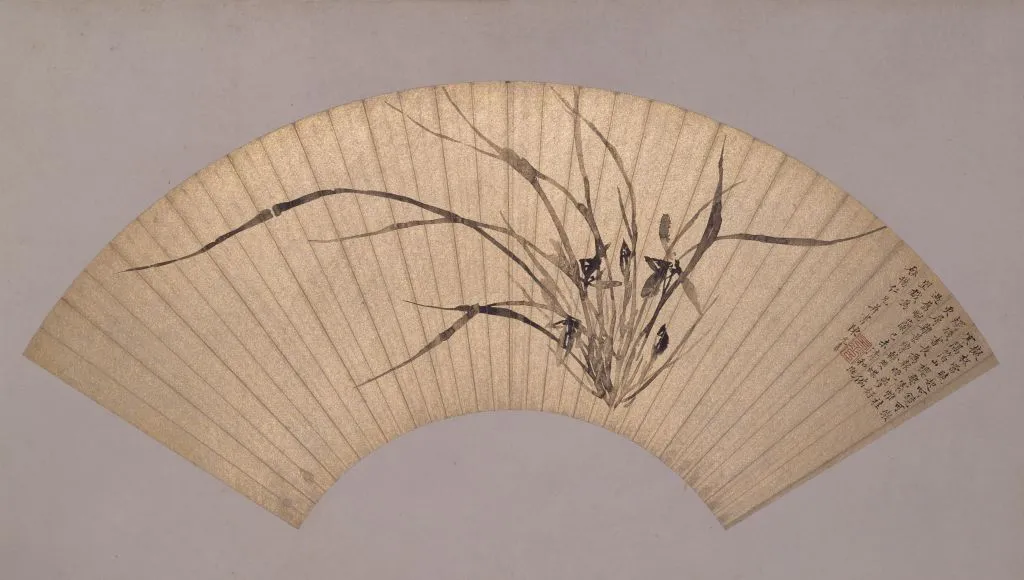
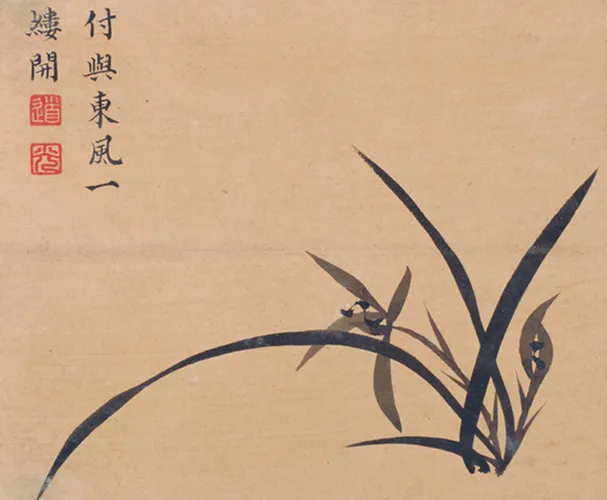
In the Song Dynasty, orchid cultivation and appreciation matured. Song people loved orchids, painted orchids, chanted orchids — the orchid became an important subject of scholar-painting. The Southern Song painter Zhao Mengjian’s Ink Orchid (《墨兰图》) is a masterpiece, painting the graceful orchid foliage in ink, pioneering the tradition of scholar-painting orchids.
Ming-Qing: Petal-Form Theory and the Golden Age of Orchid Cultivation
During the Ming and Qing dynasties, orchid cultivation reached its peak. Bao Weisheng’s Miscellaneous Notes on Orchid Cultivation pioneered the petal-form theory in the Qing Dynasty, dividing orchids into plum-petal, lotus-petal, narcissus-petal, and more — laying the theoretical foundation for Chinese orchid appreciation. Thereafter, orchid manuals such as The Heart of Orchids in Harmony (《兰蕙同心录》), Notes on the First Fragrance (《第一香笔记》), and Essays on Orchid Speech (《兰言述略》) appeared in succession, and orchid cultivation became a specialized discipline.
During the Ming and Qing, the Jiangsu-Zhejiang region had the strongest orchid culture, producing numerous classic cultivars. The spring orchid “Song Mei” (selected during the Qianlong era), “Ji Yuan,” “Long Zi,” and “Wang Zi” are still cultivated today — living artifacts of the Chinese orchid.
Uses: Ornamental, Medicinal, Tea, and Edible
The orchid is not only a spiritual symbol but also a plant useful in every part.
Ornamental
The orchid is one of China’s most important indoor ornamental flowers. One pot in a room — graceful foliage, clear fragrance, elegant and refined. Orchids are potted and displayed in studies, living rooms, and tea rooms, and used in flower arrangements. Orchid exhibitions are an important part of traditional Chinese flower shows; every spring and autumn, local orchid exhibitions draw large numbers of enthusiasts and visitors.
Medicinal
The flowers, leaves, and roots of the orchid are all used in traditional Chinese medicine.
- Orchid flower: Pungent in flavor, neutral in nature, enters the lung, spleen, and liver meridians. Functions: regulates qi and resolves stagnation, harmonizes blood and regulates menstruation, drains dampness, brightens the eyes. Indications: chest tightness, diarrhea, chronic cough, blurred vision and cataracts, menstrual irregularity.
- Orchid leaf: Pungent, slightly cold. Functions: clears heat, cools blood, regulates qi, drains dampness. Indications: lung abscess, vomiting blood, hemoptysis, cloudy urine, leukorrhea, boils, swellings.
- Orchid root: Pungent, cool. Functions: clears lung heat and resolves toxins, resolves phlegm and stops cough, cools blood and stops bleeding. Indications: tuberculosis, whooping cough, stomach disorders, rheumatic arthralgia, traumatic injuries.
The sword-leaf orchid, spring orchid, faber orchid, and winter orchid are all used medicinally. Orchid flowers can also be made into orchid distillate (兰花露), effective for brightening the eyes and relieving summer heat.
⚠️ Ethnobotanical disclaimer: The above is for historical and cultural reference only and does not constitute medical advice. Consult a qualified healthcare professional before use.
It is a valued member of the Chinese herbaceous plants tradition.
Tea and Edible
- Orchid-scented tea: The orchid’s clear fragrance is used to scent tea. Orchid tea is refreshing and fragrant, with effects of refreshing the mind, regulating qi, and resolving stagnation.
- Orchid in cuisine: Orchid petals are edible — used in soups, dishes, and desserts. Orchid soup, orchid chicken slices, and orchid porridge are all elegant orchid dishes.
- Orchid wine: Orchids steeped in wine produce a clear, elegant fragrance with effects of activating blood and unblocking meridians.
Toxicity and Pet Safety
Orchids are generally considered low-toxicity or non-toxic to pets. The American ASPCA does not list the genus Cymbidium as toxic to cats or dogs. However, note that:
- Ingesting large amounts of any plant can cause gastrointestinal upset (vomiting, diarrhea) in pets.
- The growing medium of potted orchids (such as sphagnum moss, bark, orchid stone) may cause digestive tract obstruction if ingested by pets.
- Pets should be kept away from orchids after fertilizing or pesticide treatment.
⚠️ Pet safety note: Although orchids have low toxicity, households with cats and dogs should still place orchids out of pets’ reach. If you suspect your pet has ingested a large amount of orchid or growing medium, contact a veterinarian promptly.
Cultivation and Care Guide
The care of Chinese orchids follows the saying “three parts planting, seven parts management” — the core is simulating its native environment: partial shade, moisture, ventilation, and airiness.
Light
Chinese orchids prefer partial shade and avoid strong direct sunlight. In spring, autumn, and winter, provide soft, diffused light; in summer, shade 70–80%. Insufficient light leads to fewer flowers and weak fragrance; excessive light causes leaf burn and yellowing. Orchids thrive indoors with bright diffused light or under tree shade.
Temperature
Cold tolerance varies by type:
- Spring orchid and faber orchid: Relatively cold-tolerant, surviving lows of -5°C to -8°C; require a vernalization period of 0°C to 10°C in winter to flower normally.
- Sword-leaf orchid: Moderate cold tolerance, overwintering temperature not below 0°C.
- Chinese orchid (sinense) and winter orchid: More cold-sensitive, overwintering temperature not below 5°C; require indoor overwintering in the north.
Optimal growing temperature is 15°C to 25°C; ventilation and cooling are needed above 35°C in summer.
Watering
Chinese orchids prefer moisture but hate waterlogging. Follow the principle of “water when the surface dries, water thoroughly.” Rainwater or snowmelt is best; tap water should be left to stand for a day to dechlorinate. In the summer growing season, water daily or every other day; in winter dormancy, reduce watering, keeping the medium slightly moist.
Growing Medium
Although Chinese orchids are terrestrial, their roots need air circulation — ordinary garden soil must not be used. Common media include:
- Traditional: Leaf mold, mountain soil, peat mixed with perlite.
- Modern: Bark (pine, oak), orchid stone (pumice, volcanic rock), sphagnum moss, coconut husk chunks — granular media that are loose, airy, and well-draining.
Sterilize the medium before use; repot every year or every other spring.
Fertilizing
Chinese orchids prefer dilute, frequent fertilization and hate concentrated fertilizer. During the growing season (spring to autumn), apply dilute liquid fertilizer every 10–15 days, using orchid-specific fertilizer or well-rotted organic fertilizer. During flower bud differentiation, increase phosphorus-potassium fertilizer (such as potassium dihydrogen phosphate) to promote flowering. Stop fertilizing during summer heat and winter dormancy.
Ventilation
Ventilation is one of the keys to successful orchid growing. Good ventilation reduces pests and diseases and promotes root respiration. Place orchids where air circulates freely, but avoid strong drafts directly on the plant. Indoor orchid growing can use a small fan to assist ventilation.
Final Thoughts
The orchid is a flower that perfectly unites character, beauty, and utility.
It is the gentleman of Confucius — “does not fail to perfume the air because no one is there”; it is Qu Yuan’s “autumn orchid strung to wear as ornaments” in Li Sao; it is the elegance of Wang Xizhi’s Orchid Pavilion gathering; it is the plum-petal, lotus-petal, and narcissus-petal of Bao Weisheng’s petal-form theory; it is the graceful ink orchid in scholar-paintings; and it is a pot of elegant quiet companion on an ordinary person’s desk.
Cymbidium orchid Chinese meaning is the gentlemanly character of purity and elegance, the unyielding spirit of integrity, the hermit’s refinement of mountain seclusion, and the sincere friendship of giving orchids as tokens. Its uses span from ornamental to medicinal, from tea-scenting to cuisine — a single orchid woven through the spiritual world and daily life of the Chinese people.
“An inch of heart is not large, yet it holds so much fragrance.” The orchid’s flower is not large, yet it contains such clear, subtle fragrance — just as the gentleman’s heart, though tranquil and humble, holds the purity and integrity of all under heaven. The orchid grows in secluded valleys, its fragrance reaching far — this is the unchanging spiritual pursuit of the Chinese people for three thousand years. It remains a timeless chapter in Chinese plant culture.
References
Plants of the World Online (POWO). Cymbidium Sw. Royal Botanic Gardens, Kew. — Primary taxonomic database for modern botanical classification.
Confucius Family Sayings (《孔子家语》) & Qu Yuan, Li Sao (《离骚》) — Earliest literary foundations establishing the orchid as a symbol of gentlemanly integrity and virtue.
Bao Weisheng, Miscellaneous Notes on Orchid Cultivation (《艺兰杂记》, Qing Dynasty) — Classical theoretical foundation for Chinese orchid petal-form theory (瓣型学说).
Li Shizhen, Compendium of Materia Medica (《本草纲目》, Ming Dynasty) — Historical distinction between ancient “lan-cao” (Eupatorium) and cultivated “lan-hua” (Cymbidium).
ASPCA Animal Poison Control. “Toxic and Non-Toxic Plants: Cymbidium spp.” — Authoritative pet safety database confirming non-toxicity in cats and dogs.
More from The Plant World:
- Chinese Wingnut: The Romantic “Ingot Tree” and Its Cultural Charm
- Plum Blossom Meaning: Symbolism & Cultural Significance
- The Hidden Meanings Behind Red Plum Blossoms
- Chinese Wisteria: History, Symbolism, and Identification
- Peach Blossoms in China: History, Culture, and Symbolism
- Chinese Crepe Myrtle: Guide to Origins & Symbolism
- Ginkgo Leaf Meaning: 5 Secrets of This Ancient Fossil
- Chinese Loquat Tree: Guide to Benefits & History
- Rose of Sharon Tree: Guide to Meaning & Care
- Hosta Plant Benefits: 5 Surprising Uses & Planting Guide
- Strawberry Begonia Care: How to Grow Saxifraga Stolonifera
Discover more from The Plant World
Subscribe to get the latest posts sent to your email.