
Introduction
Wander through the narrow stone lanes of an old Jiangnan village, or trace the weathered walls of a heritage garden in southern China, and you will almost certainly meet it — a dense, emerald curtain of tiny heart-shaped leaves, clinging so tightly to masonry that it seems painted onto the stone. This is Ficus pumila, the Creeping Fig, known in China as bìlì (薜荔). A woody, evergreen climber in the mulberry family, it is one of the most widespread and beloved Chinese climbing vines, creeping along the ground when young and scaling walls, tree trunks, and rock faces with aerial roots as it matures.
Long before it became a trendy living-wall plant in Western interiors, the Creeping Fig was woven into the fabric of Chinese poetry, medicine, and folk food. The Song Dynasty poet Mei Yaochen (梅尧臣, 1002–1060) captured its character with characteristic wit:
“Among plants there is the creeping fig; among creatures there is the lizard.
Though of different kinds, both are born to climb the wall.”
Mei’s comparison is apt. The lizard and the bìlì share a quiet, tenacious genius for vertical surfaces — one by instinct, the other by biology. This guide explores that biology, the plant’s surprising partnership with a tiny wasp, its two-millennia-old presence in Chinese literature, and how to grow it successfully in your own home or garden.

- Introduction
- Plant Profile: What Is Ficus pumila?
- The Hidden Flower and the Fig Wasp
- ⚠️ Toxicity, Pet Safety & Edibility Clarification
- Cultivation & Care Guide for the Creeping Fig
- Cultural Heritage & Poetic Symbolism
- Practical Traditional Uses
- Garden and Landscape Value
- Conclusion
- References
- More from The Plant World:
Plant Profile: What Is Ficus pumila?
- Scientific Name: Ficus pumila L.
- Common Names: Creeping Fig, Climbing Fig, Creeping Rubber Plant, Ivy Fig
- Chinese Name: 薜荔 (bìlì); also 凉粉果 (liángfěn guǒ, “jelly-fruit”), 木莲 (mùlián, “wood lotus”), 木馒头 (mùmántou, “wood steamed bun”)
- Family: Moraceae (Mulberry / Fig Family)
- Native Range: Southern and eastern China (south of the Yangtze River), Taiwan, Japan, and tropical to subtropical Southeast Asia
- Growth Habit: Woody evergreen climber / creeping shrub
Ficus pumila is unusual among figs in that it is primarily a vine. Its stems become woody with age, and it produces two distinct types of roots: fibrous feeding roots in the soil, and short, adhesive aerial roots along the stems that grip onto virtually any rough surface — stone, brick, bark, or wood. Once attached, a mature vine can cover an entire wall in a dense, self-sustaining mat.
The Two-Leaf Mystery
One of the Creeping Fig’s most fascinating botanical traits is its dimorphic foliage — the same plant produces two completely different leaf shapes, each with a dedicated job:
- Juvenile / climbing leaves (small leaves): Ovate-cordate (egg-shaped with a heart-shaped base), roughly 2.5 cm long, thin and slightly leathery. These grow on the flat, wall-hugging stems and are specialized for attachment and close-quarters photosynthesis.
- Mature / fruiting leaves (large leaves): Ovate-elliptic, 5–10 cm long, thicker and firmer. These appear on the “hanging branches” that extend outward from the wall once the vine reaches a certain stage of maturity. They handle the heavier photosynthetic load and support the developing figs.
A single specimen will therefore show small leaves pressed flat against the wall and larger leaves on the branches that dangle freely into the air — a division of labor that makes the Creeping Fig both an efficient climber and a productive fruiting plant.

The Hidden Flower and the Fig Wasp
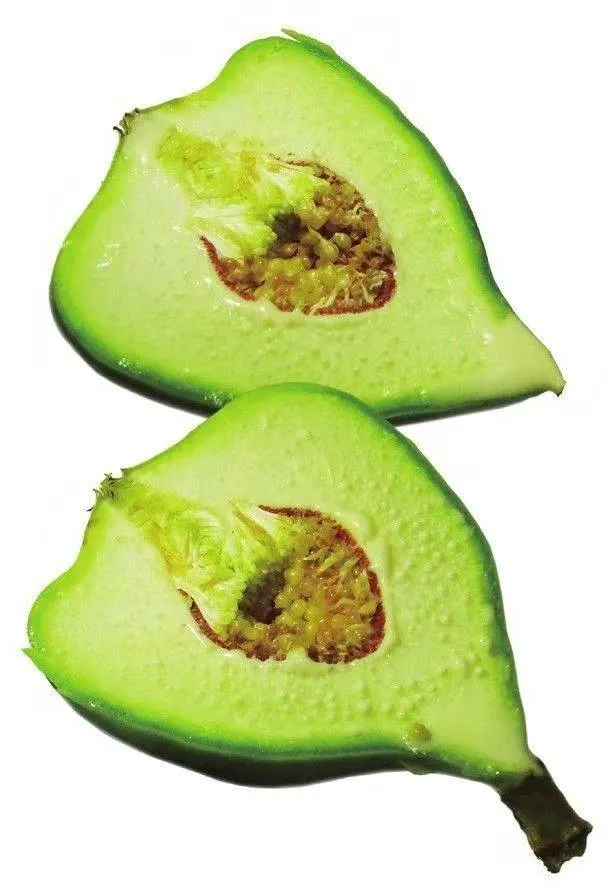
Like all figs, Ficus pumila does not bear visible flowers. Its blooms are concealed inside a fleshy, spherical or slightly flattened receptacle called a syconium — the structure we commonly call the “fig.” This enclosed inflorescence is not merely a quirk of anatomy; it is the stage for one of nature’s most precise mutualisms.
Inside each syconium are two kinds of flowers:
- Female flowers, which, once pollinated, develop into the tiny seeds that give the fig its texture.
- Gall flowers (short-styled flowers), which cannot produce seeds but serve as nurseries for the fig wasp’s larvae.
The entrance to the syconium is a minute, bract-lined opening called the ostiole — so narrow that only the specific pollinating wasp can squeeze through.

The Four-Step Contract
- The wasp enters. A pregnant female fig wasp, dusted with pollen from another fig, crawls through the ostiole in search of gall flowers where she can lay her eggs.
- Eggs are laid. She deposits eggs inside the gall flowers. Her offspring will hatch, feed, and develop safely within the fig’s fleshy walls.
- Pollination happens along the way. As she moves around, pollen from her body brushes onto the female flowers. These are not used for egg-laying, but they are now fertilized and will mature into seeds.
- The cycle closes. When the new generation of wasps emerges, the males mate with the females, and the females collect pollen before exiting through a hole the males have chewed — flying off to find another fig and begin again.
The fig provides the wasp with a protected nursery and food for its larvae; the wasp provides the fig with pollination that no wind or ordinary insect can deliver. Neither can reproduce without the other. This obligate mutualism is shared across the genus Ficus — including the edible fig, the banyan, and the Creeping Fig — and is considered one of the most remarkable co-evolutionary relationships in the plant kingdom.
⚠️ Toxicity, Pet Safety & Edibility Clarification
Is Creeping Fig toxic? Yes, the raw vegetative parts are mildly toxic — an important consideration for households with pets or small children.
Like most members of the Ficus genus, Ficus pumila produces a milky latex sap containing ficin (a proteolytic enzyme) and psoralens (photosensitizing compounds).
- Pets (cats, dogs, horses): Ingestion of raw leaves or stems can cause oral irritation, excessive drooling, vomiting, and gastrointestinal upset. The sap is also a skin irritant. The ASPCA lists Ficus species as toxic to cats, dogs, and horses.
- Humans: The milky sap can cause contact dermatitis in sensitive individuals, and psoralens may increase skin sensitivity to sunlight (phytophotodermatitis). Wear gloves during pruning.
💡 Edibility Note: While the raw sap and green tissue are irritating, the dried seeds inside fully ripe fruits contain no harmful latex. They are traditional, safe ingredients used to make the cooling mùlián dòufu jelly after water extraction (see below).
Cultivation & Care Guide for the Creeping Fig
Hardiness & Climate
USDA Hardiness Zones: 8–11. In Zone 8, it may suffer dieback in severe winters but usually recovers from the root system. In Zones 9–11, it is reliably evergreen and can be grown outdoors year-round. In colder climates, it is an excellent houseplant or greenhouse specimen and is widely used in living walls and terrariums.
Light & Placement
- Outdoors: Partial shade to full sun. In hot climates, afternoon shade prevents leaf scorch. On north-facing walls, growth will be slower but denser.
- Indoors: Bright, indirect light is ideal. A position near an east- or west-facing window works well. Low light will cause leggy growth and loss of the small juvenile leaf form.
Soil & Water
- Soil: Well-draining, fertile loam. A standard houseplant mix with added perlite or orchid bark is suitable for containers.
- Water: Keep the soil evenly moist but never waterlogged. Allow the top inch to dry out between waterings. Overwatering is the most common cause of root rot and leaf drop. Mature outdoor vines are moderately drought-tolerant once established.
Growth & Pruning
Creeping Fig is a vigorous grower in suitable conditions. On a warm, sheltered wall, it can cover a large surface within a few years.
- Prune in early spring to control spread, remove dead stems, and encourage bushier growth. Wear gloves to avoid skin contact with the sap.
- Important: Once a stem produces mature (large) leaves, it will not revert to the small climbing form. If you want the compact, wall-hugging look, prune out the mature branches as they appear.
Propagation
Easily propagated from stem cuttings taken in spring or summer. Root in moist potting mix or water; the aerial roots along the stem make establishment quick and reliable.

Cultural Heritage & Poetic Symbolism
The Creeping Fig has a longer literary history in China than almost any other climbing plant. Its name appears in the Chu Ci (楚辞, Songs of Chu), the ancient southern Chinese poetic anthology compiled in the 2nd century BCE — over two thousand years ago. In the Chu Ci, the bìlì is part of a symbolic “fragrant plant forest” (香草森林) that includes orchids, cassia, and citrus, each carrying moral and emotional meaning.
The Mountain Spirit’s Cloak
The most famous reference comes from the poem Shan Gui (山鬼, The Mountain Spirit):
“As if someone were there in the mountain’s fold,
Wearing creeping fig and girded with wild vine.”
Here, the bìlì is the garment of a mysterious, ethereal female spirit of the mountains — wild, beautiful, and untamed. The image stuck. For centuries afterward, the phrase “clad in creeping fig” (被薜荔) became shorthand for the hermit, the recluse, the person who has turned away from official life and chosen the purity of the mountains.
Other Chu Ci passages weave the plant into ritual and romantic imagery:
“Creeping fig curtains, orchid silk hangings,
Cymbidium oars, magnolia banners.”
— Xiang Jun (湘君, The Lord of the Xiang)
“Gather creeping fig from the water,
Pluck lotus from the treetops.”
— Xiang Furen (湘夫人, The Lady of the Xiang)
The second line is deliberately paradoxical — creeping fig grows on land, while the Chinese lotus belongs to the water — and the poet uses this deliberate impossibility to express the anguish of unfulfilled longing.
The Hermit’s Garment
By the Tang Dynasty, the bìlì was firmly established as the symbol of the reclusive scholar. Meng Jiao (孟郊, 751–814) wrote:
“Clad in a garment of creeping fig,
I climb the mossy ladder of the mountain.”
To wear “bìlì clothes” (薜荔衣) was to declare oneself beyond the reach of official rank and worldly ambition. There is even a saying among the “three joys of the mountain” (山中三乐): “Creeping fig can be clothing — one need not envy embroidered robes.” (薜荔可衣,不羡绣裳)
The plant’s quiet persistence — its ability to grow where nothing else can, clinging to old walls and forgotten ruins — made it a natural emblem of endurance, purity, and the romantic wildness that lies just beyond the edge of human settlement.
Practical Traditional Uses
Traditional Medicine
In Chinese herbal medicine, the Creeping Fig is considered neutral in nature and sour in flavor (性平味酸). The Supplement to the Compendium of Materia Medica (《本草纲目拾遗》, Bencao Gangmu Shiyi, 1765) records its use to dispel wind and dampness, invigorate blood circulation, unblock collaterals, and resolve toxicity and swelling. The vines and stems are used in decoctions for lower back pain, joint pain, and rheumatic conditions.
⚠️ Ethnobotanical disclaimer: This information is for historical and cultural reference only and does not constitute medical advice. Always consult a qualified healthcare professional before using any plant medicinally.
The Summer Jelly: 木莲豆腐 (Mùlián Dòufu)
The Creeping Fig’s most beloved living tradition is mùlián dòufu — literally “wood-lotus tofu,” a translucent, jiggly cold dessert made from the seeds inside the ripe fig. It is also called liángfěn (凉粉, “cold jelly”).
The method is ancient and simple:
- Split open the ripe figs and dry them in the sun.
- Soak the dried seed mass in cool water, then rub and squeeze repeatedly to release the natural pectin.
- Strain and leave the liquid to set. The pectin coagulates into a clear, trembling jelly without any added gelatin or agar.
The science behind the magic: The seeds of Ficus pumila are exceptionally rich in natural pectin and pectinesterase. When rubbed in cool water containing natural minerals (like calcium), the pectin chains cross-link and coagulate into a smooth, translucent jelly without needing agar, gelatin, or artificial thickeners.
The finished jelly is served chilled, dressed with brown sugar syrup or honey, and often garnished with fresh mint leaves. Cool, slippery, and faintly herbaceous, it is the quintessential summer refreshment in regions of southern China.
The Qing Dynasty scholar Wu Qijun (吴其浚) recorded the practice in his Illustrated Catalogue of Plants (《植物名实图考》, 1848): “Commonly, the seeds of its fruit are soaked to make cold jelly, to dispel summer heat.” (俗以其实中子浸汁为凉粉,以解暑。) The tradition has survived intact for nearly two centuries and remains a beloved street food today.

Garden and Landscape Value
In Chinese gardening, the Creeping Fig is prized for its ability to soften hard architecture, and it is a highly atmospheric Chinese Garden Plants. It covers old walls, rockeries, and courtyard corners with a living green tapestry, bringing mossy, timeless atmosphere to stone surfaces.
Compared with English ivy (Hedera helix) or the more flamboyant Chinese wisteria, the Creeping Fig has smaller, more delicate leaves and an even stronger grip — its aerial roots adhere so firmly that they can be difficult to remove without damaging old mortar. The layered leaves create a texture like a hand-woven green blanket.
Chinese poets have long celebrated this quality:
- “Bìlì stirs the green air” (薜荔摇青气)
- “A bamboo path lost in mist, a wall of creeping fig” (竹径烟迷薜荔墙)
- “Evening rain over a thousand villages of creeping fig” (暮雨千家薜荔村)
- “Creeping fig forms a meditation hut” (薜荔作禅庵)
The plant carries both the wild charm of an abandoned village and the quiet serenity of a monk’s cell — a rare combination that makes it one of the most atmospheric climbers in the Chinese garden tradition.

Conclusion
Ficus pumila, the Creeping Fig, is far more than an easy-care houseplant or a living-wall filler. It is a botanical marvel — a vine with two kinds of leaves, a flower hidden inside its fruit, and a life-or-death partnership with a wasp no bigger than a grain of rice. It is a cultural artifact, worn by mountain spirits in the oldest poetry of the Chinese south and adopted by hermits as the uniform of purity. And it is a living tradition, still transformed each summer into a cool, trembling jelly that has refreshed southern Chinese palates for hundreds of years.
Whether you grow it on a sheltered wall, train it up a mossy totem in your living room, or simply pause to notice it on an old stone wall during your travels, the Creeping Fig rewards attention. Tenacious, quiet, and endlessly adaptable, it carries two thousand years of Chinese plant culture in every tiny leaf.
References
- Plant Photo Bank of China (PPBC). Ficus pumila L. Morphological and Floral Gallery — Institute of Botany, Chinese Academy of Sciences.
- Flora of China Editorial Committee (2003). Moraceae: Ficus pumila Species Account — Flora of China, Vol. 5, p. 58. Science Press & Missouri Botanical Garden Press.
- POWO (2026). Plants of the World Online: Ficus pumila L. — Royal Botanic Gardens, Kew.
- ASPCA (2026). Toxic and Non-Toxic Plants: Creeping Fig (Ficus pumila) — Animal Poison Control Center.
- Royal Horticultural Society. Ficus pumila (Creeping Fig) Cultivation & Hardiness Guide — RHS Gardening.
- Zhao, X. (1765). Bencao Gangmu Shiyi (《本草纲目拾遗》, Supplement to the Compendium of Materia Medica). Traditional medicinal uses and pectin extraction of Ficus pumila.
- Wu, Q. (1848). Zhiwu Mingshi Tu Kao (《植物名实图考》, Illustrated Catalogue of Plant Names and Realities). Volume 19: Records on Muliang fruit and traditional grass jelly preparation.
More from The Plant World:
- Chinese Wingnut: The Romantic “Ingot Tree” and Its Cultural Charm
- Plum Blossom Meaning: Symbolism & Cultural Significance
- The Hidden Meanings Behind Red Plum Blossoms
- Chinese Wisteria: History, Symbolism, and Identification
- Peach Blossoms in China: History, Culture, and Symbolism
- Chinese Crepe Myrtle: Guide to Origins & Symbolism
- Ginkgo Leaf Meaning: 5 Secrets of This Ancient Fossil
- Chinese Loquat Tree: Guide to Benefits & History
- Rose of Sharon Tree: Guide to Meaning & Care
- Hosta Plant Benefits: 5 Surprising Uses & Planting Guide
- Strawberry Begonia Care: How to Grow Saxifraga Stolonifera
Discover more from The Plant World
Subscribe to get the latest posts sent to your email.