
Introduction
When the cold wind rises and autumn deepens, the confederate rose blooms one after another — a sight of autumn not to be missed. “Fear not that autumn has no flower to accompany your wine — when the water lotus fades, the tree lotus opens.” These lines come from Drinking with Guests Beneath the Confederate Rose, a poem by Tang-dynasty poet Bai Juyi. As summer lotuses wither away, confederate roses bloom defiantly in the autumn wind. Neither rose nor lotus, this is a flower native to China and a classic among Chinese Garden Plants. It is known in the West as confederate rose (Hibiscus mutabilis).
Its blossoms shift through three different colours within a single day. Frost-tolerant and hardy, the flower’s name carries the thousand-year-old legacy of an ancient city. To truly understand the confederate rose, one must explore its Chinese name, its magical colour-changing trait, and its rich cultural symbolism.

- Introduction
- Plant Profile: Confederate Rose in Chinese
- Plant Profile
- Three Colors in One Day: White as Morning Snow, Red as Evening Glow
- Confederate Rose Meaning: Defying Frost and the Noble Character
- History and Legend: From Qu Yuan to the City of Hibiscus
- Uses of the Confederate Rose: Ornamental, Medicinal, and Textile
- Cultivation and Care Guide
- Final Thoughts
- References
- More from The Plant World:
Plant Profile: Confederate Rose in Chinese
Plant Profile
- Scientific Name: Hibiscus mutabilis L.
- Common Names: Confederate Rose, Cotton Rose, Cotton Rosemallow, Dixie Rosemallow, Changeable Rose
- Chinese Name: 木芙蓉 (mù fú róng); also known as 拒霜花 (“frost-defying flower”), 木莲 (“tree lotus”), 地芙蓉,华木,酒醉芙蓉,三变花 (“three-change flower”), 三醉芙蓉 (“three-times-drunk hibiscus”), 弄色芙蓉
- Family: Malvaceae (Mallow Family) → Genus Hibiscus
- Native Range: Southern China (Sichuan, Yunnan, Guangdong, Hunan, and other provinces)
- Introduction to the West: Brought from China to England around the 17th century, then to the American Southern colonies
The confederate rose is a deciduous shrub or small tree, growing 2 to 5 meters tall. Its leaves are large, broadly ovate to round, palmately 3- to 7-lobed — like open palms — with stellate (star-shaped) hairs on the surface and gray-green undersides. The flowers are solitary, borne at the branch tips and leaf axils, reaching 10 to 15 centimeters (4 to 6 inches) in diameter, single or double. The stamens are numerous, fused into a staminal column — a hallmark of the mallow family. It flowers mainly from August to October, in the depths of autumn.

The specific epithet mutabilis is Latin for “changeable” — a precise description of its most famous trait: flowers that shift color three times in a single day.
Why Is It Called Confederate Rose?
The name confederate rose has its roots in the American Civil War era.
The widely accepted explanation is that by the 19th century, this plant was so widely grown in the American South — the states that would form the Confederate States of America — that it became known simply as the “confederate rose.” It was a staple in nearly every Southern garden. Its alternative name, Dixie rosemallow, reinforces this connection — “Dixie” being the traditional nickname for the American South.
There is also a romantic, bittersweet folk legend in the South: after a particularly bloody Civil War battle, a fallen Confederate soldier lay beside a confederate rose, his blood seeping into the soil at its base. That morning, the flowers had opened white; as the day wore on, they seemed to absorb the soldier’s blood, and by evening they had turned deep red. Ever since, the confederate rose’s white-to-red transformation has been associated with the memory of the fallen. This is, of course, folklore — not history. The real reason for the color change is the shifting concentration of anthocyanin in the petals in response to light intensity, not blood.
It is worth noting that the confederate rose is neither a true rose (Rosa) nor native to North America. It is a mallow-family hibiscus, native to China, closely related to the rose of Sharon (Hibiscus syriacus) and roselle (Hibiscus sabdariffa) — all in the genus Hibiscus. Cotton (Gossypium spp.) is a more distant relative in the same family (Malvaceae), though its similar leaves gave the confederate rose its alternative name, cotton rose.
Three Colors in One Day: White as Morning Snow, Red as Evening Glow
The most astonishing thing about the confederate rose is that its flowers change color three times in a single day.
In the early morning, when the flower first opens, the petals are pure white or pale red — as clean as fresh snow. By midday, they gradually turn pink, like a faint blush on a young girl’s cheek. By evening, the color deepens further to crimson or rose-red, like the glow of sunset. The ancients praised this as the “beauty of three changes in a day” and gave it a series of vivid names: three-change flower, three-times-drunk hibiscus, color-playing hibiscus.
The name “three-times-drunk hibiscus” (三醉芙蓉) is especially evocative: the morning bloom is like a gentle tipsiness, the midday pink like half-drunkenness, and the evening crimson like full intoxication — “drunk” three times in one day.


Some varieties are even more striking: half the petals are silvery white, half are pink or purple, earning them the nickname “mandarin duck hibiscus” (鸳鸯芙蓉) — named for the mandarin duck, a traditional Chinese symbol of paired lovers. Because each flower opens at a different time, a single tree often displays white, pink, and red blossoms simultaneously — layered, vivid, and spectacular.
The Science of the Color Change
Why does the confederate rose change color? It is not the “absorbed blood” of legend — there is a clear scientific explanation.
The petal cells of the confederate rose contain anthocyanin, a water-soluble natural pigment whose concentration and color shift in response to light intensity and temperature. In the early morning, light is weak and temperatures are low, so anthocyanin concentration is low and the petals appear white. As sunlight strengthens and temperature rises, acidic compounds in the petals increase, anthocyanin concentration rises, and the color shifts from white to pink to deep red.
This is a light- and temperature-sensitive physiological response — a plant’s way of adapting to its environment. Each confederate rose flower lives for only one day, but the plant produces many buds that open in succession, so the blooming period can last for months — a testament to its resilient vitality.
Varieties: Single and Double
The confederate rose is mainly divided into single and double varieties:
- Single confederate rose (the wild type): Five petals, simple and elegant form, prominent stamens, high fruit-set rate.
- Double confederate rose (H. mutabilis f. plenus): Layered petals, full and large flower form, resembling peony or tree peony, with vivid, oversized blooms and a dignified, graceful beauty. This is the most commonly cultivated variety in gardens.
Confederate Rose Meaning: Defying Frost and the Noble Character
In Chinese, the confederate rose’s most widely known alternative name is “frost-defying flower” (拒霜花) — and this name itself is the core of its cultural meaning.
Keeping Integrity Through Frost, Outshining Spring’s Flowers at Year’s End
When the autumn wind howls and a hundred flowers wither, the confederate rose blooms proudly against the frost. Like the chrysanthemum, it tolerates cold and flowers in the cool autumn. Because its blooms are as vivid as the lotus (water hibiscus), it earned the names “tree lotus” and “wood hibiscus.” The ancients admired its frost-defying, cold-resistant quality and projected onto it the ideals of noble character, proud solitude, stubborn integrity, and refusal to flatter power.
An ancient poem praises it: “Through frost it keeps its late integrity; at year’s end it outshines the flowers of spring.” This means the confederate rose blooms despite the autumn frost, preserving its integrity to the end; it flowers as the year draws to a close, and its beauty even surpasses that of spring’s blossoms. “At year’s end” (殿岁) means “bringing up the rear of the year” — the confederate rose is one of the last famous flowers to bloom in autumn, adding a splash of vivid life to the bleak season.
Thus, although the confederate rose is not among China’s Ten Traditional Famous Flowers, it is regarded as a noble gentleman among flowers, often used as a metaphor for people of high moral character and unwavering integrity.
Elegant Form, the Last Bloom of Autumn
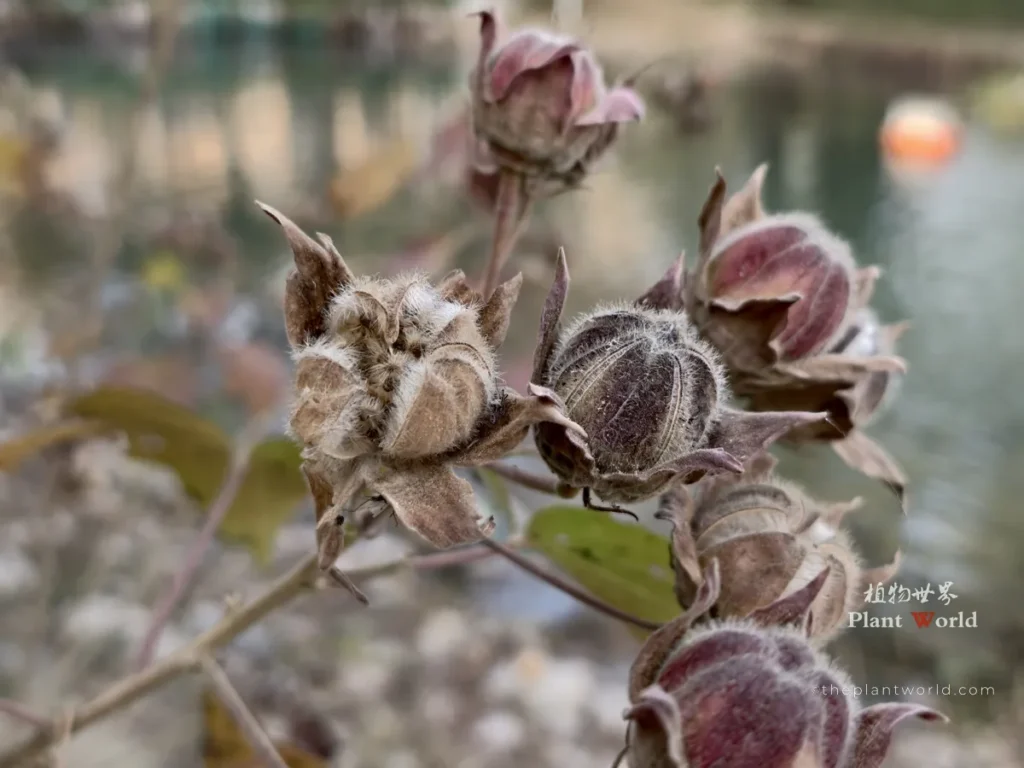
The confederate rose has an elegant flower form. It does not compete with the flowers of spring, yet it stands alone as the last great bloom of autumn. From the vitality of spring, to the green shade of summer, to the clustered blossoms of autumn, to the graceful bare branches of winter — it presents a different beauty in every season. Especially after the buds open, the shy charm and allure of their three-color transformation in a single day is a delight to behold, making visitors linger and forget to leave.
“Graceful hibiscus in the autumn wind, carrying the spring colors across the river to the south” — the confederate rose swaying in the autumn wind seems to bring the spring colors of Jiangnan back to earth.
It is one of the most evocative subjects in all of Chinese flower symbolism.
History and Legend: From Qu Yuan to the City of Hibiscus
The confederate rose has a long cultivation history in China and appears repeatedly in literature across the dynasties.
Qu Yuan’s Hibiscus in the Nine Songs
As early as the Warring States period, Qu Yuan mentioned the confederate rose in Nine Songs · Lord of the Xiang (《九歌・湘君》):
“I gather climbing fig from the water,
I pluck hibiscus from the treetop.”
The meaning: gathering climbing fig (which grows on land) from the water, and plucking hibiscus (which grows on land) from the treetop — a metaphor for seeking what cannot be found, for fruitless effort. Here, because the hibiscus is explicitly “from the treetop” (木末), scholars generally agree it refers to the confederate rose (a woody plant growing on land and in trees), not the water lotus (an aquatic plant). This suggests that over two thousand years ago, the confederate rose had already entered the realm of Chinese literature.
⚠️ Note: In ancient Chinese, “hibiscus” (芙蓉) could refer to either the confederate rose (woody, terrestrial) or the lotus (aquatic herb, also called “water hibiscus”). The context determines which is meant. “Plucking hibiscus from the treetop” clearly refers to the confederate rose, since it grows on woody branches — unlike the Chinese lotus, which rises from water.
Consort Huarui and the City of Hibiscus
Legend has it that during the Five Dynasties and Ten Kingdoms period, Consort Huarui (花蕊夫人), a concubine of Meng Chang, the last emperor of the Later Shu, adored the confederate rose. To please her, Meng Chang issued an edict to plant confederate roses all along the city walls of Chengdu: “When they bloom in autumn, they stretch for miles, as splendid as brocade.” Every autumn, the forty miles of city walls were covered in blooming confederate roses — a sea of flowers, magnificent beyond description.
Chengdu thus became known as the “City of Hibiscus” (芙蓉城), abbreviated as “Rong City” (蓉城) or simply “Rong” (蓉). To this day, Chengdu’s official abbreviation is “Rong,” and the confederate rose is its city flower. A legend of an emperor and his favorite consort ultimately gave a city its floral name for a thousand years.
Bai Juyi’s Autumn Invitation
The Tang Dynasty poet Bai Juyi wrote in Drinking with Guests Beneath the Confederate Rose:
“Fear not that autumn has no flower to accompany your wine —
When the water lotus fades, the tree lotus opens.”
Do not worry that autumn has no flower to accompany your drinking — the summer water lotus may have faded, but the tree lotus (confederate rose) has now opened. For Bai Juyi, the confederate rose was the best autumn drinking companion, its bloom bringing warmth and vitality to the bleak season.

Uses of the Confederate Rose: Ornamental, Medicinal, and Textile
Beyond its deep cultural meaning, the confederate rose is a remarkably useful plant — every part serves a purpose.
Ornamental
With its large, vivid flowers, long blooming period, and three-color daily transformation, the confederate rose is a classic autumn ornamental in traditional Chinese gardens. It can be planted alone in courtyards, in clusters in parks, in rows along roadsides, or in containers. Double varieties are especially prized for their full flower form. It has exceptionally strong resistance to sulfur dioxide (SO₂) and moderate resistance to chlorine (Cl₂) and hydrogen chloride (HCl), making it an excellent tree for greening industrial and mining areas.
Medicinal
The flowers, leaves, and roots of the confederate rose are all used in Chinese medicine — it is a common heat-clearing, detoxifying herb.
- Confederate rose flower (芙蓉花): Pungent in flavor, cool in nature, enters the lung and liver meridians. Functions: clears lung heat and cools blood, dissipates heat and resolves toxins, reduces swelling and drains pus. Indications: lung-heat cough, vomiting of blood, red and swollen eyes, uterine bleeding, excessive leukorrhea, carbuncles and swellings.
- Confederate rose leaf (芙蓉叶): Pungent and slightly bitter, cool. Functions: clears heat and resolves toxins, cools blood, reduces swelling, relieves pain. External use for carbuncles and sores, breast abscess (mastitis), mumps, shingles, burns and scalds, traumatic injuries.
- Chemical constituents: Flavonoid glycosides, phenols, amino acids, reducing sugars, mucilage.
It is recorded in texts such as Effective Prescriptions for Women (《妇人良方》), Hunan Materia Medica (《湖南药物志》), and Shanghai Common Chinese Herbal Medicine (《上海常用中草药》). Folk medicine commonly crushes fresh confederate rose leaves for external application to treat boils, carbuncles, and burns — earning it the nickname “cooling ointment.”
⚠️ Ethnobotanical disclaimer: The above is for historical and cultural reference only and does not constitute medical advice. Consult a qualified healthcare professional before use.
It is a valuable medicinal herb in traditional Chinese herbal medicine.
Fiber and Other Uses
The stem bark of the confederate rose is rich in flexible, water-resistant fiber that can be used for weaving cloth, making rope, and papermaking. In ancient times, people used confederate rose stem-bark fiber to make clothing and rope. Additionally, the flowers are edible — they can be used in soups and dishes, with a smooth, clean taste.

Cultivation and Care Guide
The confederate rose is robust and low-maintenance — an ideal autumn flower for courtyard planting.
Light and Temperature
- Light: Loves full sun, requiring at least 6 hours of direct sunlight daily. Insufficient light leads to sparse flowering and dull colors. No shade is needed in summer heat — strong light actually promotes more vivid flower color.
- Temperature: Prefers warmth, with an optimal growing temperature of 20–30°C. Cold tolerance is poor — in northern regions it cannot survive winter outdoors and must be potted and moved indoors (minimum temperature should not drop below 10°C), or protected with mulch if planted in the ground. In warm southern regions it can overwinter outdoors.
Watering and Soil
- Watering: Loves moisture and has weak drought tolerance. Keep soil moist during the growing season, following the “water when the surface dries” principle. In summer heat, water once daily and mist around the plant to increase humidity. Ensure good drainage during rainy seasons. Reduce watering in winter, keeping the soil slightly dry.
- Soil: Not fussy about soil — it can grow in poor soil — but thrives in fertile, moist, well-drained sandy loam. It tolerates wet conditions and can be planted near ponds.
Fertilizing and Pruning
- Fertilizing: After spring budbreak, apply one nitrogen-rich compound fertilizer to promote leaf and branch growth. From bud formation (summer) to before flowering, apply 1–2 doses of phosphorus-potassium fertilizer (such as potassium dihydrogen phosphate) to promote larger, more vivid flowers. Each winter or spring, dig a trench around the plant and apply well-rotted organic fertilizer.
- Pruning: Prune in winter after leaf drop — remove dead, weak, and overcrowded branches to promote new growth the following year. The confederate rose sprouts vigorously, grows quickly, and tolerates pruning well.
Propagation
The confederate rose can be propagated by cuttings, division, or seed — with cuttings being the most common method. In early spring before budbreak, take one-year-old healthy branches and root them in moist sandy loam for a high survival rate.

Final Thoughts
The confederate rose is a flower that perfectly unites the beauty of transformation with the integrity of a noble character.
It is the morning’s fresh snow, the midday’s faint blush, the evening’s sunset glow — “drunk” three times in a single day. It is the hibiscus on the treetop in Qu Yuan’s Nine Songs, the forty miles of brocade on Chengdu’s city walls for Consort Huarui, and Bai Juyi’s autumn drinking companion, the “tree lotus.” It is the noble gentleman who “keeps integrity through frost and outshines spring’s flowers at year’s end”; it is the origin of Chengdu’s “Rong City” name; and it is the confederate rose found in nearly every garden of the American South.
Confederate rose meaning in China is the resilience of defying frost, the agility of three daily color changes, the nobility of refusing to flatter power, and the warmth of bringing life to a bleak autumn. It can be admired, used as medicine, and woven into fiber — from the Chu ci poems of over two thousand years ago to gardens across the globe today, it continues to bloom in its own unique way.
The cold wind rises, autumn deepens, and the confederate rose blooms again. Three colors in one flower, defying frost — this is the unique, irreplaceable beauty of autumn. It remains a timeless chapter in Chinese plant culture.
References
- Plants of the World Online (POWO). Hibiscus mutabilis L. Royal Botanic Gardens, Kew. — Primary taxonomic database for modern botanical classification.
- Qu Yuan, Nine Songs · Lord of the Xiang (《九歌·湘君》, Warring States Period) — Earliest classical literary reference to terrestrial tree hibiscus (“pluck hibiscus from the treetop”).
- Bai Juyi, Drinking with Guests Beneath the Confederate Rose (《木芙蓉花下招客饮》, Tang Dynasty) — Classic poetic depiction of the flower as the ultimate autumn drinking companion.
- NC State Extension (2022). “Confederate Rose, Not a Rose at All.” — Etymology, historical introduction to the American South, and cultivation parameters.
- Hunan Materia Medica (《湖南药物志》) & Shanghai Common Chinese Herbal Medicine (《上海常用中草药》) — Historical medicinal records on heat-clearing, detoxifying, and topical soothing properties.
More from The Plant World:
- Chinese Wingnut: The Romantic “Ingot Tree” and Its Cultural Charm
- Plum Blossom Meaning: Symbolism & Cultural Significance
- The Hidden Meanings Behind Red Plum Blossoms
- Chinese Wisteria: History, Symbolism, and Identification
- Peach Blossoms in China: History, Culture, and Symbolism
- Chinese Crepe Myrtle: Guide to Origins & Symbolism
- Ginkgo Leaf Meaning: 5 Secrets of This Ancient Fossil
- Chinese Loquat Tree: Guide to Benefits & History
- Rose of Sharon Tree: Guide to Meaning & Care
- Hosta Plant Benefits: 5 Surprising Uses & Planting Guide
- Strawberry Begonia Care: How to Grow Saxifraga Stolonifera
Discover more from The Plant World
Subscribe to get the latest posts sent to your email.